
Reviewed · MOSTAR DAY TRIPS
Mostar War Heritage Walking Tour
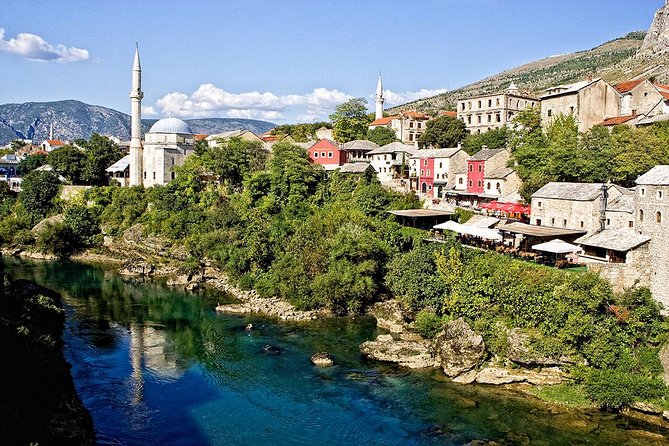
Mostar’s recent war history is best understood on foot, where damaged buildings, memorial sites, bridges, and rebuilt streets tell a story that a standard old-town walk can miss. This tour follows parts of the former front line and connects the city’s Ottoman past with the violence and reconstruction of the 1992 to 1995 war.
I like the way the walk brings in personal experience, not just dates and military facts. Guides such as Elma and Serdin have been praised for making the tour flexible and informative, and one guide lived through the war as a teenager. I also like the private format, since your group can ask direct questions and spend more time on subjects that matter to you.
The main consideration is emotional weight. Burial sites and first-person accounts can be difficult, while the tour’s short duration means some places receive only a few minutes. You’ll need to be ready for a serious experience, not simply a sightseeing stroll.
Key points about the Mostar War Heritage Walk
- Personal war stories: Your guide explains the conflict through lived experience as well as historical context.
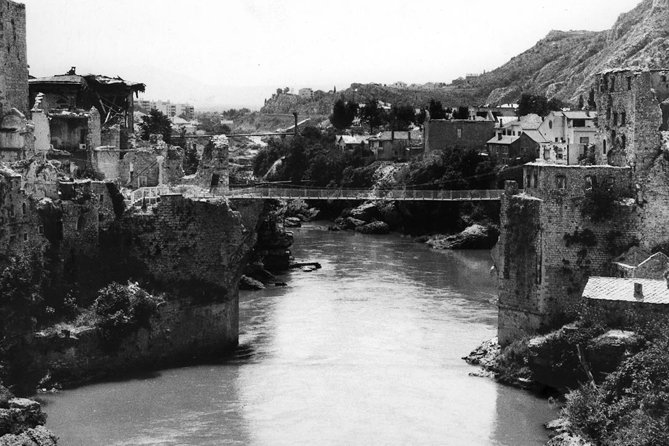
- Former front line: The route links important locations on both sides of the Neretva and shows how divided Mostar once was.
- Old Bridge context: You see Mostar’s best-known monument as both an Ottoman masterpiece and a symbol of wartime destruction and rebuilding.
- Sensitive memorial sites: Liska Park and Spanish Square bring the human cost of the conflict into focus.
- Private English-language tour: Only your group participates, with an authorized guide leading the walk.
- Short but concentrated format: Plan on about two to three hours, with no admission charges at the listed stops.
Why this walk adds something to Mostar
Mostar is easy to reduce to one famous bridge and a photogenic old quarter. That misses the city’s harder story. The war left Mostar divided, damaged, and marked by civilian and military deaths. The physical setting still matters, because the Neretva River, bridges, squares, cemeteries, and streets helped shape how people moved through the city.
I see the value of this tour in the connections it makes. The Old Bridge is not presented only as a handsome Ottoman structure. You also learn why its destruction mattered so deeply and how it fits into the wider story of Mostar. The route then moves away from the postcard view to places that carry quieter, more painful memories.
The experience is offered in English and begins at 9:00 am at the skate plaza on Spanish Square. It ends back at the meeting point. Since the activity lasts roughly two to three hours, you still have much of the day left for lunch, museums, or a second walk through the old town.
The private setup is useful here. War history often raises sensitive questions, and you may want to pause or ask about a detail that would be difficult to bring up in a large group. The small format also means the guide can adjust the pace, though the actual timing depends on how much your group discusses.
More ways to reach Mostar:
- From Dubrovnik: Mostar and Kravica Waterfall Day Trip
★ 4.7 · 4,709 reviews - Dubrovnik: Kravica Waterfalls, Mostar and Pocitelj Day Trip
★ 4.5 · 3,045 reviews - Dubrovnik: Mostar & Kravica Waterfalls Day Trip
★ 4.8 · 1,970 reviews
Starting at Mostar’s Old Bridge
Although the meeting point is Spanish Square, the listed route begins with the Old Bridge. This is the right place to set the scene.
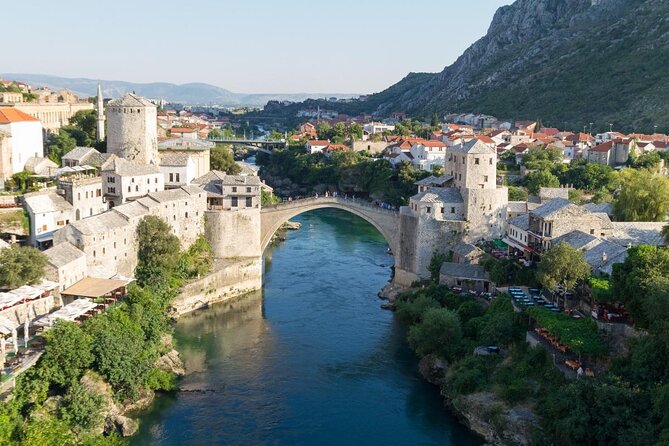
Before the present bridge, a wooden crossing hung on chains at this point. By the middle of the 16th century, it had worn out, and Mostar’s residents asked authorities in Istanbul for a stronger replacement. The bridge was designed by Hajrudin, a pupil of the great Ottoman architect Sinan, and completed in July or August 1566.
The structure is remarkably spare. One large stone arch spans 28.70 meters, with a width of 4.49 meters and a height of about 21 meters above the summer water level. Square stones were connected with iron hooks and cast in lead. Those details help you see why the bridge was such a major engineering achievement for its time.
The guide also places it within the old town, where towers, gates, forts, workshops, and houses developed around the crossing. That wider setting matters. The bridge was never an isolated monument. It was the center of daily life and a key link across the Neretva.
You spend about 15 minutes here, with no admission charge. That is enough for an introduction and orientation, but not a long architectural lecture. If you want detailed photographs or a leisurely look at the river, return later on your own.
The bridge also gives the war story its emotional anchor. You can admire the restored arch while learning that Mostar’s most recognizable structure became part of the conflict. The combination of beauty and loss is central to understanding the city.
Liska Park and the city’s burial ground
The stop at Mezarje, or Groblje Liska Park, is brief, about five minutes. It is a green space first established in 1954, but during the 1992 to 1995 war it became a burial place for civilians and soldiers of several nationalities.
The reason was grimly practical. Existing cemeteries could not handle the number of dead, so the park took on a role it was never meant to have. That fact changes how you see the space. It may look calm today, but its use during the war reflects the scale of the city’s suffering.
I would treat this stop with quiet respect. Five minutes is not long, and the guide may offer only a concise explanation, but the location does not need a long presentation to make its point. If you prefer a tour focused only on architecture and food, this part may feel heavy. For anyone trying to understand Mostar beyond its tourist center, it is essential.
Spanish Square and the Old Gymnasium
Spanish Square is both the tour’s meeting point and one of its important historical locations. Its present name was given in 1995 to honor 21 Spanish UNPROFOR troops killed during the last war.
The square is dominated by Stara Gimnazija, or the Old Gymnasium. Completed in 1902, the building was among the oldest schools in the former Yugoslavia. It was also known for a time by the name of the poet Aleksa Šantić.
The building’s Moorish Revival style, also called Neo-Moorish, adds another layer to Mostar’s story. The city’s architecture reflects Ottoman, Austro-Hungarian, Yugoslav, and modern influences, and this school is a clear example of how architectural identity was shaped under Austro-Hungarian rule.
The building is listed as a national monument. You may find the stop especially useful if you want to understand that Mostar’s story did not begin with the war. The conflict is recent, but the city has been shaped by several political and cultural periods.
Because Spanish Square is also the starting point, arriving a little early makes sense. The stated meeting place is the skate plaza at 8RV4+9QM, Španski trg, Mostar 88000. The tour starts at 9:00 am, and the activity ends at the same point.
More history walks near Mostar:
- Mostar gastro and historical treasures
★ 5.0 · 6 reviews - East Bosnia & West Serbia UNESCO heritage day tour from Sarajevo
★ 5.0 · 55 reviews - Sarajevo Full Day Tour: History, Culture, Nature, War & Olympics
★ 5.0 · 27 reviews - Sarajevo genuine walking tour: Steps through history
★ 5.0 · 22 reviews
Kujundziluk and the old artisan quarter
Kujundziluk is the traditional bazaar area on the left bank of the Neretva. Its name comes from the coppersmiths, or kujundžije, who once worked here. Tailors and leather workers were also part of the old commercial life, with tanners among the most numerous artisans.
Today, the area is known for small workshops and handicrafts. This is where the tour shifts from war memorials and political history back toward everyday urban life. That change is valuable. Mostar is not only a place marked by conflict. It is also a city of trade, craft, food, and ordinary routines.
You spend about 15 minutes in the bazaar. That is enough to walk through and hear how the quarter developed, but it may not allow time for serious shopping. Lunch is not included, and any purchases or food are your responsibility.
I would use this stop to notice the practical details of the old town rather than rush through for souvenirs. Look at the workshop fronts, the narrow lanes, and the way the market sits within the historic center. The guide can help explain how the area functioned before and after the war, while you get a feel for the part of Mostar that continues to welcome daily commerce.
The Carinski Bridge and the city’s crossings
The Carinski Bridge, or Customs Bridge, is less famous than Stari Most but important to the city’s structure. It crosses the Neretva just north of the Old Bridge and dates to the Austro-Hungarian period.
Its original role was practical: it connected different parts of Mostar and served as a vital crossing. On a tour about division and movement, that makes it a useful stop. Bridges in Mostar are not simply scenic viewpoints. They determine how people reach neighborhoods, markets, schools, and public spaces.
The supplied route does not give a precise time for this stop, so I would expect a short explanation while moving through the city. Do not plan on a long standalone visit here. Its value is in the link between locations and in showing that Mostar’s important crossings extend beyond the one monument seen in nearly every photograph.
Crooked Bridge and the older shape of Mostar
The Crooked Bridge, or Kriva Ćuprija, crosses the Radobolja River in the old quarter. It is generally dated to the 16th century and is considered a small prototype for the Old Bridge.
You spend about five minutes here. That is short, but the bridge provides a pleasant architectural counterpoint to the larger crossing over the Neretva. Its smaller scale lets you look closely at the arch and the surrounding old quarter without the same crowd of attention focused on Stari Most.
The stop also reinforces the Ottoman-era design story introduced at the Old Bridge. You see how a simpler crossing can echo the form of a much greater monument. If you have time after the tour, this is a place worth revisiting at a slower pace.
The guide makes the difference
The central strength of this experience is the guide, especially because the subject calls for care. Elma has been described as friendly and flexible, while Serdin led a small private walk through the town and pointed out additional places of interest. Another guide shared that he had lived through the war as an adolescent.
Those details matter. A guide who can explain the war from personal experience may give you a very different understanding from a basic timeline. At the same time, personal testimony can make the walk more intense. You should expect the tone to depend partly on who leads your group.
A short film about Mostar’s history is also included in the experience. The supplied information does not specify exactly where or how long the film is shown, so I would treat it as a compact visual introduction rather than a full museum presentation.
The five-star rating and small number of published comments point to strong satisfaction, but I would not use that alone to choose the tour. The real question is fit. If you want a personal, serious explanation of Mostar’s recent past, the format makes sense. If you want a broad architectural tour with long stops inside monuments, this is not designed for that.
Is $47.66 a fair price?
At $47.66 per person, the value depends on your group size and what you want from a guide. The price includes a professional authorized guide, the walking route, and the short film. The listed stops have no admission charges, so you are paying mainly for interpretation rather than tickets.
That can be a fair deal for a private activity. Your group is the only group participating, and you can ask questions without competing with a large crowd. For two people, the per-person cost is higher than a shared walk, but the private attention may be worthwhile for a subject as personal as wartime memory.
There is no lunch included, and tips are not included. Group discounts are available, so larger private groups may find the price easier to justify. I would compare the cost with the value of having someone explain the former front line, burial site, memorial square, and bridges in one connected route.
Who should book this walk?
I would recommend it to you if you want:
- A clear introduction to Mostar’s 1992 to 1995 war experience
- First-person stories alongside architectural and political context
- A private English-language tour
- A route that includes memorials and less obvious crossings
- A compact morning activity lasting about two to three hours
It suits adults and older teenagers who can handle serious subject matter. Most people can participate, and service animals are allowed. The meeting point is near public transportation, which helps if you are arriving from elsewhere in Mostar.
I would think twice if your main goal is shopping, food, or a relaxed old-town stroll. The bazaar and bridges are attractive, but the focus remains the war and its effect on the city. Also, because several stops are brief, you may want to return later for more photographs and unhurried sightseeing.
Should you book the Mostar War Heritage Walking Tour?
Book it if you want the city’s famous bridge placed in a human story. The strongest parts are the former front-line route, the Liska Park burial site, Spanish Square, and the chance to hear a guide’s personal account of the war.
The private format and flexible guides such as Elma and Serdin add real value, especially if you want to ask questions. Just go in prepared for a sober morning, and leave time afterward to explore the Old Bridge and bazaar at your own pace.
Free cancellation is available if you cancel at least 24 hours before the 9:00 am start. Changes or cancellations made later are not accepted for a refund.
FAQ
How long does the Mostar War Heritage Walking Tour last?
The tour lasts approximately two to three hours.
What time does the tour start?
The stated start time is 9:00 am.
Where does the tour meet?
You meet at the Spanish Square skate plaza, listed at 8RV4+9QM, Španski trg, Mostar 88000, Bosnia and Herzegovina.
Where does the tour end?
The activity ends back at the meeting point.
Is the tour private?
Yes. Only your group participates in the activity.
What is included in the price?
A professional authorized guide is included. Lunch and tips are not included.
Is the tour offered in English?
Yes. The experience is offered in English.
Can I cancel for a full refund?
Yes, if you cancel at least 24 hours before the experience start time. Cancellations or changes made less than 24 hours before the start are not accepted for a refund.
More Walking Tours in Mostar
- Mostar Private Walking Tour
★ 5.0 · 93 reviews - Charming Mostar: Private Mostar Walking Tour
★ 5.0 · 23 reviews - Best of Mostar – Private Walking Tour
★ 5.0 · 21 reviews - Mostar Private Walking Tour – where East meets West
★ 5.0 · 15 reviews
Just added around Mostar
- Mystical Sutjeska National Park★ 5.0 · 3 reviews
- Mostar Guided Tour & Sweet Delights★ 5.0 · 3 reviews
- Private tour from Split to Dubrovnik via Mostar★ 5.0 · 3 reviews
- From Dubrovnik: Sarajevo and Mostar Private Full-Day Tour★ 4.7 · 3 reviews
- From Dubrovnik to Mostar and Kravice waterfalls★ 3.5 · 3 reviews
- Pocitelj City Tour★ 4.5 · 3 reviews
- All Inclusive Neretva Rafting, Day Tour from Mostar★ 5.0 · 4 reviews
- From Dubrovnik: Day Trip to Mostar and Kravica Waterfall★ 3.8 · 4 reviews
Mostar Day Trips, compared.
From Dubrovnik: Mostar and Kravica Waterfall Day Trip
Read our review →
Dubrovnik: Kravica Waterfalls, Mostar and Pocitelj Day Trip
Read our review →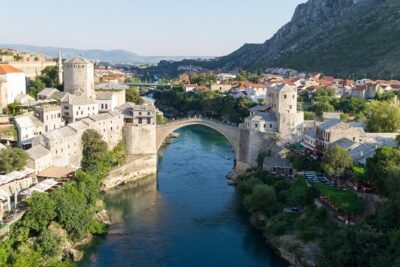
Sarajevo: Mostar, Konjic, Blagaj Tekke, Pocitelj & Waterfall
Read our review →
Dubrovnik: Mostar and Kravice Waterfalls Small-Group Tour
Read our review →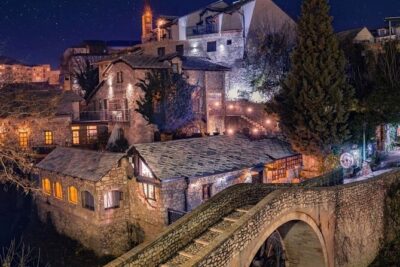
Sarajevo: Mostar, Konjic, Sufi House, Pocitelj & Kravice Falls
Read our review →From Split or Trogir: Mostar & Kravica Waterfall Group Tour
Read our review →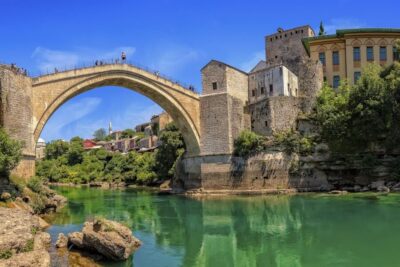
From Dubrovnik: Mostar and Medjugorje Full-Day Tour
Read our review →
Discover Herzegovina Day Tour from Mostar: Kravice Waterfalls, Blagaj, Počitelj
Read our review →Browse the lists this tour appears in