
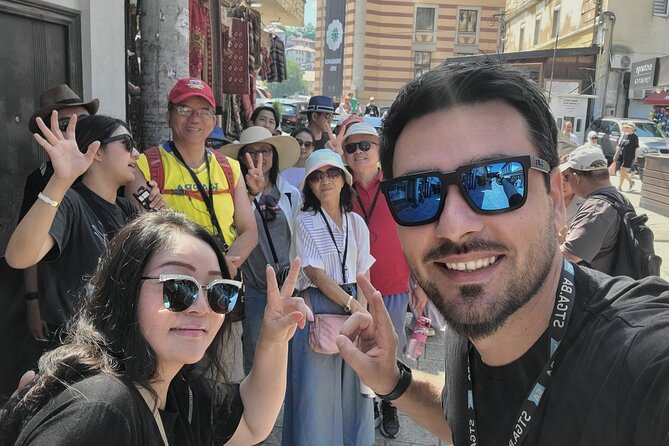
Reviewed · HISTORICAL TOURS IN SARAJEVO
Sarajevo Full Day Tour: History, Culture, Nature, War & Olympics
Sarajevo’s story is unusually concentrated: Ottoman bazaars, Austro-Hungarian buildings, three major Christian traditions, Jewish heritage, the 1984 Winter Olympics, and the scars of the 1990s war all appear in one day. This tour connects those chapters by car and on foot, from the Bosna River Springs to the lanes of Baščaršija.
I like the mix of nature and serious history, especially the Tunnel Museum and the abandoned Olympic bobsleigh track. I also like that hotel pickup, lunch, coffee, water, and two key admission fees are included. The drawback is pace: 18 stops in six to seven hours leave little time for lingering, and one past booking included no promised horse-and-carriage ride.
Key points at a glance
- Bosna River Springs first: Begin among clear water, trees, and the source of the river that gives Bosnia its name.
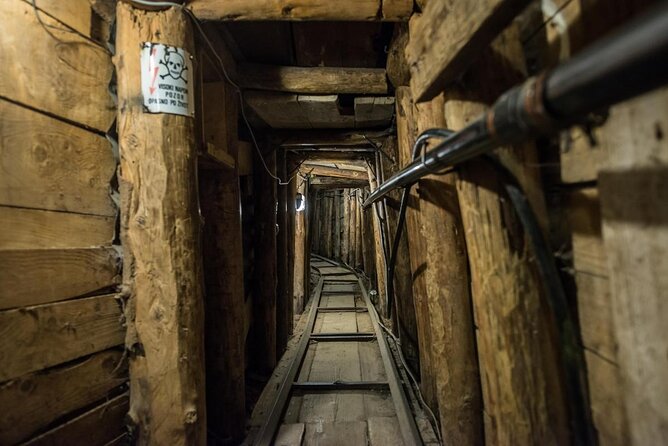
- The Tunnel Museum adds context: Learn how Sarajevo endured the siege through the narrow wartime passage known as the Tunnel of Hope.
- Olympic and wartime history meet: See the 1984 bobsleigh track, later abandoned and caught on the front line.
- A strong Old Town walk: Visit Baščaršija, Kazandžiluk, Morica Han, the mosque, market, cathedral, and Latin Bridge.
- Personal guiding matters: Guides such as Enes, Elvis, Edis, Ahmed, and Adnan are praised for clear explanations and, at times, firsthand family stories.
- Good value for a packed day: At $114.45 per person, the price includes transport, lunch, water, coffee, pickup, and selected admission fees.
Why Sarajevo makes sense as a one-day history lesson
Sarajevo is a city where major events sit close together. You can begin beside a river spring, look down over neighborhoods shaped by war, then walk from an Ottoman market to a Catholic cathedral in a few city blocks.
That makes this outing useful at the start of a visit. You get the basic map and the broad story before choosing which places deserve a longer return visit. The tour also helps you understand that Sarajevo is not only a war-history destination. Its Ottoman trade culture, Jewish past, religious variety, mountain setting, and Olympic memory receive real attention.
The format is a small group of no more than 15 people, with an air-conditioned vehicle between distant stops. That matters here. The springs, Tunnel Museum, bobsleigh track, cemetery, and hilltop viewpoints are spread around the city, so doing this independently in one day would take planning and several transport decisions.
More Historical Tours in Sarajevo
- East Bosnia & West Serbia UNESCO heritage day tour from Sarajevo
★ 5.0 · 55 reviews - Sarajevo genuine walking tour: Steps through history
★ 5.0 · 22 reviews - SARAJEVO STREET ART TOUR (art, history & mystery) – sARTajevo!
★ 5.0 · 18 reviews
From Bosna River Springs to the edge of the city
The morning begins at Vrelo Bosne, the spring area of the Bosna River. You have about 40 minutes there, and admission is included.
This is a smart opening. The water and park offer a quiet contrast to the heavy subjects later in the day, while the guide can explain why the river matters to the country’s name. If you have spent your first hours in Sarajevo’s stone streets, the change of setting is welcome.
Do not expect a long nature walk. Forty minutes is enough for a look around and photographs, but not for a leisurely park outing. The stop works best as a brief introduction to Bosnia’s natural side rather than a separate day in the countryside.
The Tunnel Museum and Sarajevo’s wartime story
The Sarajevo War Tunnel Museum receives about 40 minutes, with admission included. This is one of the most important stops because it gives physical scale to the siege of Sarajevo.
The tunnel was a vital route during the war, allowing supplies and people to move under the airport area. The visit is not just about looking at an old passage. It gives you a way to understand how the city functioned while surrounded and under fire.
The guides can make this section especially powerful. Ahmed has been praised for explaining the siege through memories of living through it as a child. Enes has also been noted for sharing personal wartime stories and explaining the Dayton Agreement and its effect on Bosnia and Herzegovina today. Edis has connected the museum visit with his family’s experiences.
That personal element changes the tone. You are not simply receiving dates and military facts. You are hearing how the war affected ordinary families. Still, this is a serious stop, and you should allow yourself time to process it rather than treating it as just another attraction on a checklist.
The Olympic bobsleigh track above Sarajevo
The 1984 Sarajevo Olympic bobsleigh and luge track gets another 40 minutes. Admission is free.
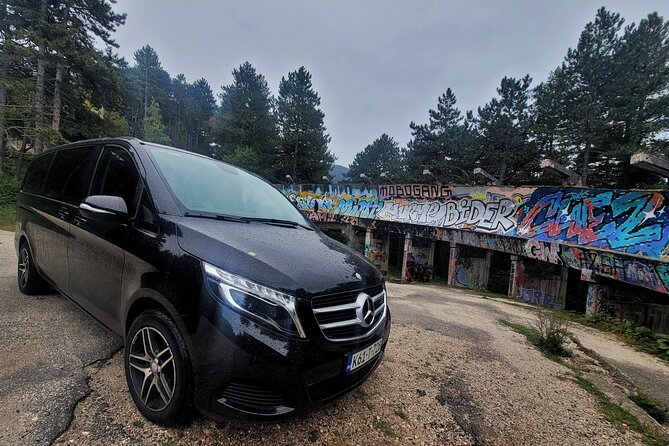
The track is compelling because it carries two very different memories. It was built for the Winter Olympics, when Sarajevo hosted the world, and it was later abandoned and positioned on the front line during the war. Graffiti, decay, and the mountain setting give the place a stark mood.
This is one of the tour’s best contrasts. At the Tunnel Museum, you learn how people survived inside a besieged city. At the bobsleigh track, you see how a symbol of international celebration became part of the conflict.
The stop also gives you a chance to breathe. The mountain setting and open views break up the more enclosed museum and city visits. Wear shoes suitable for uneven ground, since the experience involves seeing an old outdoor facility rather than visiting a polished Olympic venue.
More history walks near Sarajevo:
- BOSNIAN PYRAMIDS TOUR (nature, history & archeology)
★ 5.0 · 17 reviews - Sarajevo: Jewish Heritage Tour
★ 5.0 · 13 reviews - Sarajevo Under Siege: A War History Tour
★ 5.0 · 10 reviews - Mostar War Heritage Walking Tour
★ 5.0 · 6 reviews
Sarajevo from Yellow Fortress and the Jewish Cemetery
Yellow Fortress is a 30-minute viewpoint with no admission fee. From above, you can see the shape of Sarajevo and better understand how the surrounding hills affected life during the siege.
This is a good place for photographs, but the view has more than postcard value. The city’s narrow valley and hills help explain why elevated positions were so important during the war. A guide can connect the panorama with the places you have already visited.
The Jewish Cemetery follows, with about 30 minutes. It represents Sarajevo’s Jewish heritage and also served as a sniper position during the war. That pairing is typical of this city: a site of religious and cultural memory also carries a painful modern history.
You will not get a long museum visit here. The value comes from the explanation and the setting. Listen closely to how your guide links the cemetery’s past with the city’s more recent violence.
Sniper Alley, the Holiday Inn, and wartime Sarajevo
The section identified as Sniper Alley takes about an hour. Here, the guide points out the war hotel, the Bosnian Rome and Juliette Bridge, and places connected with United Nations forces, journalists, and international support during the siege.
The longer time allocation is useful because this is not one monument. It is a moving explanation of how the city center worked during wartime. The guide can show you where the main routes were, how civilians faced danger, and why the area became known around the world.
This is another section where a guide’s own background can make a difference. Several guides have been praised for explaining the war in plain language and for answering questions about its effects on present-day Bosnian society. You should feel free to ask about the parts of the story that are often simplified elsewhere.
The drawback is emotional and practical. An hour of war sites can feel heavy, especially after the Tunnel Museum and Jewish Cemetery. The schedule also depends on moving from place to place, so you will not have unlimited time at each location.
Sarajevo City Hall and the meeting of cultures
The tour then turns toward Sarajevo City Hall, where you spend about 30 minutes inside. The admission fee is not included, so check the cost before you go if entering the building is important to you.
City Hall is a useful bridge between the city’s Ottoman past and Austro-Hungarian period. Its architecture helps explain how Sarajevo changed as outside empires shaped its streets, institutions, and public buildings.
The tour also visits the Sarajevo Meeting of Culture, a five-minute stop marking the point where the city’s eastern and western architectural traditions meet. Five minutes is brief, but the idea is memorable. Sarajevo’s character comes from the overlap of different cultural zones, not from a single style.
Baščaršija and the working craft streets
The walking portion becomes more focused once you reach the Old Town. Kazandžiluk, the copper smith street, receives about 10 minutes. This is one of the most authentic small stops because it remains tied to a traditional craft.
You may see copper coffee sets, trays, and other goods in the shops. The time is enough for orientation and browsing, but not a long shopping session. If you want to buy something, keep an eye on the clock and ask your guide how much freedom you have.
Baščaršija Square and Sebilj take another 10 minutes. Sebilj, the wooden fountain, is one of the city’s main landmarks, and the square is the heart of the Old Town’s trading area.
The short timing means you will get the essential introduction rather than an unhurried market wander. That is a fair trade on a day covering so much ground. You can return later if you want to explore the lanes, shops, and food stalls at your own speed.
Bosnian coffee at Morica Han
Morica Han is a former Ottoman caravanserai, a place where merchants and visitors once stayed. The tour allows about 20 minutes here for Bosnian coffee, and the coffee is included.
This is a small but valuable pause. After the war and Olympic sections, sitting in an old caravan courtyard gives the day a more social rhythm. Bosnian coffee is served in a traditional style and is meant to be enjoyed slowly, not gulped down between photo stops.
The stop also gives you a chance to ask your guide about food and daily life. Several guides have offered restaurant suggestions, and the meal included in the tour adds another local taste to the day. Burek has been singled out as a particularly enjoyable part of the food experience.
The mosque, clock tower, and Ottoman market
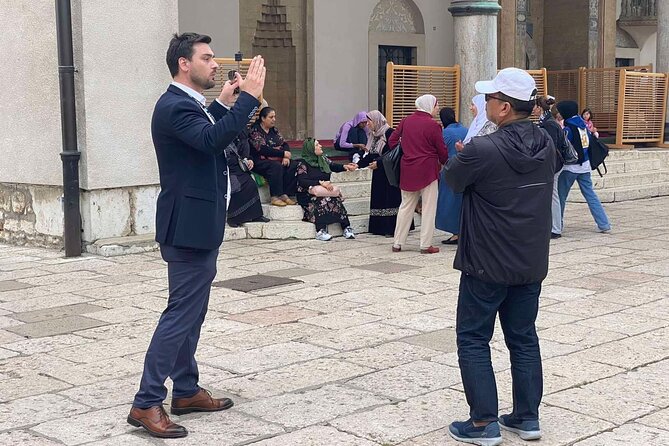
Gazi Husrev-beg Mosque is the largest mosque in the Old Town and gets about 10 minutes. Admission is not included.
The guide explains Gazi Husrev-beg’s role in building Sarajevo and the story of how he invested his resources in the town. The visit is brief, so it works mainly as an introduction. If you want to enter, dress and behave respectfully, and confirm any entry arrangements with the guide.
The nearby Old Sarajevo Clock Tower takes only five minutes. Its lunar time system is a detail easy to miss on your own, yet it shows how Ottoman-era customs still appear in the city’s daily landmarks.
Gazi Husrev-beg’s Bezistan, a covered Ottoman market, receives about 10 minutes. Together, these stops give you the framework of old Sarajevo: mosque, market, clock, coffeehouse, and craft street. You see how religion, trade, and public life were woven into one compact quarter.
Latin Bridge and Sarajevo’s layered religious identity
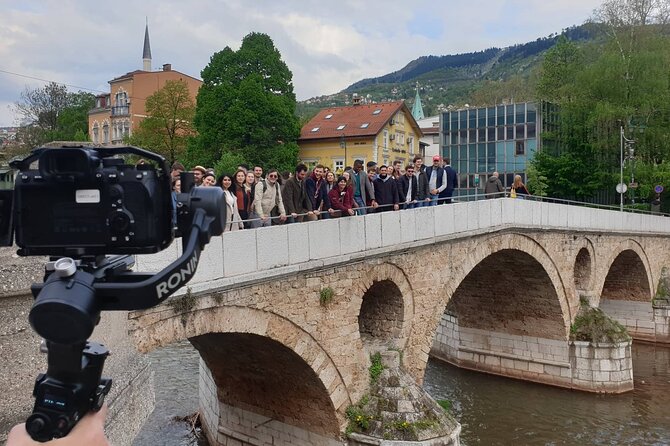
Latin Bridge gets 15 minutes. It is associated with the assassination that triggered World War I, making it one of the most historically famous points in Sarajevo.
The stop is not grand in size. Its importance comes from what happened there and from how one local event helped set off a global conflict. Your guide can place the assassination within the wider tensions of the period, which is far more useful than simply taking a picture of the bridge.
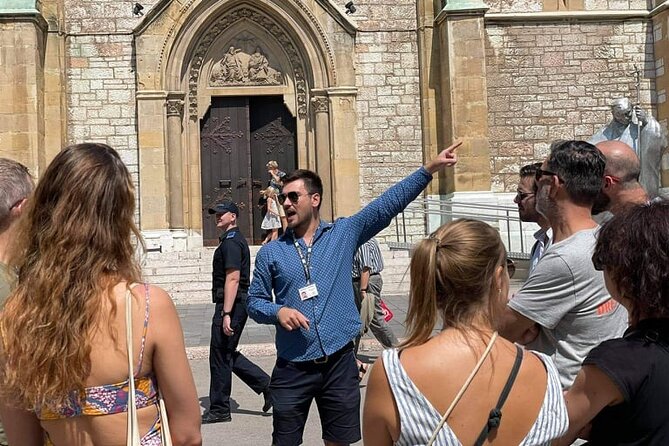
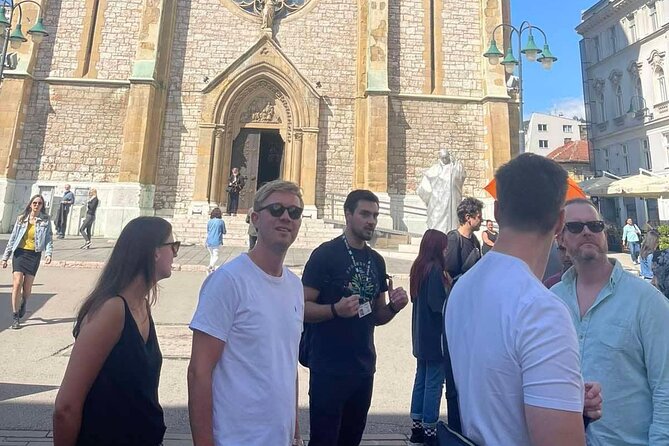
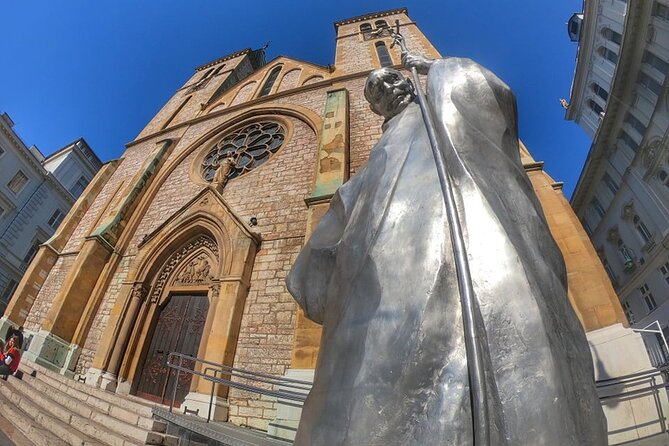
The final religious stops are the Jewish Museum of Bosnia and Herzegovina, the Catholic Cathedral of the Sacred Heart, and the Serbian Orthodox Cathedral. The Jewish Museum gets 15 minutes, with admission not included. It traces Jewish heritage in Bosnia from the 16th century to today.
The Catholic Cathedral and Serbian Orthodox Cathedral each receive about 10 minutes, with free admission listed for both. Seeing all three Christian and Jewish sites in the same walking circuit is one of the day’s strongest features. It gives you a direct sense of Sarajevo’s mixed religious heritage instead of presenting the city as only Ottoman or only European.
What the $114.45 price really covers
The cost is $114.45 per person. That is not the cheapest way to see Sarajevo, but the comparison should include what you would otherwise arrange yourself.
The price includes:
- Hotel pickup in Sarajevo
- An air-conditioned vehicle
- Bottled water
- A tour guide
- Lunch
- Bosnian coffee
- Admission to the Tunnel Museum
- Admission to Vrelo Bosne
You still pay separately for entry to Sarajevo City Hall, Gazi Husrev-beg Mosque, and the Jewish Museum. Tips are also not included.
I see the price as reasonable for someone with only one full day, especially because the route combines distant sites with an Old Town walk. The value is strongest when you want interpretation, not just transport. A guide can explain the siege, the Olympics, the Ottoman city, and the religious mix while you move efficiently between them.
If you prefer to spend an hour in one museum or sit over a long lunch, this tour may feel too packed. You are paying for breadth and organization, not a slow schedule.
Timing, walking, and the small-group setup
The start time is 9:00 a.m., with pickup at your hotel lobby or another location in Sarajevo. The full outing lasts about six to seven hours.
The first part uses the vehicle to reach the springs, tunnel, Olympic track, viewpoints, cemetery, and war-related sites. The Old Town section involves walking between closely placed landmarks. One past experience described a lot of walking, although the guide’s storytelling made it feel easier. You should still wear comfortable shoes.
A maximum of 15 people keeps the group smaller than a large coach outing. That gives you a better chance to ask questions and hear personal explanations, though the exact feel depends on the number booked that day.
The tour is offered in English, and confirmation is provided at booking. Most people can participate. It requires good weather, and if poor weather or an insufficient number of bookings causes cancellation, you are offered another date or a full refund. You can cancel for a full refund up to 24 hours before the start time.
Who will get the most from this Sarajevo tour?
I would choose this for a first full day in Sarajevo. It gives you the city’s main themes quickly and helps you decide where to return.
It suits you especially well if you:
- Have limited time in the city
- Want war history explained with personal and local context
- Prefer a guide to organize transport between scattered sites
- Want both natural scenery and urban history
- Enjoy asking questions during a small-group tour
- Appreciate having lunch and key fees included
It is less suited to you if you dislike a full schedule or want extensive free time at each stop. The Old Town visits are introductions, not long independent explorations. Also, check any special extras promised when booking. A horse-and-carriage ride was expected on one occasion but did not happen, and it is not part of the included features listed here.
Should you book the Sarajevo Full Day Tour?
Book it if you want a strong first look at Sarajevo and Bosnia’s recent past without spending your day sorting out transport. The best parts are the Tunnel Museum, Olympic bobsleigh track, Yellow Fortress views, Bosna River Springs, and the Old Town’s mixture of mosques, markets, churches, and Jewish sites.
The guide is central to the experience. Guides including Enes, Elvis, Edis, Ahmed, and Adnan have been praised for clear history lessons, humor, patience, and personal family stories. Ask questions, especially during the war sections, and you will get more than a sightseeing loop.
Skip it if your ideal day means lingering over coffee, shopping slowly, or visiting every interior in depth. For most first-time visitors, though, the combination of pickup, transport, lunch, admissions, and strong local interpretation makes this a practical and worthwhile way to get your bearings in Sarajevo.
FAQ
What is included in the tour price?
Hotel pickup, an air-conditioned vehicle, bottled water, a tour guide, lunch, Bosnian coffee, admission to the Tunnel Museum, and admission to Vrelo Bosne are included.
How much does the tour cost?
The listed price is $114.45 per person.
How long does the tour last?
The tour lasts approximately six to seven hours and starts at 9:00 a.m.
Where does pickup take place?
Pickup is available at the lobby of your hotel or another location in Sarajevo.
Is the tour offered in English?
Yes. The tour is offered in English.
How many people can join the tour?
The maximum group size is 15 people.
Are all entrance fees included?
No. Admission to the Tunnel Museum and Vrelo Bosne is included. Admission to Sarajevo City Hall, Gazi Husrev-beg Mosque, and the Jewish Museum of Bosnia and Herzegovina is not included. The bobsleigh track and several outdoor landmarks have no admission fee listed.
Is lunch included?
Yes, lunch is included. Bosnian coffee and bottled water are also provided.
What is the cancellation policy?
You can cancel at least 24 hours before the start time for a full refund. Cancellations or changes made less than 24 hours before the start time are not accepted for a refund. Poor weather or failure to reach the minimum number of participants may lead to a different date, another experience, or a full refund.
More Full-Day Tours in Sarajevo
- From Sarajevo: Full-Day Hike to Lukomir Village
★ 5.0 · 59 reviews - Sarajevo to Belgrade Full Day Tour one-way
★ 4.5 · 9 reviews - Private Full Day Safari Tour
★ 5.0 · 8 reviews - Best of Sarajevo – Ultimate Full-Day Experience
★ 5.0 · 7 reviews
Just added around Sarajevo
- Strbacki Buk and Una Waterfalls: Day Trip from Sarajevo★ 5.0 · 3 reviews
- Bosnian Kingdom Capitals: Travnik & Jajce Tour from Sarajevo★ 5.0 · 3 reviews
- Walking Tour in Sarajevo★ 5.0 · 3 reviews
- MTB Bjelasnica – Lukomir★ 5.0 · 3 reviews
- Sarajevo Under Siege: A City’s Struggle & Survival Tour★ 5.0 · 3 reviews
- Herzegovina Tour from Sarajevo: Mostar, Počitelj, Blagaj, Kravice★ 5.0 · 3 reviews
- Travnik, Jajce, Pliva Lakes & Mills –Medieval & Ottoman Bosnia Full Day Tour★ 5.0 · 3 reviews
- Tour of Herzegovina – From Sarajevo★ 5.0 · 3 reviews
Historical Tours in Sarajevo, compared.
East Bosnia & West Serbia UNESCO heritage day tour from Sarajevo
Read our review →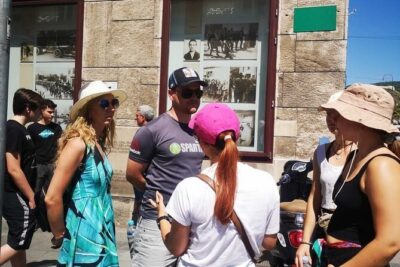
Sarajevo genuine walking tour: Steps through history
Read our review →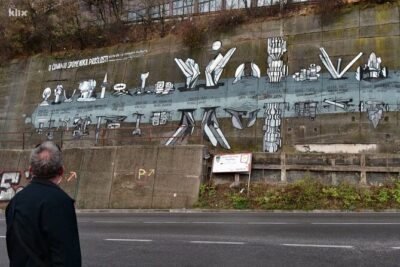
SARAJEVO STREET ART TOUR (art, history & mystery) – sARTajevo!
Read our review →
BOSNIAN PYRAMIDS TOUR (nature, history & archeology)
Read our review →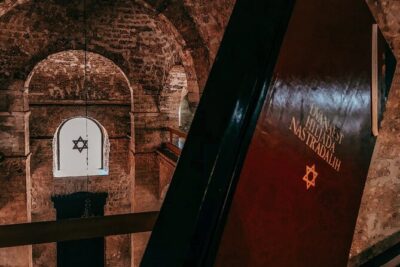
Browse the lists this tour appears in