
Reviewed · MOSTAR DAY TRIPS
Break-up of Yugoslavia & The War in Mostar: Life Under Siege
Mostar’s famous bridge is only part of the story. This tour takes you from a concealed Yugoslav aircraft hangar to the streets where Bosnian and Croatian forces fought at close range, while guides such as Esmer and Harun explain how the breakup of Yugoslavia changed everyday life. The strongest part is the human scale: maps, ruined buildings, family memories, and questions that do not get brushed aside.
I like the small group size, capped at eight, and the hotel pickup, which makes a serious subject easy to fit into a morning. I also like the guides’ effort to present the conflict with care rather than turning it into a simple heroes-and-villains tale. The possible drawback is that this is information-heavy and emotionally difficult, while several stops are stark wartime sites rather than polished attractions.
Key points
- Tito’s concealed aircraft hangar: Visit an abandoned military facility cut into the mountain south of Mostar.
- Personal local accounts: Esmer and other guides explain the siege through family and community experiences.
- A practical history lesson: A hand-drawn map of former Yugoslavia helps make the complicated political story easier to follow.
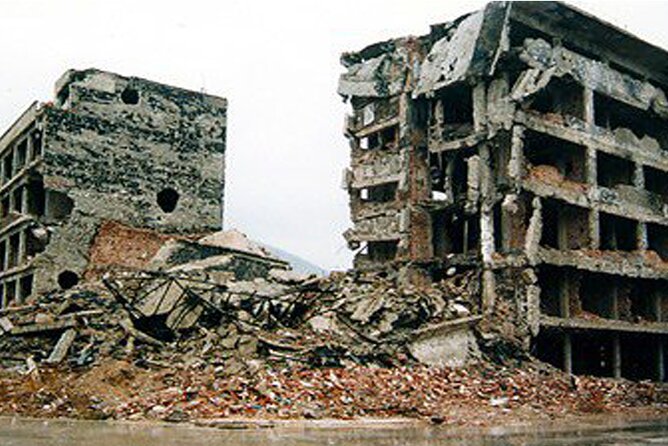
- Front-line remains in the city: See bunkers, damaged buildings, and streets once caught between Bosnian and Croatian forces.
- Useful cultural advice: Guides may point you toward Bosnian coffee, ćevapi, bakeries, cafés, documentaries, and other local experiences.
- Good value for a short visit: The price is $42.33 per person for roughly three hours, with transport and museum entry included when applicable.
Why Mostar Needs More Than a Bridge Visit
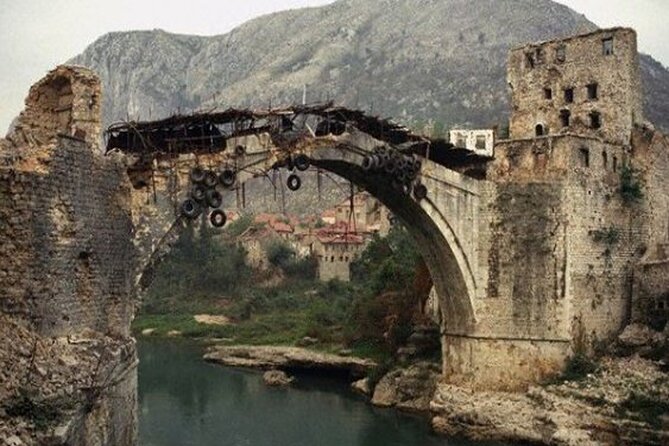
Mostar is easy to enjoy at street level. You can cross the reconstructed Stari Most, watch divers leap from it in season, and browse the lanes of the Old Town. Yet the city can feel puzzling if you do not understand what happened here in the 1990s.
This experience supplies that missing frame. It connects the breakup of Yugoslavia with the war in Bosnia and Herzegovina, then narrows the focus to Mostar during the siege from 1992 to 1995. You are not simply shown ruins. You are asked to consider how a city once shared by different communities became divided, how civilians lived between military lines, and why that division still affects daily life.
I find the local viewpoint especially useful. International coverage often reduces the conflict to dates, factions, and political leaders. A guide who grew up in Mostar can explain what those events meant for homes, schools, neighbors, food, movement, and family life. The result is less tidy than a standard museum timeline, but much more useful.
Expect a serious morning, not a light sightseeing outing. The stories include loss and civilian suffering. The guides also discuss forgiveness, coexistence, and their hopes for Bosnia and Herzegovina, so the tone is not fixed in grief.
More ways to reach Mostar:
- From Dubrovnik: Mostar and Kravica Waterfall Day Trip
★ 4.7 · 4,709 reviews - Dubrovnik: Kravica Waterfalls, Mostar and Pocitelj Day Trip
★ 4.5 · 3,045 reviews - Dubrovnik: Mostar & Kravica Waterfalls Day Trip
★ 4.8 · 1,970 reviews
Starting at the Hidden Yugoslav Aircraft Hangar
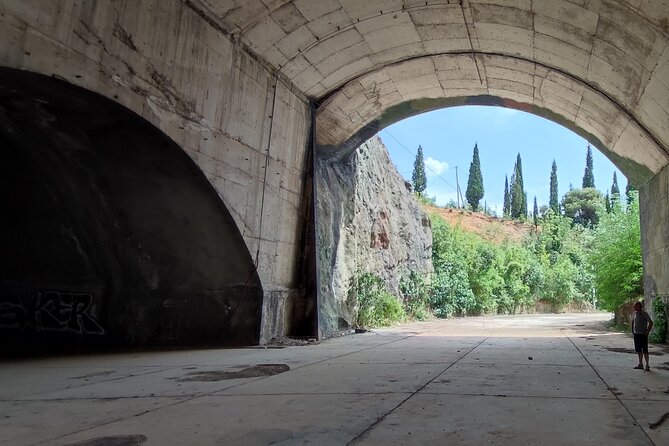
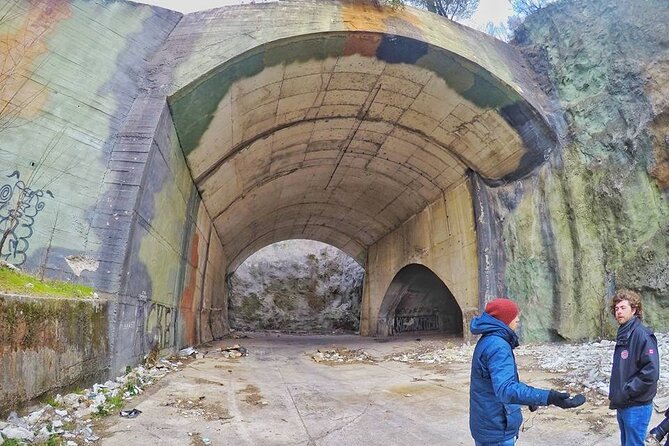
The first stop is an abandoned aircraft hangar about five minutes south of Mostar. The facility was built into the mountain, where the natural rock offered protection for fighter jets and helped keep the military operation out of public view.
You receive about 50 minutes here. There is no admission charge, and the air-conditioned vehicle handles the short transfer from your accommodation. The site is compelling because it shows another side of Yugoslavia, the military state behind the more familiar images of Tito-era unity and public monuments.
Inside, the scale and purpose of the place do much of the work. This is not a restored exhibition with neat labels and bright lighting. It is an abandoned military space, and its rough condition is part of the experience. You might find it more atmospheric than photogenic. The value comes from understanding why a government would place aircraft inside a mountain and how much planning went into protecting them.
Your guide fills in the political and military background. The hangar works best as the opening chapter because it gives you a physical reminder that Yugoslavia was not only a collection of picturesque towns and shared slogans. It was also a heavily organized state preparing for possible attack.
Wear practical shoes. The supplied information does not promise a fully polished visitor facility, so you should be ready for an old, utilitarian site rather than an accessible modern museum. Keep your attention on the guide’s explanation, since the meaning of the hangar matters more than the number of photographs you take.
The Mostar War Museum and Its Hand-Drawn Map
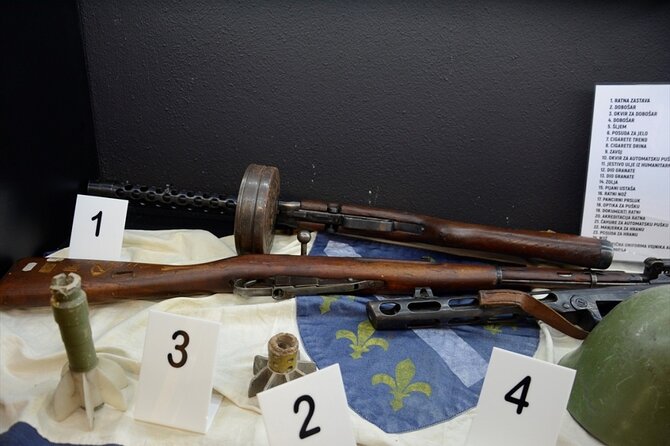
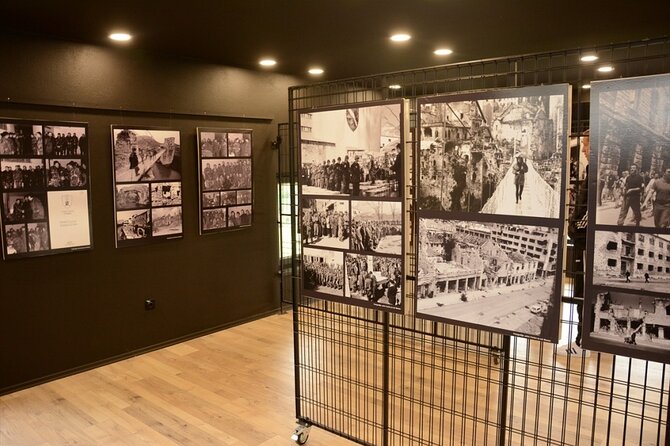
The second stop lasts about 50 minutes at the Mostar War Museum on Gojka Vukovića. Museum entry is included. This is the main teaching stop, where the guide lays out the breakup of Yugoslavia and the war’s effect on Mostar.
One of the most helpful features is a board and a hand-drawn map. The guide uses it to show the former Yugoslavia, the changing political relationships, and military movements. That may sound simple, but it is exactly the kind of explanation many visitors need. The conflict involved shifting alliances and several communities, and a map can turn a confusing sequence into something you can place in your head.
Esmer is frequently named as the guide who makes this section work. Harun, Huran, and Vedad have also led tours, so your guide may vary. The consistent feature is a strong command of the subject and a willingness to answer direct questions.
The personal material gives the museum its weight. Esmer has described his family’s experience during the siege, including what it meant to live through attacks and uncertainty. Another account makes an important distinction: a guide may have been a child during the war, so his first-hand perspective is that of a young person and survivor of the period, not an adult military participant. That difference matters, and a good guide explains what he personally remembers alongside the wider historical record.
The museum is also connected to local families and the experience of Mostar residents. You hear about people caught between the lines, not only about commanders and agreements. That focus helps you understand why streets, apartment blocks, and ordinary neighborhoods appear later in the tour.
Allow yourself room to ask questions. The guide’s aim is educational, and no question is treated as off limits within the bounds of a respectful conversation. You may leave with links to documentaries or other material for later study, as some guides have shared these with visitors.
This stop is not designed for a quick photograph and departure. It asks you to listen. If you want a fast list of famous sights, you may find the pace slow. If you want to understand why Mostar looks and feels divided, this is likely the most useful part of the morning.
Walking the Former Front Line Near Šantića Street
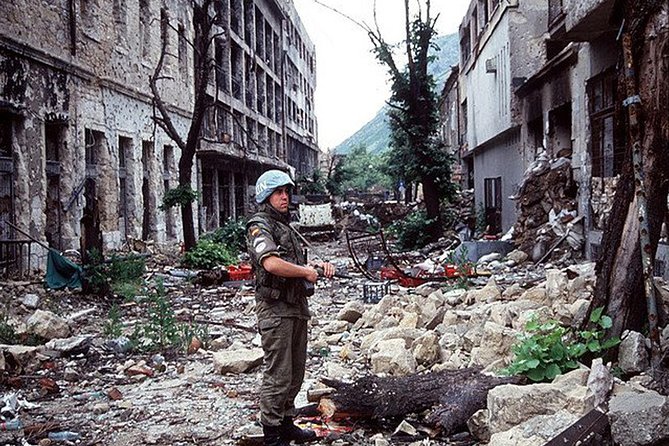
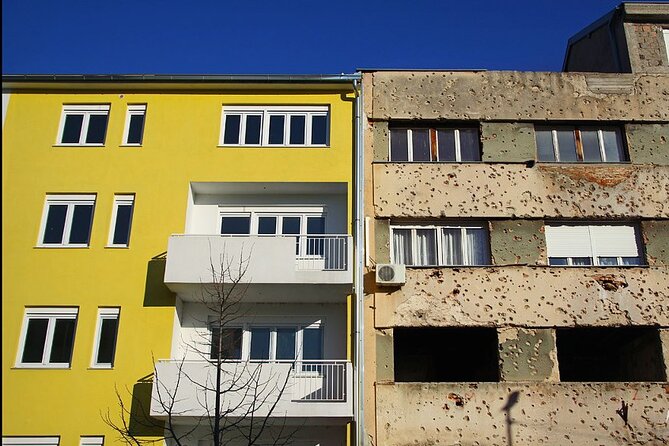
The final section takes you through the city, including Šantića Street, the area associated with some of the closest fighting between Bosnian and Croatian forces. You see surviving bunkers and wartime damage close to the urban center, not in an isolated memorial park.
The guide then connects the streets near Spanish Square and Boulevard Street with photographs from the war. Comparing the same locations across time makes the destruction easier to grasp. A normal intersection can carry a very different meaning when you see how it looked under fire.
This walk also explains Mostar’s present-day division. The former combat line is no longer marked like a border, but it can still function as an invisible line between parts of the city. The guide helps you notice how the political and social split continues after the shooting stopped.
Some buildings remain damaged or derelict. These places are not decorative ruins, and it is worth keeping that distinction in mind. You are looking at evidence of a recent conflict in a living city, often close to homes, shops, and daily routines.
One account praised the city views from higher ground, while the listed itinerary centers on the hangar, museum, and front-line streets. Your exact route may vary slightly with the guide, traffic, or group needs. The reliable element is the focus on visible war remains and the line that once separated opposing forces.
The walk is about 50 minutes. It is long enough to connect several locations without turning the entire day into a march. You should have time to listen and ask questions, but do not expect a long free period for shopping or independent wandering.
More Sarajevo war and siege history tours:
- Fall of Yugoslavia, Sarajevo War Tour with Tunnel of Hope Museum and Frontlines
★ 5.0 · 1,314 reviews - Tunnel Museum: Bosnian & Yugoslav Wars Tour with War Veteran
★ 5.0 · 551 reviews - Sarajevo War Tour: A Veteran’s Story of the Siege (fees included)
★ 5.0 · 326 reviews - Sarajevo 1425 days under the siege – War Tour
★ 5.0 · 170 reviews
What the Guides Add Beyond a Standard History Tour
The guides are the main reason this experience feels personal. Esmer is the name most often associated with the tour, and the descriptions of his approach are consistent: careful, passionate, objective, and easy to follow. Harun, Huran, and Vedad are also named as excellent teachers and hosts.
That does not mean the tour is detached. It means the guides try to explain competing sides and the damage caused by war without pretending that every part of the story is simple. Esmer has discussed the wrongs committed by different sides and expressed acceptance that war can produce wrongdoing across communities. He has also spoken about living in Mostar after the war and raising a family in a city still working through its past.
The conversation can extend beyond military events. Guides have recommended a small coffee place, explained the ritual of Bosnian coffee, suggested places for ćevapi, and helped with practical food choices when shops were closed. One memorable local touch involved picking a wild pomegranate during the hangar visit. These details are not guaranteed, but they show how the tour can move from history into present-day life.
I value that connection. You do not leave thinking of Mostar only as a war memorial. You also learn about food, hospitality, ordinary friendships, and the city’s future. The positive outlook does not erase the suffering. It gives the story somewhere to go.
Price, Timing, and Group Size
At $42.33 per person, the tour offers solid value if you want context rather than a simple ride around town. The price covers a professional guide, an air-conditioned vehicle, the Mostar War Museum entrance fee, and hotel pickup and drop-off if you select that option.
The transport matters because the aircraft hangar is outside the central sightseeing area. Without a vehicle, fitting the hangar, museum, and west-side front line into three hours would be less convenient. Pickup also removes the need to find a meeting point, though you should provide the address if your accommodation is not already listed.
The advertised duration is about three hours. Some guides may run longer when questions and personal stories lead to a fuller discussion. One morning lasted about four hours because Esmer continued explaining the subject. That can be a gift if you have time, but it matters if you have a bus, border crossing, lunch reservation, or another fixed appointment.
The group maximum is eight people. That is small enough for a real conversation and large enough to keep the price below a private tour. A low booking count may result in a very small group, and one account describes the experience becoming private rather than being canceled.
The tour is offered in English. Confirmation is sent within 48 hours, subject to availability, so do not leave a time-sensitive booking until the last moment. Free cancellation is available if you cancel at least 24 hours before the local start time. Changes or cancellations inside that window are not refunded.
Who Will Get the Most From This Experience
I would choose this tour if you are spending several days in Bosnia and Herzegovina, or if Mostar is part of a route between Croatia and Dubrovnik. It is also useful if you have only a few hours and want a clear introduction to the city’s recent past.
The tour suits adults and older teenagers who can handle difficult material. Children may participate, but they must be accompanied by an adult. The subject is not presented as entertainment, and younger children may struggle with the war stories and damaged sites.
You do not need a background in Balkan history. In fact, the hand-drawn map and chronological explanations are particularly helpful if your knowledge begins and ends with the name Yugoslavia. Come ready to listen, ask questions, and accept that you may not understand every political detail on the first pass.
This is less suitable if your priority is architecture, shopping, food, or scenic photography. The stops are valuable, but several are stark rather than pretty. You may also find the experience emotionally tiring, especially when the guide describes civilian life under siege.
How to Pair It With Your Time in Mostar
The tour can change the way you see the Old Town afterward. The bridge and Ottoman-era lanes become part of a larger city story, one that includes division, rebuilding, and the effort to live together again.
If you take the tour early, you can later return to the Old Town with better questions. You may notice the distance between tourist routes and residential areas, or think differently about the modern city on both sides of the former line. Guides may point you toward ćevapi, Bosnian coffee, bakeries, or small cafés for the rest of your day.
If you have a fixed departure, schedule carefully. Pickup and drop-off are offered, but traffic and a conversation that runs past three hours can affect your timing. If you are traveling onward to Croatia or elsewhere, leave a buffer rather than planning a tight connection.
The tour is also a useful counterweight to a brief bridge stop. A short visit can make Mostar look like a single postcard view. This experience gives you the harder context needed to understand why the city carries such emotional force.
Should You Book the Mostar War Tour?
Yes, if you want to understand Mostar rather than simply photograph it. The hidden military hangar, the museum map, and the front-line walk create a logical three-part route, while the local guides add the memories and current concerns that books cannot provide.
Book it with realistic expectations. This is a serious, information-heavy tour, and some stories may stay with you. The sites are not always polished or visually dramatic, and the subject demands attention.
For $42.33, a group of up to eight receives transport, museum admission, and roughly three hours with a guide who can explain both the breakup of Yugoslavia and the city’s continuing divisions. If you have room in your Mostar schedule, I would make this a priority, especially before spending the rest of your time exploring the bridge and Old Town.
FAQ
How long does the tour last?
The experience lasts approximately three hours. It may run longer if the guide spends extra time answering questions or explaining personal experiences.
How much does the tour cost?
The listed price is $42.33 per person.
Is hotel pickup available?
Yes. Hotel pickup and drop-off are offered in Mostar if you select that option. If your accommodation is not listed, provide its address.
Is transportation included?
An air-conditioned vehicle is included as part of the experience.
Is the Mostar War Museum entrance fee included?
Yes. The Mostar War Museum entrance fee is included.
What language is the tour offered in?
The tour is offered in English.
What places does the tour visit?
The route includes a hidden Yugoslavian military aircraft hangar south of Mostar, the Mostar War Museum on Gojka Vukovića, and former front-line areas including Šantića Street, Spanish Square, and Boulevard Street.
How many people can join the tour?
The maximum group size is eight people.
Can children take the tour?
Yes. Children can participate, but they must be accompanied by an adult.
Can I cancel for a full refund?
Yes, if you cancel at least 24 hours before the experience start time. Cancellations or changes made less than 24 hours before the start time are not refunded or accepted.
Just added around Mostar
- Mystical Sutjeska National Park★ 5.0 · 3 reviews
- Mostar Guided Tour & Sweet Delights★ 5.0 · 3 reviews
- Private tour from Split to Dubrovnik via Mostar★ 5.0 · 3 reviews
- From Dubrovnik: Sarajevo and Mostar Private Full-Day Tour★ 4.7 · 3 reviews
- From Dubrovnik to Mostar and Kravice waterfalls★ 3.5 · 3 reviews
- Pocitelj City Tour★ 4.5 · 3 reviews
- All Inclusive Neretva Rafting, Day Tour from Mostar★ 5.0 · 4 reviews
- From Dubrovnik: Day Trip to Mostar and Kravica Waterfall★ 3.8 · 4 reviews
Mostar Day Trips, compared.
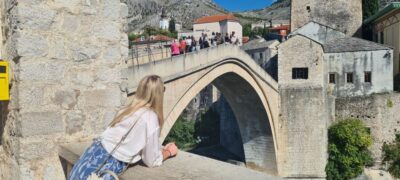
From Dubrovnik: Mostar and Kravica Waterfall Day Trip
Read our review →
Dubrovnik: Kravica Waterfalls, Mostar and Pocitelj Day Trip
Read our review →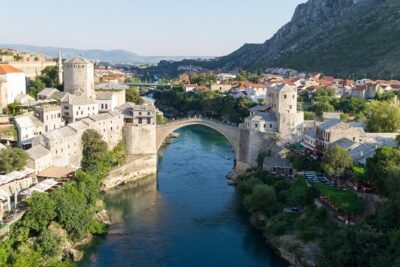
Sarajevo: Mostar, Konjic, Blagaj Tekke, Pocitelj & Waterfall
Read our review →
Dubrovnik: Mostar and Kravice Waterfalls Small-Group Tour
Read our review →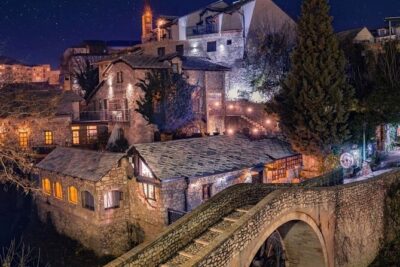
Sarajevo: Mostar, Konjic, Sufi House, Pocitelj & Kravice Falls
Read our review →From Split or Trogir: Mostar & Kravica Waterfall Group Tour
Read our review →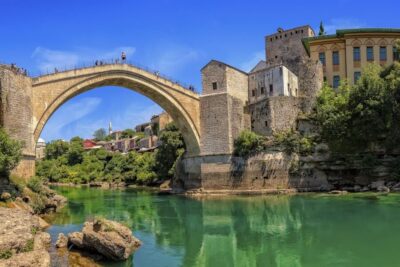
From Dubrovnik: Mostar and Medjugorje Full-Day Tour
Read our review →
Discover Herzegovina Day Tour from Mostar: Kravice Waterfalls, Blagaj, Počitelj
Read our review →Browse the lists this tour appears in