
Reviewed · JAJCE & TRAVNIK DAY TRIPS
Bosnian Kingdom Capitals: Travnik & Jajce Tour from Sarajevo
Travnik and Jajce give you two very different views of Bosnia in one long day. Travnik was an Ottoman seat of power, while Jajce served as the medieval Bosnian kingdom’s capital and later played a major role in Yugoslav history. The result is a sightseeing day that moves from mosques and viziers to royal ruins, Roman soldiers, and rushing water.
I like the private group format, which means your party is not mixed with strangers, and I like that entrance fees, bottled water, snacks, transport, and onboard WiFi are covered. The main drawback is the pace: with 14 stops and several hours on the road, you will see a lot, but you will not have time for a slow, unplanned visit at every site.
The tour is led through Balkland, with Muhmmnad named as the organizer. One especially useful feature is the arrangement of local guides in both Travnik and Jajce when needed, giving you more context than a simple drive-by excursion.
Key points to know before booking
- Two former capitals in one day: Explore Travnik, an Ottoman center, and Jajce, the medieval capital of the Bosnian kingdom.
- Fourteen planned stops: The route includes fortresses, mosques, museums, a catacomb, a Roman temple, a waterfall, and historic watermills.
- Private transport from Sarajevo: Your group travels in an air-conditioned vehicle with WiFi, bottled water, snacks, and fees included.
- Pliva Waterfall is the natural highlight: The broad cascade sits close to Jajce and gives the day a welcome change of pace.
- Meals cost extra: Lunch is not included, and a 45 to 60 minute dinner stop in Jajce comes before the drive back.
- Plan for a full day: The total outing lasts about 10 to 12 hours, with roughly 2.5 hours needed for the return drive alone.
Why Travnik and Jajce make a strong day trip
If you have limited time in Sarajevo, this tour takes you into central Bosnia rather than keeping you in the capital. The two towns are close enough to combine, but their stories are quite different.
Travnik is shaped by Ottoman rule. Its old fortress, painted mosque, mausoleums, and religious buildings show how the town functioned as a center of administration and faith. It also has a literary connection through Ivo Andrić, the Nobel Prize-winning author born there.
Jajce offers a wider historical sweep. You will find medieval royal remains, underground catacombs, a Roman Mithraic temple, a museum devoted to the creation of Yugoslavia, and the Pliva River’s famous waterfall. That mix makes Jajce feel less like a single monument and more like an open-air history lesson.
The trade-off is time. This is not a leisurely two-town stay. It is a structured circuit designed to cover the main sights, so you should expect short visits, regular departures, and plenty of road time between stops.
More Jajce, Pliva and Travnik days:
- Jajce, Travnik and Pliva watermills – Day Tour from Sarajevo
★ 5.0 · 295 reviews - From Sarajevo: Travnik, Jajce, Pliva Lakes & Watermills Tour
★ 5.0 · 213 reviews - Jajce, Travnik, Pliva lake and Watermills Tour
★ 5.0 · 104 reviews
Starting at Sarajevo City Hall
The tour begins at Sarajevo City Hall, at Brodac 1, and returns there at the end of the day. Pickup is offered, but the stated meeting point gives you a clear place to start if you are arranging your own way to the departure location.
The vehicle is air-conditioned, and WiFi is available onboard. Bottled water and a small snack, such as a chocolate bar or chips, are included. These are modest extras, but they matter on a 10 to 12 hour outing with many stops.
The remaining hours are spent traveling. That is important when you compare this trip with a shorter excursion around Sarajevo. You are paying for a long-distance day with a driver, not only for time spent walking around monuments.
The activity is private, meaning only your group participates. Group discounts are also offered, so the price can make more sense when shared among several people. At $150.10 per person, the value depends on how much you want to see in a single day and how useful you find included transport and entry fees.
Travnik’s Plava Voda and Ottoman setting
The first Travnik stop is Plava Voda, a national monument associated with the Derventa cemetery, the Lutvina Kahva café, and the tomb of Mufti Mehmed Efendi and his wife, Ajiša. You have about 20 minutes here.
This is a short introduction to Travnik’s Ottoman character. The setting combines water, old religious landmarks, and a traditional café atmosphere. Do not expect a long café visit on this schedule. The point is to get a quick sense of the town’s old quarter before moving uphill.
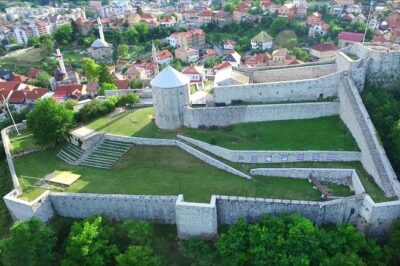
The next stop is Travnik’s Old Town fortress, known locally as Tvrđava Stari Grad. You have about 35 minutes, with admission included. The fortress sits above town and offers views over Travnik and the surrounding area.
The stone walls, towers, and winding interior give you a clear feel for the town’s defensive role. Bring shoes suitable for uneven ground, since old fortresses rarely offer smooth walking surfaces. The visit is long enough to see the main areas and take in the views, but not long enough for a slow examination of every corner.
Šarena Džamija and Travnik’s layered identity
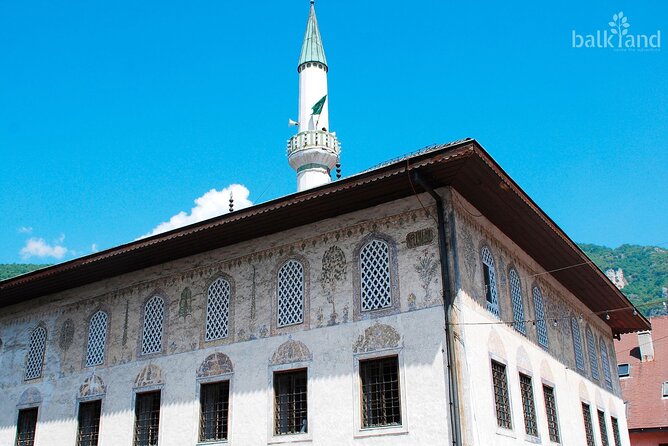
Šarena Džamija, or the Colorful Mosque, dates from the 16th century and is known for painted decoration and detailed Ottoman design. You have around 20 minutes here, and admission is included.
This is one of the most visually distinctive stops in Travnik. The building gives you a better sense of Ottoman artistic traditions than a general walk through town because the decoration is the main attraction. As with any active religious site, follow the guide’s instructions about appropriate behavior and access.
The itinerary then shifts from Islamic architecture to Catholic heritage at the Church of St. John the Baptist. Built in the mid-19th century, the church has religious artwork and a decorated altar. The visit lasts about 10 minutes.
That short stop is valuable because Travnik’s story is not limited to one empire or faith. In a compact area, you see Ottoman Muslim, Catholic, and Austro-European influences. The quick timing does mean you will have only a brief look inside.
You also visit the Vizier’s grave, an Ottoman-style mausoleum dedicated to a prominent Ottoman official. The stop takes about 10 minutes and is free. It is a quiet architectural pause, with a focus on the town’s former political power.
Hadži Ali Beg’s Mosque follows, also for about 10 minutes and without an admission charge. This historic mosque adds another example of Ottoman religious architecture. Taken together, these short visits help you understand Travnik as a former administrative center rather than simply a pretty old town.
A few more Sarajevo day trips to weigh up
- Sarajevo: Mostar, Konjic, Blagaj Tekke, Pocitelj & Waterfall
★ 4.9 · 1,335 reviews - Fall of Yugoslavia, Sarajevo War Tour with Tunnel of Hope Museum and Frontlines
★ 5.0 · 1,314 reviews - Sarajevo: Mostar, Konjic, Sufi House, Pocitelj & Kravice Falls
★ 5.0 · 1,179 reviews - ROSES OF SARAJEVO (Official WAR + CITY tour)- Story of a Survivor
★ 5.0 · 770 reviews
Ivo Andrić and the Travnik museums
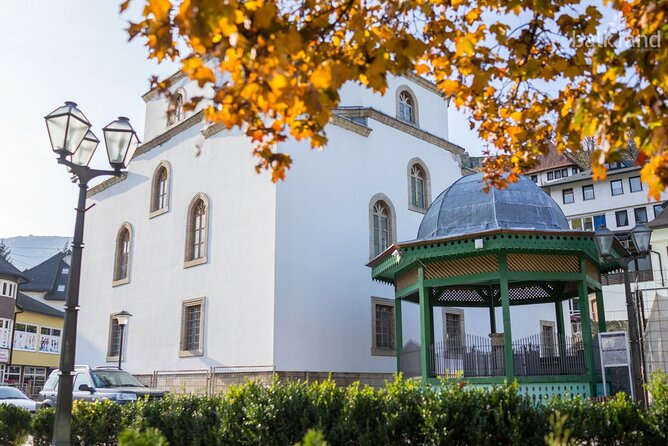
Travnik is also linked to Ivo Andrić, who was born in the Zenjak neighborhood in 1892 and later won the Nobel Prize in Literature. His reconstructed birth house now contains a permanent memorial exhibition about his life and writing.
You have 15 minutes at the Birth House Museum. That is enough for an introduction, especially if you already know something about Andrić. If you want a detailed literary visit, the schedule will feel tight.
The Regional Museum of Travnik receives about 10 minutes. It was founded in 1950 and now occupies a building constructed in 1928 for medical and health purposes with support from the Rockefeller Foundation. Its permanent exhibition opened in 1975.
Ten minutes is a quick museum visit, but it can help organize what you have seen outdoors. The museum adds local context to the fortress, religious buildings, and Ottoman remains. If museums are your main interest, you may wish for more time here, but the tour is designed to balance indoor stops with a much broader route.
Food is part of the Travnik experience too. The tour description points to ćevapi, Bosnia’s well-known grilled meat dish, as something to try. Lunch is not included, so you should budget separately and use the meal break to order local food if available.
Jajce’s catacombs, fortress, and royal past
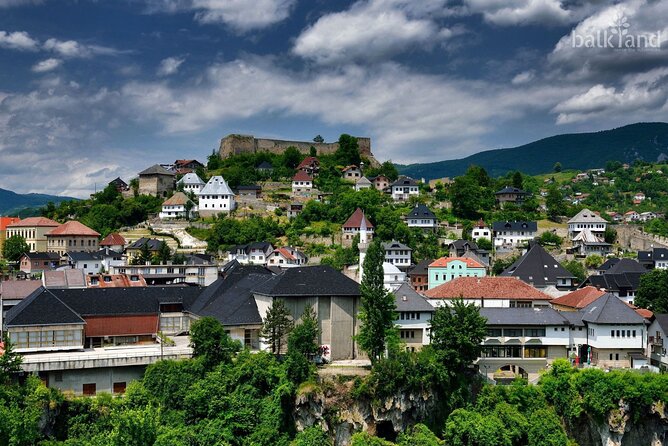
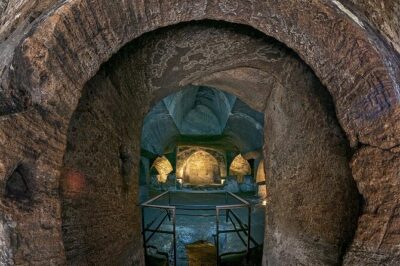
Jajce begins with its underground catacombs, a medieval tunnel system visited on a 30 minute admission-covered stop. The enclosed setting gives you a different experience from the open fortress above.
The catacombs are linked to Jajce’s medieval past and are among the town’s more unusual historical sites. The visit may be less comfortable for anyone who dislikes underground spaces, but the short duration keeps it manageable.
The Fortress of Jajce comes next, with about 30 minutes inside and admission included. Jajce was the former capital of the Bosnian kingdom, and the fortress occupied an important position above the town. The final two Bosnian kings lived here, and the Coronation Church of St. Mary lies beneath the fortress.
The main reward is the view. From the hilltop, you can look over Jajce and the surrounding countryside while connecting the remains to the town’s royal role. Thirty minutes lets you see the key sections and enjoy the panorama, though it is not enough for a slow archaeological examination.
This is one of the strongest historical portions of the day. Travnik explains Ottoman administration, while Jajce takes you into the medieval kingdom itself. The contrast helps the two towns complement one another.
The AVNOJ Museum and a 3rd-century Roman temple
The AVNOJ Museum is devoted to the second session of the Anti-Fascist Council of the People’s Liberation of Yugoslavia, held in Jajce in 1943. That meeting helped establish the political foundation of postwar Yugoslavia and reaffirmed Bosnia’s state status within the new federal structure.
You have 20 minutes in the museum, with admission included. The displays include original objects and artifacts connected with the session and the partisan resistance movement during the Second World War.
This stop is especially useful if you want to understand why Jajce matters beyond medieval history. The town connects the Bosnian kingdom with the later political story of Yugoslavia and the states that emerged after its breakup.
The Temple of Mithras offers an even older layer. Built in the 3rd century AD by Roman soldiers, it was dedicated to Mithra, an Indo-Iranian god worshipped in parts of the Roman world. The site is considered one of the best-preserved Mithraic monuments in the Balkans.
The visit lasts about 20 minutes and includes admission. It is a compact stop, but it gives the day an impressive time span, from Roman religious practice to medieval kings and 20th-century political change.
Pliva Waterfall and the wooden watermills
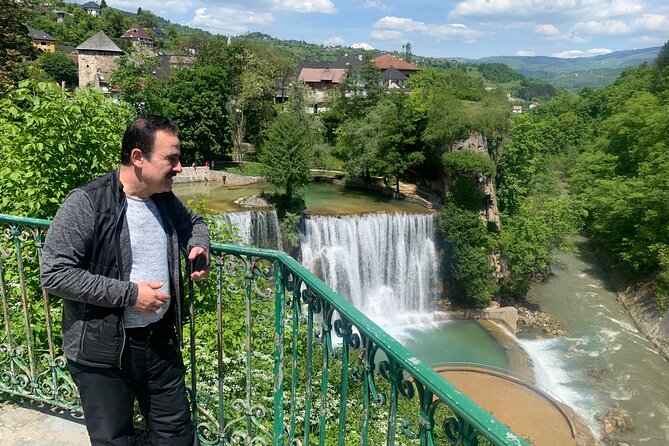
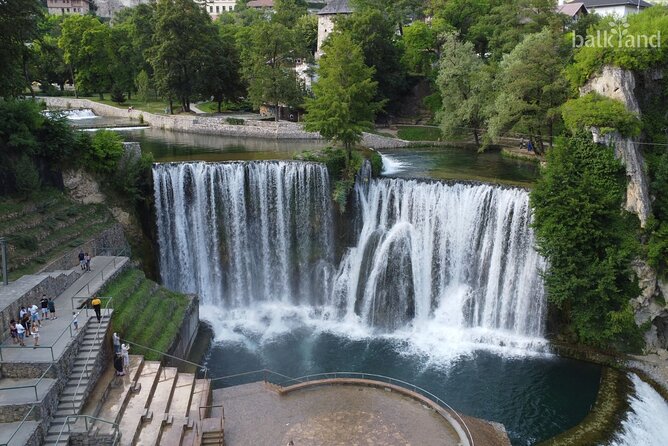
The Pliva Waterfall is the natural centerpiece of the Jajce portion. Water drops over rock near the town, creating a powerful scene that breaks up the steady run of museums, fortifications, and religious buildings.
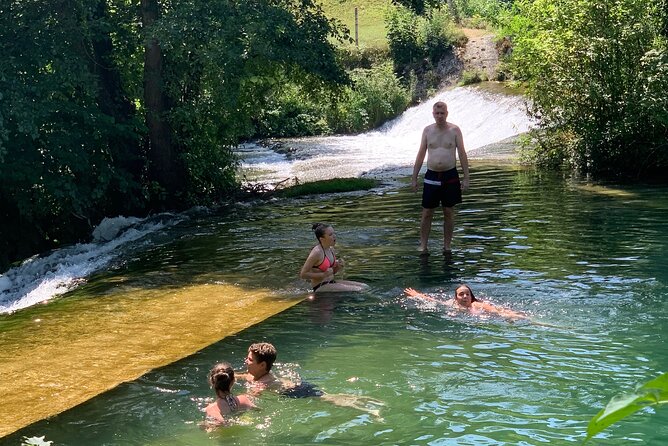
You have about 30 minutes at the waterfall, with admission included. This is enough time for photographs and a close look at the rushing water. The description also notes natural pools, but you should treat the stop primarily as sightseeing unless your guide confirms that swimming is suitable on the day.
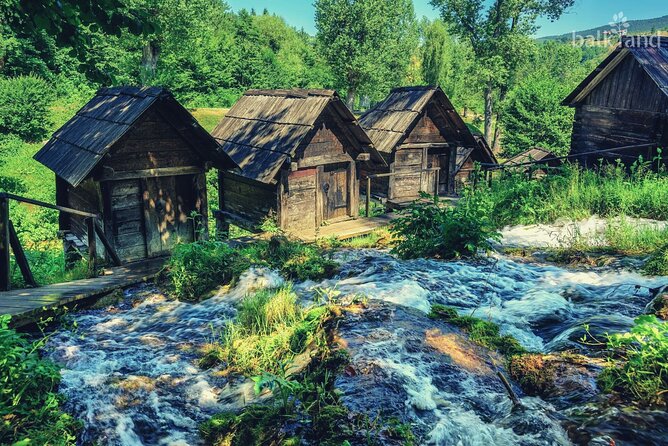
After the waterfall, the route continues to Mlincici, the traditional wooden watermills along the Pliva River. These small mills once ground grain into flour and played an important part in local life, especially during the Ottoman period.
The watermills are worth seeing because they show how the river supported ordinary households, not only grand buildings and rulers. They are a practical reminder that Bosnia’s past was shaped by working landscapes as much as by political events.
You have about 20 minutes here. The mills are simple structures, so the appeal comes from their setting and their connection to traditional technology. This is a good place to slow down for a moment before the final meal break.
Meals, road time, and the long return to Sarajevo
Lunch and dinner are not included in the price. The tour includes a 45 to 60 minute dinner break in Jajce before the return journey, giving you time to eat at your own expense.
Because the day is long, food planning matters. Bottled water and a snack are supplied, but they do not replace a proper meal. If you have dietary needs, confirm your options before ordering, since the tour details do not specify a set restaurant or menu.
The drive back to Sarajevo takes about 2.5 hours. After a full day of walking and sightseeing, that final stretch can feel long, though the countryside views give you something to watch and time to review the day.
The route is best for people who prefer seeing many major sights rather than spending half a day in one town. If you tire easily on long drives, you should take the duration seriously. If you have only a short stay in Bosnia, the same long day becomes a practical way to reach two important destinations without arranging separate transport.
What the $150.10 price includes
At $150.10 per person, this is not a budget bus ride. The value comes from the amount of coordination involved: transport from Sarajevo, a full-day driver, a private group setup, and entry fees for the listed paid sites.
You also receive air conditioning, onboard WiFi, bottled water, and a snack. Those inclusions reduce the small costs and practical hassles that can add up during a long day.
The price is easier to justify for a small group that wants a private vehicle and a planned route. It is less appealing if you prefer public transport, long independent museum visits, or choosing your own stops. The tour has group discounts, which may improve the calculation for larger parties.
A useful point in its favor is the reported arrangement of local guides in Travnik and Jajce. Muhmmnad, the named organizer, can arrange those local guides, adding place-specific explanation instead of relying only on the driver. Confirm how guiding is handled for your booking if that detail is important to you.
Who should book this Bosnia day tour?
I would recommend it to you if you want a broad introduction to central Bosnia and have one open day from Sarajevo. It suits people interested in architecture, medieval politics, Ottoman culture, religious buildings, literature, Yugoslav history, and nature.
It is also a sensible choice for a private group that values convenience. You avoid planning separate routes to Travnik and Jajce, and the included fees make the day easier to manage.
I would think twice if your ideal day means lingering over coffee, browsing museums for hours, or taking long walks without a clock. The schedule is full, and several stops last only 10 or 20 minutes.
Free cancellation is available up to 24 hours before the start time. Changes or cancellations within 24 hours are not refunded, and poor weather or failure to meet the minimum number of participants can lead to a rescheduled experience or full refund. Most people can participate, and the tour runs near public transportation.
Should you book Travnik and Jajce from Sarajevo?
Book this tour if you want maximum historical variety in a single day. The strongest combination is the Travnik fortress and Ottoman quarter, Jajce’s royal fortress, the Pliva Waterfall, and the old watermills. Add the Roman temple and AVNOJ Museum, and you get a wide view of Bosnia across many centuries.
Do not book it expecting a slow village-style outing. This is a long, carefully packed circuit with substantial driving and short visits. For the right person, the full schedule is the point: you return to Sarajevo having seen two former capitals, major religious sites, several museums, and one of the country’s best-known waterfalls.
FAQ
Where does the tour begin and end?
It begins at Sarajevo City Hall, Brodac 1, Sarajevo 71000, Bosnia and Herzegovina. The activity ends back at the same meeting point.
How long does the tour last?
The tour lasts approximately 10 to 12 hours. The return drive from Jajce to Sarajevo takes about 2.5 hours.
Is this a private tour?
Yes. Only your group participates in the activity.
Is pickup available?
Pickup is offered. The stated meeting point is Sarajevo City Hall.
What is included in the price?
The price includes bottled water, a snack such as a chocolate bar or chips, all listed fees and taxes, an air-conditioned vehicle, and WiFi onboard.
Are lunch and dinner included?
No. Lunch and dinner are not included. A dinner break of about 45 to 60 minutes is planned in Jajce before the return to Sarajevo.
Are entrance fees included?
Yes. Admission is included for the listed paid stops, including Travnik Old Town, Šarena Džamija, the Ivo Andrić Birth House, the Catacomb of Jajce, the Fortress of Jajce, the AVNOJ Museum, the Temple of Mithras, Pliva Waterfall, and Mlincici.
What is the cancellation policy?
You can cancel at least 24 hours before the start time for a full refund. Cancellations or changes made within 24 hours are not refunded or accepted. If poor weather or an insufficient number of participants causes cancellation, you will be offered another date or experience, or a full refund.
Just added around Sarajevo
- Strbacki Buk and Una Waterfalls: Day Trip from Sarajevo★ 5.0 · 3 reviews
- Walking Tour in Sarajevo★ 5.0 · 3 reviews
- MTB Bjelasnica – Lukomir★ 5.0 · 3 reviews
- Sarajevo Under Siege: A City’s Struggle & Survival Tour★ 5.0 · 3 reviews
- Herzegovina Tour from Sarajevo: Mostar, Počitelj, Blagaj, Kravice★ 5.0 · 3 reviews
- Travnik, Jajce, Pliva Lakes & Mills –Medieval & Ottoman Bosnia Full Day Tour★ 5.0 · 3 reviews
- Tour of Herzegovina – From Sarajevo★ 5.0 · 3 reviews
- The Siege of Sarajevo Tour★ 5.0 · 3 reviews
Jajce & Travnik Day Trips, compared.
Jajce, Travnik and Pliva watermills – Day Tour from Sarajevo
Read our review →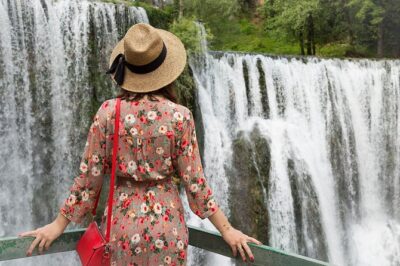
Travnik, Jajce & Pliva Lakes Day Tour From Sarajevo (fees Incl.)
Read our review →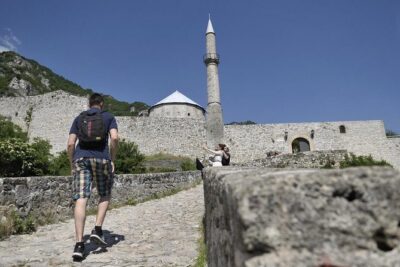
CENTRAL BOSNIA | A medieval tour (Jajce + Travnik + Pliva lakes)
Read our review →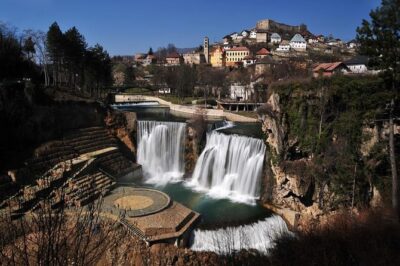
Sarajevo to Zagreb: One-Way Tour via Jajce, Travnik, Pliva Lake and Watermills
Read our review →
Travnik, Jajce, Pliva Lakes & Mills –Medieval & Ottoman Bosnia Full Day Tour
Read our review →Browse the lists this tour appears in