
Reviewed · WALKING TOURS IN SARAJEVO
Sarajevo Essential Full Walking Tour
Sarajevo’s story is easiest to grasp on foot, where a Catholic cathedral, an Ottoman mosque, an Orthodox church, and Austro-Hungarian buildings sit within a compact center. This tour gives you that remarkable sequence in about two hours, with a local guide explaining how the city’s different communities shaped one place.
I like the route’s cultural range and its strong value at $18.15. I also like that the guide adds local context to places you could otherwise pass in minutes, such as the coppersmiths’ street and the Sarajevo Rose. The main consideration is pace: with up to 50 people and many short stops, you will see a lot, but some sites receive only a few minutes.
Key points at a glance
- Four faiths in one short walk: Catholic, Muslim, Orthodox, and Jewish heritage all appear along the route.
- The Ottoman quarter feels especially tangible: Sebilj Fountain, Kazandziluk, the bazaar, and Gazi Husrev-bey Mosque connect history with daily life.
- Latin Bridge brings the 20th century into focus: This is the site linked to the assassination that helped trigger the First World War.
- You see Sarajevo’s wartime memory in the streets: A Sarajevo Rose gives a quiet, physical reminder of the city’s shelling.
- The price is easy to justify: At $18.15, the tour costs little more than a casual meal while covering the city’s main historic core.
- A well-regarded guide can make the difference: Ado, also called Adnan, has been singled out for his clear, authoritative style and willingness to answer questions.
Why this short Sarajevo walk works

I like this tour because it gives you a useful framework before you wander Sarajevo on your own. In a short distance, you move from the Neo-Gothic Sacred Heart Cathedral to Ottoman mosques, a covered bazaar, Austro-Hungarian architecture, Orthodox worship, and memorials linked to the 1990s war.
That mix is not just a checklist of monuments. It explains why Sarajevo feels different from many European capitals. Its identity was shaped by several religious and imperial traditions, often within a few streets of one another.
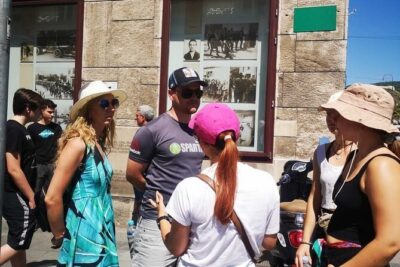
The guide is the key to making those connections clear. One guide, Adnan, known as Ado, has been praised for being easy to listen to, well informed, and open to questions. A small private group can give you more time for conversation, though the advertised maximum is 50 people, so the size may vary.
The tour is offered in English and lasts roughly one to two hours. The listed stops add up to more than the shortest advertised duration, so expect the timing to depend on the guide’s pace, group size, and how much time is spent explaining each site.
More Walking Tours in Sarajevo
- Sarajevo: 2 Hours Old Town Walking Tour With Local Guide
★ 5.0 · 505 reviews - Private Walking Tour, Food Tasting and Bosnian Coffee in Sarajevo
★ 5.0 · 255 reviews - Sarajevo Grand Walking Tour
★ 5.0 · 232 reviews
Sacred Heart Cathedral and Sarajevo’s Catholic thread
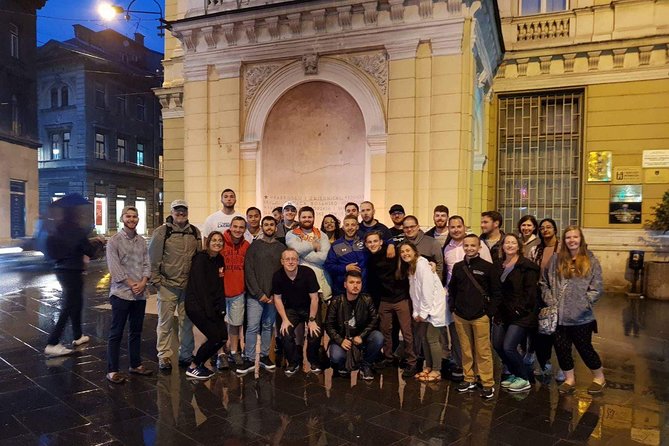
The walk begins at the Cathedral of Jesus’ Sacred Heart, Sarajevo’s largest Catholic church. Built in 1889 in Neo-Gothic style, it is the seat of the Archdiocese of Vrhbosna.
You get about ten minutes here, enough to understand the cathedral’s place in the city rather than make a long interior visit. Its pointed arches and European form introduce the Austro-Hungarian period, when Sarajevo’s rulers left a strong architectural mark on the center.
This is a useful opening because the tour does not begin with only Ottoman Sarajevo. You are shown from the start that the city’s religious story has several chapters.
The Jewish Museum and the Meeting of Cultures
The Museum of the Jews of Bosnia and Herzegovina is housed inside Sarajevo’s oldest synagogue. It is part of the City Museum of Sarajevo, and admission is not included in the tour price.
The planned visit is brief, around five minutes. If this museum interests you, check whether you have enough time and whether an additional admission charge fits your plans. The stop is still valuable as a reminder that Jewish life is part of Sarajevo’s urban story, not an afterthought.
Next comes the Sarajevo Meeting of Cultures marker on Ferhadija Street, near Gazi Husrev-bey’s Bezistan. This is where the city’s Ottoman and Austro-Hungarian architectural zones meet. It is an easy spot to miss when walking alone, yet it gives you one of the clearest visual explanations of Sarajevo’s divided and connected past.
Gazi Husrev-bey Mosque and the Ottoman center
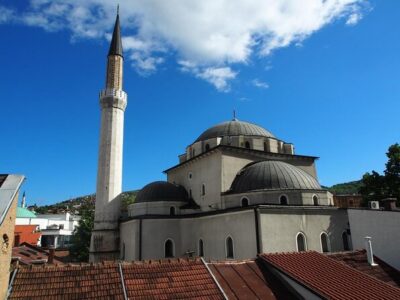
The Gazi Husrev-bey Mosque is one of the strongest stops on the walk. Built in the 16th century, it is the largest historic mosque in Bosnia and Herzegovina and one of the most important Ottoman buildings in the Balkans.
The visit lasts about ten minutes. The mosque is still a place of worship, so you should follow the guide’s instructions about appropriate conduct and access. The tour provides an introduction rather than a long architectural study, but the setting makes the Ottoman period feel immediate.
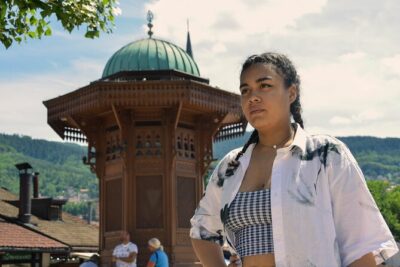
From there, you reach Sebilj Fountain in Baščaršija Square. This wooden Ottoman-style fountain dates to 1753 and is one of Sarajevo’s best-known meeting points. Five minutes is enough for a quick explanation and photographs, but the square deserves another look later if you have free time.
Same base, a completely different day out:
- Sarajevo: Mostar, Konjic, Blagaj Tekke, Pocitelj & Waterfall
★ 4.9 · 1,335 reviews - Fall of Yugoslavia, Sarajevo War Tour with Tunnel of Hope Museum and Frontlines
★ 5.0 · 1,314 reviews - Sarajevo: Mostar, Konjic, Sufi House, Pocitelj & Kravice Falls
★ 5.0 · 1,179 reviews - ROSES OF SARAJEVO (Official WAR + CITY tour)- Story of a Survivor
★ 5.0 · 770 reviews
Kazandziluk, where an old craft is still visible
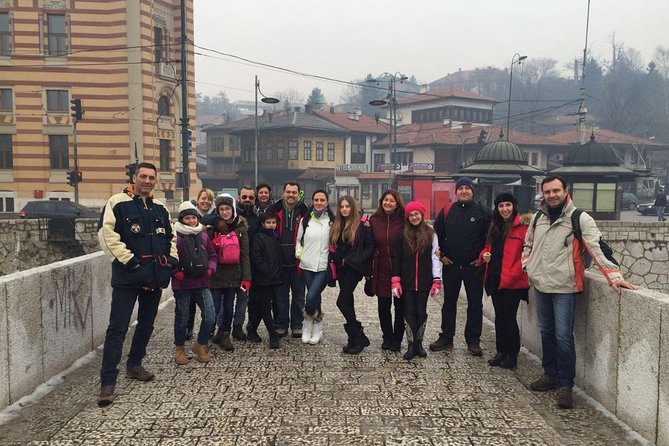
Kazandziluk is the coppersmiths’ street, and I consider it one of the most practical stops on the route. The street has retained its traditional appearance, and the craft is still carried on there.
You are scheduled to spend about ten minutes in this part of Baščaršija. That is enough to see examples of handmade copper objects and get a sense of how trade and craft shaped the old quarter.
A particularly useful detail is the chance to look at the work in a coppersmith’s shop. The visit is not simply about old buildings. It connects the city’s Ottoman commercial past with a skill that remains visible today.
City Hall, the Spite House, and the Miljacka River
Sarajevo City Hall, or Vijećnica, is the grandest building associated with the Austro-Hungarian occupation. Its elaborate design reflects the empire’s effort to give Sarajevo a new civic center, while its present meaning is broader: it represents the meeting of different worlds.
Admission to City Hall is not included. The tour allows about ten minutes, which normally means seeing the exterior and hearing the story rather than taking an extended interior visit. If you want to go inside, plan that separately.
Nearby, the Cumurija Bridge sits close to the Spite House. The house became known by that name because its owner refused to move when the city wanted to build City Hall. Today it functions as a national restaurant and is protected as cultural and historic heritage.
This is the sort of local story that improves a walking tour. You can understand the building project, the riverfront, and the stubborn human reaction to grand plans in one short stop.
Two mosques and the city’s early foundations
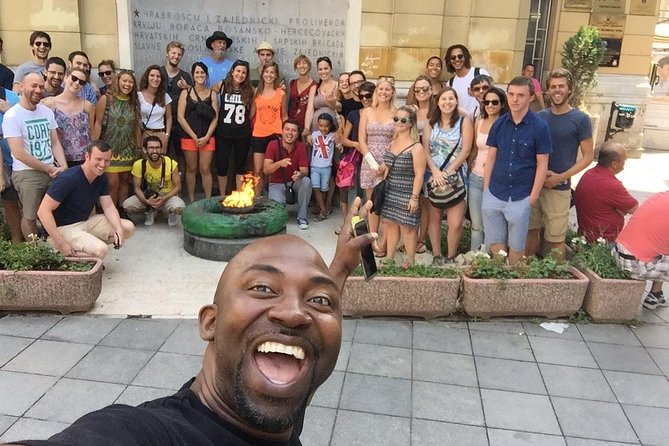
The Emperor’s Mosque is Sarajevo’s oldest mosque and one of the oldest in Bosnia and Herzegovina. It is thought to have been built soon after Sarajevo’s founding in 1462 by Isa Bey Ishaković, in honor of Sultan Mehmed II, known as the Conqueror.
The stop is brief, around five minutes, so expect an explanation from outside or a short visit rather than a detailed tour of the complex. Its value lies in the link to Sarajevo’s beginnings and to the city’s early Ottoman development.
You then return to the commercial heart of the old town for Gazi Husrev-bey’s Bezistan. This covered bazaar was built in 1555 and still serves its original purpose as a place for trade.
The bezistan gives you a more grounded view of Ottoman Sarajevo than a grand mosque alone. Here, the focus shifts to shops, movement, and commerce. It is a good place to notice how the old center remains part of everyday city life.
Taslihan and Hotel Europe reveal changing Sarajevo
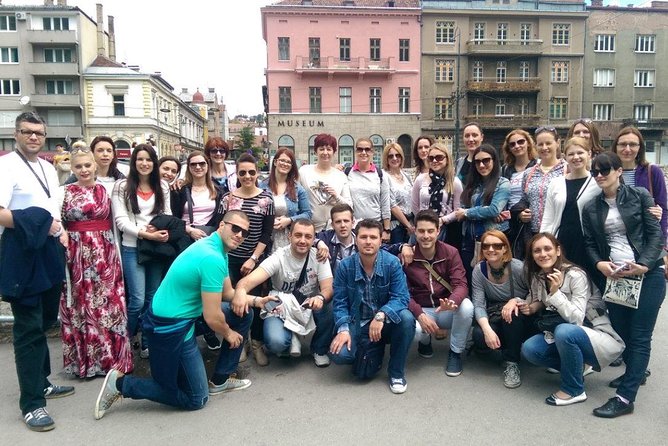
Taslihan was built in 1543 as part of Gazi Husrev-bey’s charitable foundation. It once included a fountain, mosque, courtyard, shops, and storage rooms, but fires severely damaged it.
Today, the remains offer a short lesson in what has disappeared. Do not expect a complete caravanserai. The stop is more about imagining the larger commercial complex that once supported merchants and trade.
Hotel Europe provides a sharp contrast. This Austro-Hungarian building sits just outside the old town core, and its ornate exterior shows how Sarajevo changed under imperial rule.
In only a few blocks, you see an Ottoman market building, its surviving fragments, and an Austro-Hungarian hotel. That quick shift is one of the tour’s best teaching tools.
Orthodox Sarajevo and the multicultural monument
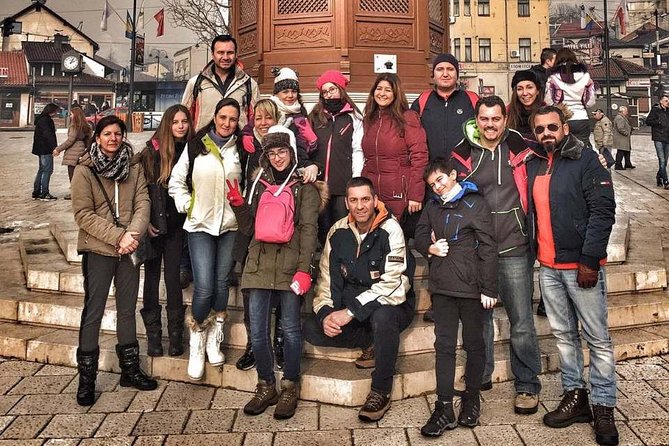
The Cathedral Church of the Nativity of the Theotokos is the largest Serbian Orthodox church in Sarajevo and one of the largest in the Balkans. The visit lasts about five minutes, so the guide’s explanation matters more than a lengthy interior inspection.
The Orthodox cathedral completes the tour’s major religious sequence. Earlier, you saw Catholic and Muslim landmarks, and you also visited the location of the Jewish Museum. Together, these stops show why Sarajevo has long been described as a meeting point of cultures.
The Monument to the Multiethnic Human sits between the Catholic cathedral, a Muslim mosque, and the Orthodox church. Its message about multiethnicity is written in Italian and Bosnian.
You get about ten minutes here, enough to consider the monument’s location and message. It is not just a sculpture to photograph. Placed among the city’s major religious symbols, it presents coexistence as an active civic choice.
Latin Bridge and the Sarajevo Rose
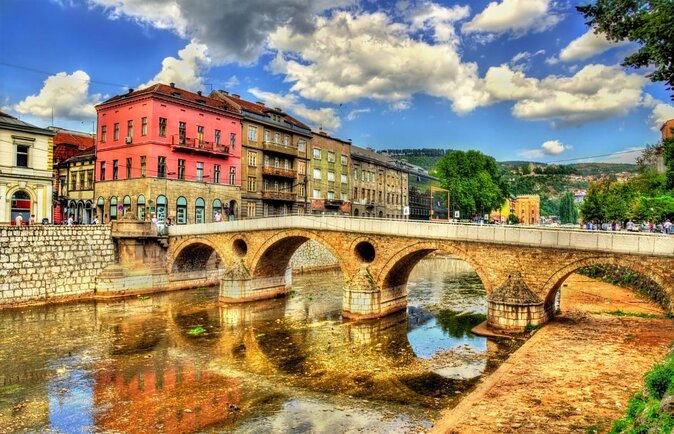
Latin Bridge is one of the most important historical stops. It is associated with Gavrilo Princip, who assassinated Archduke Franz Ferdinand and his wife, Sophie, nearby. That event helped set off the First World War.
The tour gives you about ten minutes at the bridge. The stop is especially useful if you know the assassination only as a date from a textbook. Seeing the location helps connect the political crisis to an ordinary street, bridge, and riverfront.
The Sarajevo Rose brings the story much closer to the present. These memorials mark concrete scars caused by mortar-shell explosions, later filled with red resin.
The exact spot visited depends on the route and guide, but the purpose is clear. You are not only being shown imperial buildings and Ottoman monuments. You are also asked to notice how recent violence remains marked on the pavement.
Price, group size, and the real value
At $18.15 per person, this is an inexpensive way to get oriented in Sarajevo. The price includes a local professional guide, while food, drinks, and admission to the Jewish Museum and City Hall are extra.
I would judge the value by the range of material covered. You receive religious, political, architectural, commercial, and wartime context in one compact walk. If you explored every stop alone, you could save the tour fee, but you would need to research the connections and identify several easy-to-miss places yourself.
The word small-group deserves a practical note. The maximum is 50 people, which is not small by most walking-tour standards. A quiet departure may feel personal, as it did for one couple who had the guide to themselves, but you should not book expecting a private experience.
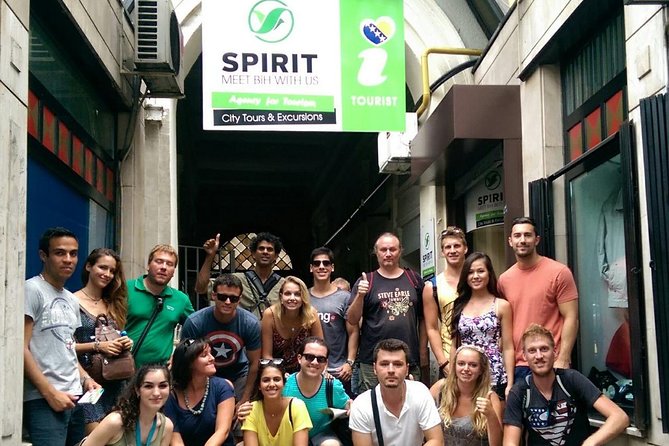
Pickup is offered from the Spirit Tours office at Ferhadija 19. Hotel, apartment, or hostel pickup can be arranged in advance if required. The activity ends back at the meeting point, and the office is open Monday through Sunday from 9:00 a.m. to 5:00 p.m.
Confirmation is provided when you book. Service animals are allowed, public transportation is nearby, and most people can participate. Free cancellation is available up to 24 hours before the start time. If the minimum number is not reached and the tour is canceled, you are offered another date or experience, or a full refund.
Who should book this Sarajevo tour?
I would recommend it most strongly at the start of a Sarajevo stay. It gives you a map in your head, introduces the main quarters, and helps you decide which places deserve a longer return visit.
It suits first-time visitors, history-minded walkers, and anyone with only a short visit. It also works well for people who want cultural context without committing to a half-day activity.
You may want something else if you prefer slow museum visits, long time inside religious buildings, or a very small group guaranteed from the start. The quick stops keep the route lively, but they limit the depth possible at each site.
Should you book it?
Book this tour if you want Sarajevo’s main story in a compact, affordable walk. The mix of cathedral, mosque, synagogue museum, bazaar, bridge, city hall, Orthodox church, and war memorial is unusually strong for a one-to-two-hour route.
I would especially choose it for your first day, then return to Gazi Husrev-bey Mosque, City Hall, the Jewish Museum, or the old bazaar with more time. Just keep the $18.15 price focused on guided orientation, not included admissions or a full museum tour. If Ado is leading, expect a clear and thoughtful guide who welcomes questions, but group size can affect how personal the experience feels.
FAQ
How long does the Sarajevo Essential Full Walking Tour last?
The tour lasts approximately one to two hours.
How much does the tour cost?
The listed price is $18.15 per person.
Is the tour offered in English?
Yes. The experience is offered in English.
Where does the tour begin and end?
It begins at the Spirit Tours office, BH Spirit City Tours and Excursions, at Ferhadija 19 in Sarajevo. It ends back at the meeting point.
Is hotel pickup available?
Pickup from a hotel, apartment, or hostel can be arranged in advance if required.
Are admission tickets included?
Admission is free at several outdoor and religious stops, but admission to the Museum of the Jews of Bosnia and Herzegovina and Sarajevo City Hall is not included.
What is included in the tour price?
A local guide and professional guide are included. Food and drinks are not included.
Can I cancel for a full refund?
Yes. You can cancel at least 24 hours before the experience start time for a full refund. Changes or cancellations made less than 24 hours in advance are not accepted for a refund.
Just added around Sarajevo
- Strbacki Buk and Una Waterfalls: Day Trip from Sarajevo★ 5.0 · 3 reviews
- Bosnian Kingdom Capitals: Travnik & Jajce Tour from Sarajevo★ 5.0 · 3 reviews
- Walking Tour in Sarajevo★ 5.0 · 3 reviews
- MTB Bjelasnica – Lukomir★ 5.0 · 3 reviews
- Sarajevo Under Siege: A City’s Struggle & Survival Tour★ 5.0 · 3 reviews
- Herzegovina Tour from Sarajevo: Mostar, Počitelj, Blagaj, Kravice★ 5.0 · 3 reviews
- Travnik, Jajce, Pliva Lakes & Mills –Medieval & Ottoman Bosnia Full Day Tour★ 5.0 · 3 reviews
- Tour of Herzegovina – From Sarajevo★ 5.0 · 3 reviews
Walking Tours in Sarajevo, compared.
Sarajevo: 2 Hours Old Town Walking Tour With Local Guide
Read our review →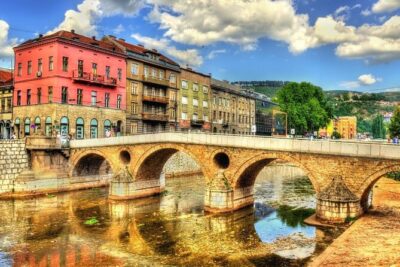
Private Walking Tour, Food Tasting and Bosnian Coffee in Sarajevo
Read our review →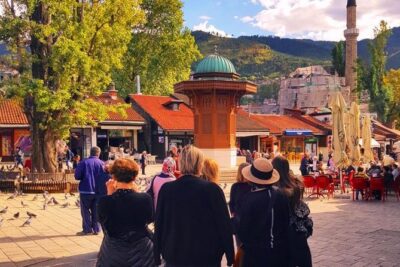
Delicious Sarajevo: Eat, Walk & Discover City Tour
Read our review →
PROFESSIONAL SARAJEVO WALKING TOUR – With guide who guided STING!
Read our review →
Sarajevo genuine walking tour: Steps through history
Read our review →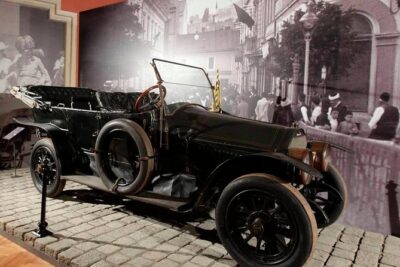
InstaSarajevo – Photography Walking Tour of Sarajevo
Read our review →Browse the lists this tour appears in