
Reviewed · WALKING TOURS IN SARAJEVO
Private Walking Tour, Food Tasting and Bosnian Coffee in Sarajevo
Sarajevo’s story is easiest to grasp over a cup of Bosnian coffee, and this private walk makes that ritual the heart of the experience. In about two and a half hours, you move from Ottoman lanes to Austro-Hungarian monuments, with traditional food along the way and the assassination site that helped trigger World War I.
I like the private format, since your guide can adjust the pace and explain Sarajevo in a personal way. I also like the mix of large food tastings and coffee served in the local style, rather than a tour that simply points at restaurants and sends you on your way.
The main consideration is time. Two and a half hours gives you a useful first look, but stops such as City Hall, the mosque, cathedral, clock tower, and Latin Bridge are introductions, not full visits. The tour is best for getting your bearings, eating well, and deciding where to return later.
Key things to know before booking
- Bosnian coffee is part of the experience: You learn how it is prepared and how locals traditionally drink it at Morića Han.
- The food is more than a token bite: The tasting includes traditional dishes and sweets, with portions described as generous enough to feel like a proper meal stop.
- Your guide makes the difference: Emina and Lamija are named guides associated with especially warm, informative tours.
- Sarajevo’s major eras appear in one walk: Ottoman, Austro-Hungarian, religious, and modern wartime stories all enter the route.
- The tour is private: Only your group participates, making it easier to ask questions or pause for photos.
- You finish at Latin Bridge: The final stop connects Sarajevo to the 1914 assassination of Archduke Franz Ferdinand and the start of World War I.
Why this Sarajevo walk works so well as a first introduction
I would use this tour early in a Sarajevo visit. It gives you a practical map of the old center while explaining why the city feels so different from one street to the next.
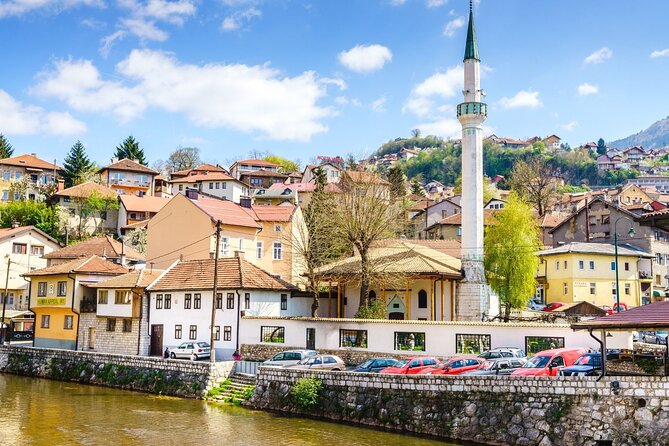
The route brings together several parts of Sarajevo that can seem disconnected if you explore alone. Ottoman courtyards, copper workshops, Austro-Hungarian facades, Islamic architecture, Orthodox Christianity, Catholicism, and the city’s painful recent past all appear within a compact walking area.
That variety is the real value. You are not signing up for only a food tour, and you are not getting a standard monument checklist. The meal and coffee stops give the historical talk a human scale. You learn what people eat, how coffee is served, and how old buildings still fit into daily life.
The private setup matters, too. A guide such as Emina or Lamija can spend more time on the subjects that catch your attention. If you want more context about the war, religion, architecture, or food, you can ask directly instead of waiting for a group schedule.
The tour is offered in English and uses a mobile ticket. It is near public transportation, and most people can take part, though you should expect a steady city walk with stops on foot.
More Walking Tours in Sarajevo
- Sarajevo: 2 Hours Old Town Walking Tour With Local Guide
★ 5.0 · 505 reviews - Sarajevo Grand Walking Tour
★ 5.0 · 232 reviews - Sarajevo Essential Full Walking Tour
★ 5.0 · 198 reviews
Starting near City Hall and finding Sarajevo’s center
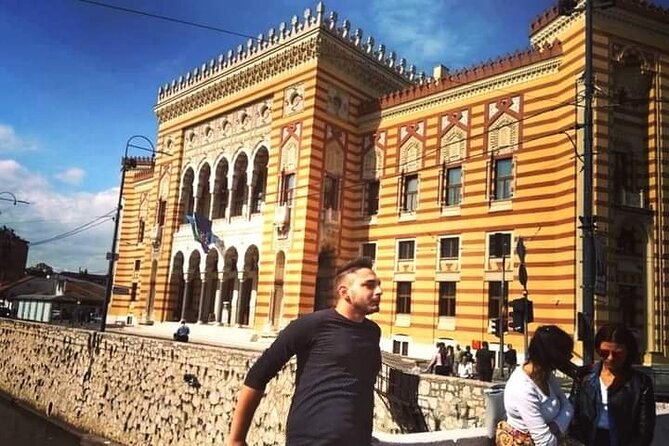
The meeting point is Sarajevo City Hall at Brodac 1. This is a sensible place to begin because the building gives you an immediate look at Sarajevo’s Austro-Hungarian chapter before the route moves toward the older Ottoman quarter.
The stated route also includes Sebilj Fountain as its first major stop. Since the meeting point and first listed attraction are different places, check the exact meeting instructions when you book and arrive a little early. The start is in the central old city, not at a remote meeting area, so reaching it by public transportation is straightforward according to the tour details.
From the first minutes, the guide sets up the larger story of Bosnia and Sarajevo. That introduction is useful because the city’s past is not a simple succession of periods. Different empires, faiths, and political powers left their mark close together, and the walk helps you read those layers as you go.
Sebilj Fountain and the pigeon-filled Baščaršija square
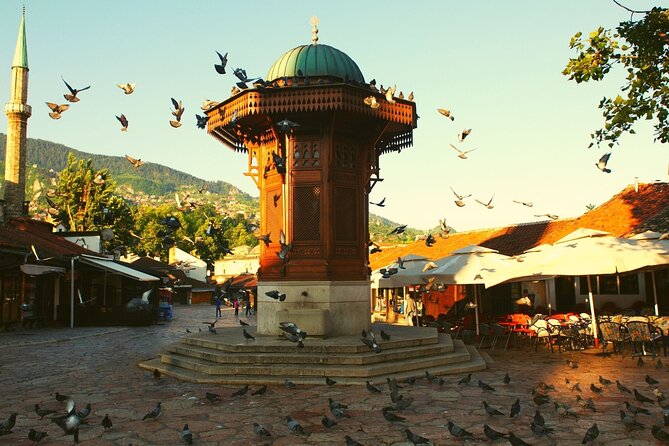
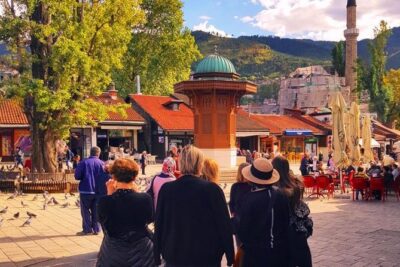
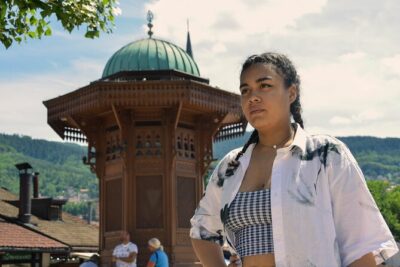
Sebilj is an 18th-century wooden fountain on Baščaršija Square, often called Pigeon Square. It is one of Sarajevo’s most recognizable meeting points, and the setting gives you an immediate sense of the old bazaar district.
The fountain itself is attractive, but the important part is the explanation around it. Here, your guide introduces Sarajevo and Bosnia before the route gets more specific. This is where the tour begins to connect architecture, trade, food, and local custom.
The stop lasts about 25 minutes, making it one of the longer pauses. That is helpful if you want a proper orientation rather than a quick photograph. The square can also be a lively place, so stay close to your guide and keep track of your group while listening.
No admission charge is listed for the stop. You are paying for the guide’s time, interpretation, food, and coffee, not entrance tickets to a paid monument.
Sarajevo City Hall and the Austro-Hungarian chapter
Sarajevo City Hall is described as the city’s most representative Austro-Hungarian building. Its decorative style makes a sharp contrast with the Ottoman streets nearby, which is exactly why it works so well on this route.
The building also served as the National and University Library. That detail gives the stop more weight than an architecture photograph. It links the building to Sarajevo’s cultural and intellectual life, not just to imperial design.
The listed visit lasts around 10 minutes. That is enough to discuss the building from outside and place it in the city’s story, but it is not a full interior tour. If you want to explore City Hall at length, set aside separate time before or after this experience.
I like this stop because it prevents the walk from treating Sarajevo as an exclusively Ottoman city. You see the sharp change in style and power within a short distance, which is one of the pleasures of walking here.
A few more Sarajevo day trips to weigh up
- Sarajevo Uncovered: Old Town Tour with Coffee and Food Tasting
★ 5.0 · 12 reviews
Kazandžiluk and the sound of copperwork
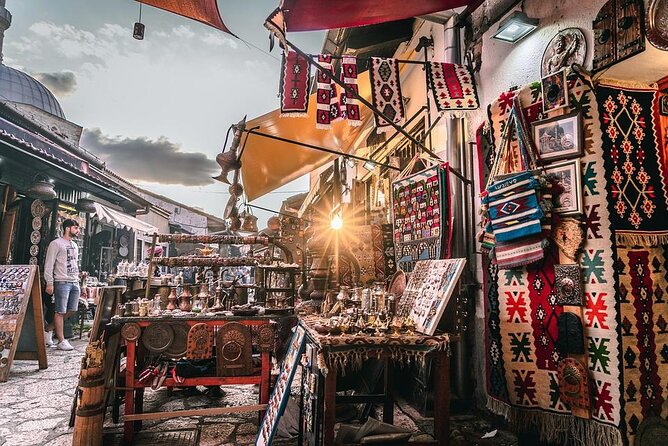
Kazandžiluk is Sarajevo’s oldest street and the place to focus on copper craftsmanship. Shops display distinctive copper and brass pieces, making this one of the route’s most tangible stops.
The tour uses the street to explain the role of coffee in Bosnian tradition. You also learn how Bosnian coffee is made and how it is drunk. That preparation is not just a food detail. It is a social custom, and the guide gives you enough background to understand the later coffee tasting at Morića Han.
A particularly meaningful detail from the experience is the chance to see local metalwork that gives old mortar shell casings a new purpose as vases. That kind of craft carries Sarajevo’s difficult past into an object used in ordinary life. It is a small but memorable example of how local makers turn a painful material into something peaceful and useful.
The stop is short, about 10 minutes, so you should not expect an extended workshop or a shopping session. Still, it gives you a better reason to notice the copper shops later, instead of seeing them as simple souvenir stalls.
Morića Han and the proper way to drink Bosnian coffee
Morića Han is one of the strongest historical stops on the walk. This former caravanserai recalls the Ottoman period, when merchants and their animals needed places to rest along trade routes.
The building helps explain how Sarajevo functioned as a trading center. Its courtyard setting also provides a natural pause from the street. Here, you taste Bosnian coffee in the traditional local manner, after learning the basic customs at Kazandžiluk.
Expect the coffee to be served as a cultural experience, not as a modern cafe drink. Your guide explains how to approach it and how it fits into Bosnian hospitality. The point is to slow down and understand the ritual, rather than rush through a caffeine stop.
This is scheduled for about 25 minutes. That longer pause is welcome because coffee needs a little time, and the guide can answer questions without keeping you standing in a busy lane.
If you do not usually drink strong coffee, you may want to ask your guide what to expect before taking a full serving. The tour is built around the tradition, so coffee is not an optional side detail.
Bravadžiluk Street and the food tasting
Bravadžiluk Street is known for restaurants serving Bosnian food. Here, the guide points out popular local dishes and sweets, and the tasting provides the tour’s most substantial food moment.
The exact dishes are not specified, which is worth knowing if you have allergies, dietary restrictions, or one particular food in mind. Ask what will be served when you meet your guide. The experience is designed around traditional food, and the portions have been described as generous and delicious, with one stop taking place at a small cafe.
That makes the price easier to assess. At $66.54 per person, you are not paying only for a short guided stroll. The fee combines a private guide, food sampling, Bosnian coffee, and a route through several of Sarajevo’s key central sights. For one person, that is not the cheapest way to eat in the city, but it can be good value on a first day when you want orientation and a meal at the same time.
I especially like food tours that explain what to order later. This one gives you a starting point for Bosnia’s popular dishes and sweets, even though you will need to ask for exact names and recommendations on the day.
The clock tower and Sarajevo’s unusual time
The Old Sarajevo Clock Tower is a very brief stop, listed at about two minutes. It is near one of the city’s major mosques and is known for showing an unusual kind of time.
Your guide explains the story behind the clock rather than leaving you to puzzle it out. This is a quick cultural detail, but it shows how local customs can differ from the timekeeping system you use every day.
Do not expect a long visit or a climb. The value is in the explanation and the way the clock fits into the old city’s religious and commercial setting.
Sacred Heart Cathedral and the Sarajevo roses
The Sacred Heart Cathedral brings another architectural and religious layer to the route. Built in Neo-Renaissance style during the Austro-Hungarian period, it looks very different from the Ottoman buildings nearby.
The stop also includes the statue of Pope John Paul II, who visited Bosnia twice. Your guide then discusses Sarajevo roses, a term used for marks in the pavement associated with deadly shell impacts during the city’s siege. Red resin fills some of these scars, turning places of loss into quiet memorials.
This is a serious part of the walk. The route does not treat Sarajevo’s past as a collection of picturesque stories. It connects grand buildings with the more recent experiences of the people who lived through war.
The visit lasts about 10 minutes. That is enough for a clear explanation, though you may want to return later if you want more time inside or around the cathedral.
Gazi Husrev-beg Mosque and the Ottoman heart of town
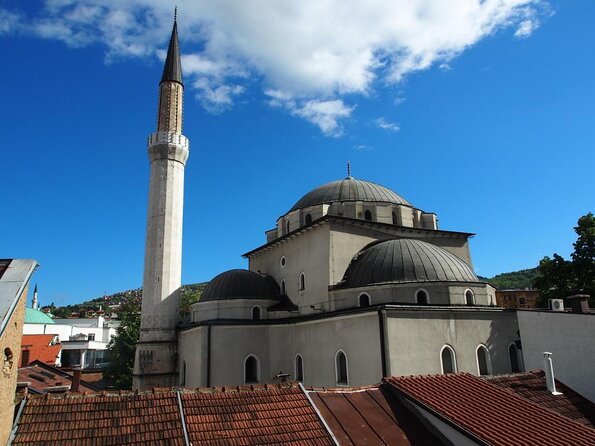
Gazi Husrev-beg Mosque is one of Sarajevo’s most important Islamic buildings and is described as the largest and one of the most beautiful mosques in the city. Its inclusion gives the Ottoman portion of the tour a strong focal point.
Your guide explains the mosque within the wider setting of Sarajevo’s old bazaar. You should treat it as a functioning religious site, so modest clothing and respectful behavior are sensible. The supplied details do not specify interior access rules or whether the group enters, so ask your guide about the visit on the day.
Nearby, Gazi Husrev Bey’s Bezistan adds another Ottoman commercial space to the route. This old bazaar still shows Oriental elements in the architecture and culture. Together, the mosque and bezistan show how faith, trade, and public life were connected in the old city.
The listed mosque stop takes about 10 minutes. As with City Hall and the cathedral, that timing works for an introduction but not a detailed architectural study.
Latin Bridge and the event that changed world history
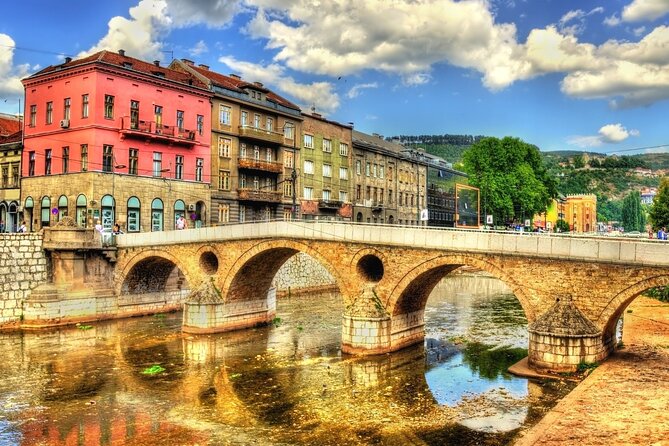
The walk finishes near Latin Bridge, the site associated with the assassination of Archduke Franz Ferdinand. The event in 1914 set off a chain of political decisions that led to World War I.
This is a powerful ending because the tour has already shown you the Ottoman and Austro-Hungarian city. At Latin Bridge, those earlier explanations come together. Sarajevo was not a random backdrop to the story. Its mix of communities, imperial politics, and local tensions formed the setting for an event with global consequences.
The listed stop lasts about 10 minutes. Since the activity ends in a different location from the starting point, Latin Bridge is a useful place to continue exploring on your own. You are close to other central sights, but the exact onward arrangements are not specified, so plan your next step before the tour ends.
What the private format adds to the experience
A private tour is most useful here because Sarajevo’s history raises questions. You may want to spend more time on the Ottoman period, the Austro-Hungarian buildings, the 1990s war, coffee customs, or food. With only your group present, the guide can respond to those interests.
The named guides Emina and Lamija receive especially warm attention in the supplied material. Emina is described as friendly, easy to talk with, and generous with practical suggestions for the rest of a Bosnia visit. Lamija is described as informative and interesting during both the walking and tasting portions.
A guide also helps with the food. Instead of ordering blindly, you can ask what a dish is, how it is traditionally eaten, and what sweets are worth trying later. That sort of advice can save you from spending your next meal guessing at a menu.
The private format does not guarantee a longer visit at each landmark. The route still has a fixed approximate duration, and the schedule is fairly full. Think of it as a focused introduction with food, not a slow architectural tour.
Timing, comfort, and practical details
The experience lasts about two hours and 30 minutes. The route includes several short stops, walking between neighborhoods, a food tasting, and coffee, so wear comfortable shoes and leave room in your schedule for a relaxed pace.
The starting point is Sarajevo City Hall, while the tour ends near Latin Bridge. It is not a round trip back to the first address. The activity is available in English, uses a mobile ticket, and is near public transportation.
The booking pattern suggests that people often reserve about 28 days ahead. That does not mean you must book that early, but it is a sensible idea if your Sarajevo dates are fixed and you specifically want a private English-language guide.
Free cancellation is available up to 24 hours before the local start time for a full refund. Changes or cancellations inside that window are not accepted, and the minimum group requirement means the provider may offer another date or a full refund if the activity cannot run.
Who should book it
I would recommend this walk to a first-time visitor who wants food and context together. It is also a good match for couples, families, and small groups who prefer direct conversation to a large scheduled group.
You should book it if Bosnian coffee interests you, if you want help choosing local food, or if Sarajevo’s mix of Ottoman and Austro-Hungarian architecture feels hard to organize on your own. The private guide and generous food stop add real value to a short visit.
You may want something else if you are looking for museum interiors, a long mosque visit, a full cooking class, or a detailed war-focused tour. The sightseeing stops are brief, and no paid admissions are included as a central feature.
At $66.54 per person, I see the strongest value on your first day in Sarajevo. You get a meal-style tasting, coffee, personal guidance, and a compact tour of the old center. If you already know the city well, the price may be harder to justify unless the private food and coffee focus is exactly what you want.
Final verdict: a tasty, useful first walk through Sarajevo
This is a strong introduction to Sarajevo because it lets you understand the city through ordinary pleasures as well as major events. Copperwork, coffee, sweets, a caravanserai, a mosque, a cathedral, and Latin Bridge make a more lasting impression together than they would as isolated stops.
Book it early in your stay, ask about the exact food and coffee serving, and keep later time free if you want to revisit City Hall, the cathedral, or the religious buildings. For a private two-and-a-half-hour orientation with plenty to eat and discuss, this tour is worth considering.
FAQ
Where does the tour start?
The meeting point is Sarajevo City Hall, Brodac 1, Sarajevo 71000, Bosnia and Herzegovina.
Where does the tour end?
The activity ends at a different location from the meeting point, near the famous Latin Bridge.
How long does the tour last?
The tour lasts approximately two hours and 30 minutes.
Is the tour private?
Yes. Only your group participates in the activity.
Is the tour offered in English?
Yes. English is the listed tour language.
What food is included?
The experience includes tastings of traditional Bosnian food and sweets in the Bravadžiluk Street area. Exact dishes are not specified in the provided details.
Is Bosnian coffee included?
Yes. You learn how Bosnian coffee is prepared and traditionally consumed, then taste it at Morića Han.
Are admission tickets included?
The listed stops show free admission. The tour focuses on guided visits and outdoor sightseeing rather than paid entry tickets.
Can I cancel for a full refund?
Yes, if you cancel at least 24 hours before the experience start time. Cancellations made less than 24 hours before the start are not refunded.
Is the tour suitable for most people?
Most people can participate, and service animals are allowed. The experience takes place on foot and is near public transportation.
More Food in Sarajevo
- Delicious Sarajevo: Eat, Walk & Discover City Tour
★ 4.5 · 37 reviews - Eat, Pray, Love Tour
★ 4.5 · 32 reviews
More Food Tours in Sarajevo
- Sarajevo: 4-Hour Food And Craft Tour
★ 5.0 · 70 reviews - LUKOMIR VILLAGE HIKE & TREK TOUR (nature, hike, food & panorama)
★ 5.0 · 11 reviews - Split/Trogir: Mostar and Medjugorje Tour with Wine Tasting
★ 4.5 · 282 reviews - Safari kayak adventure w BBQ & Beer
★ 5.0 · 34 reviews
Just added around Sarajevo
- Strbacki Buk and Una Waterfalls: Day Trip from Sarajevo★ 5.0 · 3 reviews
- Bosnian Kingdom Capitals: Travnik & Jajce Tour from Sarajevo★ 5.0 · 3 reviews
- Walking Tour in Sarajevo★ 5.0 · 3 reviews
- MTB Bjelasnica – Lukomir★ 5.0 · 3 reviews
- Sarajevo Under Siege: A City’s Struggle & Survival Tour★ 5.0 · 3 reviews
- Herzegovina Tour from Sarajevo: Mostar, Počitelj, Blagaj, Kravice★ 5.0 · 3 reviews
- Travnik, Jajce, Pliva Lakes & Mills –Medieval & Ottoman Bosnia Full Day Tour★ 5.0 · 3 reviews
- Tour of Herzegovina – From Sarajevo★ 5.0 · 3 reviews
Walking Tours in Sarajevo, compared.
Sarajevo: 2 Hours Old Town Walking Tour With Local Guide
Read our review →
Delicious Sarajevo: Eat, Walk & Discover City Tour
Read our review →
PROFESSIONAL SARAJEVO WALKING TOUR – With guide who guided STING!
Read our review →
Sarajevo genuine walking tour: Steps through history
Read our review →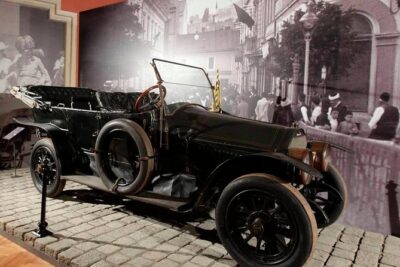
InstaSarajevo – Photography Walking Tour of Sarajevo
Read our review →Browse the lists this tour appears in