
Reviewed · WALKING TOURS IN SARAJEVO
Walking Tour in Sarajevo
Sarajevo’s best story is told in a few city blocks, where Ottoman courtyards, Austro-Hungarian façades, church bells, and calls from minarets share the same streets. This private walk follows that meeting point of cultures, from City Hall and Baščaršija to the place where the assassination of Archduke Franz Ferdinand helped set World War I in motion. Guide Suvad brings personal stories and clear historical context to the route.
I like the private format, especially because a small group of up to four can ask questions and shape the pace. I also like the sensory side of the walk: the scent of Bosnian coffee, the food stalls serving cevapi and pita, and the working craft shops of Kazandžiluk. The main consideration is that the tour can last anywhere from one to three hours, and several major sites are discussed from outside unless you pay separate admission.
Key points to know before booking
- Ottoman and Austro-Hungarian Sarajevo in one walk: The route shows how sharply the city changes from Baščaršija’s market streets to European-style boulevards and churches.
- A genuinely private experience: Your group alone participates, with a maximum of four people.
- Suvad is the named guide: His approach combines factual history with personal stories and leaves room for questions.
- Food and crafts are part of the route: You pass cevapi and pita shops, copper workshops, coffee sellers, and traditional carpet displays.
- Many stops are exterior visits: Entry tickets for City Hall, Gazi Husrev-beg Mosque, the Sarajevo Museum, and the Jewish Museum are not included.
- Good value for a small group: At $69.46 per group, the cost is attractive when shared by two to four people.
Sarajevo’s East Meets West story
The walk begins at Telali 19 at 9:00 in the morning. From there, you move through the old center on foot, following a route that makes Sarajevo’s cultural mix easy to see rather than just hear about.
The central idea is simple: Sarajevo can feel like Istanbul in miniature in one direction and Vienna in miniature in another. That contrast is not confined to a museum display. It appears in the street plan, the buildings, the religious sites, the food, and the sounds around you.
I find this a useful way to approach the city because Sarajevo’s past can otherwise seem like a long list of empires and conflicts. Here, the story is attached to places you can see and touch. A copper shop tells you something about Ottoman craft traditions. A neogothic cathedral points to Austro-Hungarian influence. A busy square links everyday city life with major political events.
The morning start should also give you a cooler, calmer period for walking, though the exact pace depends on your group and the guide. The route is in the historic center, and most participants can take part. Comfortable shoes are still sensible because the experience is primarily a walking tour.
More Walking Tours in Sarajevo
- Sarajevo: 2 Hours Old Town Walking Tour With Local Guide
★ 5.0 · 505 reviews - Private Walking Tour, Food Tasting and Bosnian Coffee in Sarajevo
★ 5.0 · 255 reviews - Sarajevo Grand Walking Tour
★ 5.0 · 232 reviews
City Hall and the first view of Sarajevo’s past
Sarajevo City Hall is the opening stop. The guide explains its construction, the role it played, its destruction, and its reconstruction. That sequence gives you a compact introduction to the city’s modern history.
The building is especially useful as a starting point because it represents the Austro-Hungarian period, while the nearby streets lead quickly into the Ottoman quarter. You begin with a grand civic building, then move toward smaller shops, courtyards, and market lanes.
Admission to City Hall is not included, so expect this portion to be an exterior explanation unless you choose to visit inside on your own. The listed time is short, about five minutes, so the stop is designed more for orientation and context than a full interior tour.
Cevapi, pita, and the edible side of the old town
The route continues along a street known for cevapi and pita. You have a chance to see how these Bosnian specialties are prepared, and the food smells become part of the sightseeing.
This is one of the walk’s most practical touches. Sarajevo’s cuisine is not treated as a separate activity that you must arrange later. It appears naturally as part of the old-town route. You can note where the food is prepared, ask the guide what to order, and return afterward if you want a full meal.
The tour does not state that food is included, so plan to buy anything you want separately. That is not a flaw, but it is worth knowing. This is a guided introduction to local food, not a food-tasting package.
Kazandžiluk and the working craft quarter
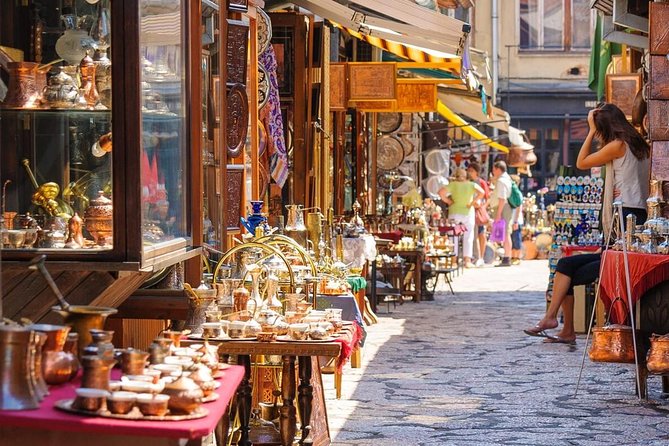
Kazandžiluk is one of the most atmospheric parts of the walk. The street is associated with copper and tin craftsmanship, and you meet shop vendors while hearing about coffee preparation, pot making, decoration, and daily life during the Ottoman period.
I like this stop because it gives the Ottoman story a human scale. Instead of hearing only about rulers, dates, and buildings, you see the kind of work that helped define the quarter. The shops also give you a chance to look at handmade objects without being pushed into a formal shopping stop.
The guide also talks about Turkish coffee and its place in local life. The emphasis is on how coffee is made and tasted, not on a guaranteed drink or tasting session. If coffee matters to you, ask Suvad how Sarajevo’s style differs from what you already know.
Same base, a completely different day out:
- Sarajevo: Mostar, Konjic, Blagaj Tekke, Pocitelj & Waterfall
★ 4.9 · 1,335 reviews - Fall of Yugoslavia, Sarajevo War Tour with Tunnel of Hope Museum and Frontlines
★ 5.0 · 1,314 reviews - Sarajevo: Mostar, Konjic, Sufi House, Pocitelj & Kravice Falls
★ 5.0 · 1,179 reviews - ROSES OF SARAJEVO (Official WAR + CITY tour)- Story of a Survivor
★ 5.0 · 770 reviews
Sebilj and the center of Baščaršija
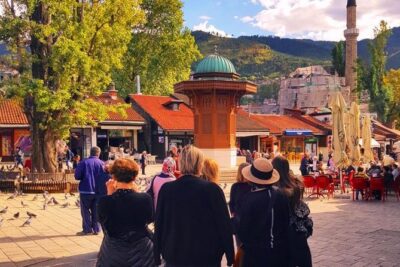
The wooden fountain Sebilj is another short stop. The guide covers its origins, design, and use over the centuries.
Because the stop is brief, the value comes from the explanation rather than a long visit. Sebilj helps you read the old market area as a historic public space, not simply as a photogenic square. After the fountain, you remain close to the craft shops and food streets, so the route keeps its sense of place.
This is also a point where the small-group setup helps. With only your party present, you can ask for a quick explanation of a detail you might otherwise pass without noticing.
Morića Han and the caravan routes
Morića Han was once a caravan saray, a lodging place for caravans moving through the region. The guide explains how those journeys connected Sarajevo with wider commercial routes.
The stop lasts about ten minutes and is free to visit. You can also see a carpet shop displaying traditional Bosnian carpets. That pairing works well: the building introduces long-distance trade, while the carpets connect the old commercial world with a craft tradition that remains visible today.
Morića Han is a useful reminder that Sarajevo was not an isolated provincial town. Its markets depended on movement, trade, and visitors from elsewhere. The caravan story also gives the Ottoman quarter a broader frame before the walk turns to religious and civic buildings.
Gazi Husrev-beg Mosque and its surrounding institutions
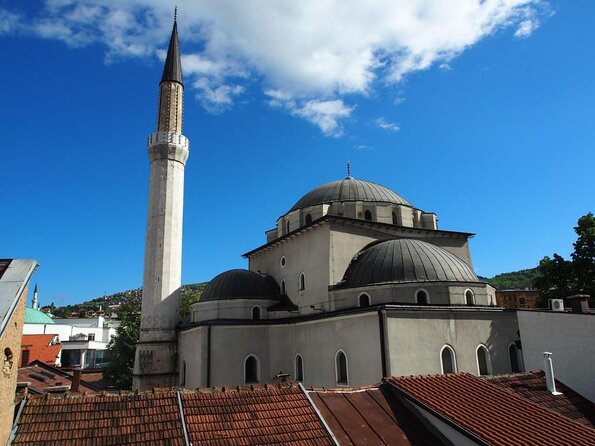
At Gazi Husrev-beg Mosque, the guide discusses the construction and use of the mosque, then places it within the larger neighborhood built around it in the 16th century.
You hear about the medressah, or Islamic school, public toilets, library, and other facilities connected with the complex. This is more informative than treating the mosque as a single building. It shows how religious, educational, civic, and social functions worked together in the Ottoman city.
The listed visit is about fifteen minutes. Admission is not included, so the tour may remain in the courtyard or outside depending on access and your choices. Dress and entry requirements can vary, so ask the guide what is appropriate if you want to go farther inside.
I consider this one of the most important stops because it explains how the surrounding streets were organized. Look beyond the main façade and notice the way the complex shapes the neighborhood.
The Franz Ferdinand assassination site
At the Sarajevo Museum, the guide stops near the place where Austro-Hungarian Archduke Franz Ferdinand was assassinated in 1914. The discussion includes photographs of Gavrilo Princip and the causes that led to World War I.
This is a point where a good guide matters. The event is often reduced to a single dramatic sentence, but the tour promises a more detailed explanation of the political conditions behind it. You can ask questions and connect the assassination to the Austro-Hungarian presence you have already seen in the city’s architecture.
Admission to the museum is not included. The stop is listed at about ten minutes, which is enough for the site explanation but not for a complete museum visit. If you want the exhibits inside, plan extra time and a separate ticket after the walk.
Bezistan and the covered market
Gazi-Husrev Beg’s Bezistan is a covered bazaar built in the 16th century and modeled on Istanbul’s Kapalı Çarşı. The guide leads you through the building and explains its commercial role.
This is one of the clearest places to see the connection between Sarajevo and the wider Ottoman world. The covered market also gives you a change of pace from open streets and squares. Its architecture makes the old trading system easier to picture, especially after hearing about caravans at Morića Han.
The visit is free and takes about five minutes. You should think of it as a focused architectural stop rather than a long shopping session.
The Sarajevo Meeting of Culture
At the Sarajevo Meeting of Culture marker, the guide points out the precise transition between the Ottoman and Austro-Hungarian parts of the city.
The appeal is visual and immediate. One side feels tied to the old bazaar, while the other leads into the more European architectural zone. The phrase small Istanbul meets small Vienna makes sense here because the boundary is so compact.
This stop takes about five minutes and is free. It is also a good place to pause and consider the whole route. You have already seen the shift in food, building styles, and street character, and now the city names that contrast directly.
Jewish Sarajevo and the Sephardic story
The Jewish Museum of Bosnia and Herzegovina is located in what was once a Sephardic synagogue. From outside, the guide discusses Jewish life in Bosnia and Herzegovina, the Sarajevo Haggadah, the Holocaust, and the people recognized as Righteous among Nations.
This section adds an essential part of Sarajevo’s story. The city’s identity is not only Ottoman Muslim and Austro-Hungarian Christian. Jewish communities also shaped its history, and the Haggadah gives the discussion a strong cultural focus.
The museum admission is not included, and the scheduled stop is about ten minutes. If you want to see the displays, treat the walking tour as an introduction and return with extra time. The exterior explanation still helps you understand why the building and collection matter.
Three religious traditions in a short walk
The route then reaches the Cathedral of the Sacred Heart of Jesus. You hear about its neogothic construction and about papal visits in 1997 and 2015. Admission is free.
From there, the walk continues to the Serbian Orthodox Cathedral, where the guide discusses its ornate architectural style and the Serbian community. The tour does not list an admission cost for this stop, and the description focuses on the exterior.
Together, these visits make the city’s religious variety visible. You are not simply ticking off separate places of worship. You are seeing Catholic and Serbian Orthodox buildings within the same central district as the mosque and former synagogue.
The tour’s balance is one of its strengths. It does not stop with one community’s story. It gives you several viewpoints and shows how close they are to one another. Keep in mind that the time at each site is short, so you will receive an introduction rather than a full architectural study.
Big chess pieces and the walk’s final message
The tour ends in front of the Cathedral Church of the Nativity of the Theotokos, at the square beside the Multicultural Man monument. You also see a square where people play chess with oversized pieces.
That final setting brings the tour back to ordinary city life. The chess area is a public meeting place, while the monument points toward Sarajevo’s multicultural identity. After a route filled with imperial history, war, religion, craft, and trade, the ending feels grounded in the city as it functions today.
The official end point is different from the starting point, so you finish in a useful central area rather than returning to Telali 19. The walk does not include private transportation between stops. Pickup is offered, but because the experience is described as a walking tour, confirm the exact pickup arrangement when booking.
Price, timing, and what is actually included
The price is $69.46 for a private group of up to four. Shared by four people, that is about $17.37 per person. For two people, it is about $34.73 each, which is still reasonable if you value a private guide and the ability to ask questions freely.
The duration is given as approximately one to three hours. That is a wide range. The ten main stops can be covered briskly, but a slower pace, extra questions, food stops, or museum entry could push the experience toward the longer end. Ask for a likely duration based on your planned interests.
An air-conditioned vehicle and WiFi on board are listed among the included features, while private transportation is listed as not included. Since the core activity is on foot, I would clarify how those vehicle features apply before booking, especially if you need pickup.
Admission is not included at several stops, including City Hall, Gazi Husrev-beg Mosque, the Sarajevo Museum, and the Jewish Museum. Other stops are free or exterior visits. Bring a little flexibility if you may want to enter a building.
The experience is private, service animals are allowed, and it is near public transportation. Most people can participate. Free cancellation is available until 24 hours before the 9:00 a.m. start time. A late cancellation or late change is not refundable, and poor weather or failure to meet the minimum group size can lead to a new date or a full refund.
Who will get the most from this Sarajevo walk
I would choose this tour if you want a clear first look at Sarajevo and prefer conversation over a large group lecture. It suits couples, families, and small groups of friends particularly well because the flat group price becomes better value as your party grows.
It is also a good fit if you want history connected to real streets. The route includes food, markets, religious buildings, craft shops, and political history rather than focusing on only one museum or monument.
You may want something else if you prefer long interior visits, a highly structured three-hour schedule, or a tour centered mainly on the 1990s siege. This route covers Ottoman and Austro-Hungarian Sarajevo, the city’s religious communities, and the First World War turning point. The supplied details do not promise a dedicated siege-history segment.
Should you book it?
Book this walk if you want Sarajevo’s old center explained by someone who can move between architecture, food, faith, and politics without making the city feel like a textbook. Suvad’s personal approach and willingness to answer difficult questions are especially valuable for a subject as layered as Sarajevo.
For the best value, bring three or four people, start with questions about your interests, and decide in advance which paid interiors you might want to visit. I would also confirm pickup and the likely duration because the vehicle details and one-to-three-hour timing are broad. If you want a friendly, flexible introduction to the city’s central historic quarters, this is a sensible choice.
FAQ
Where does the walking tour start?
The tour starts at Telali 19 in Sarajevo, Bosnia and Herzegovina.
What time does the tour begin?
The scheduled start time is 9:00 a.m.
Where does the tour end?
It ends in front of the Cathedral Church of the Nativity of the Theotokos, at the square beside the Multicultural Man monument.
How much does the tour cost?
The listed price is $69.46 per group, for up to four people.
Is this a private tour?
Yes. Only your group participates, with a maximum of four people.
How long does the experience last?
The approximate duration is one to three hours.
Are entrance tickets included?
No. Admission is not included for City Hall, Gazi Husrev-beg Mosque, the Sarajevo Museum, or the Jewish Museum of Bosnia and Herzegovina. Several other stops are free.
Is pickup available?
Pickup is offered. Private transportation is listed as not included, so confirm the exact pickup details when booking.
Can I cancel for a full refund?
Yes. You can cancel at least 24 hours before the local start time for a full refund. Cancellations or changes made less than 24 hours before the start are not accepted for a refund.
Just added around Sarajevo
- Strbacki Buk and Una Waterfalls: Day Trip from Sarajevo★ 5.0 · 3 reviews
- Bosnian Kingdom Capitals: Travnik & Jajce Tour from Sarajevo★ 5.0 · 3 reviews
- MTB Bjelasnica – Lukomir★ 5.0 · 3 reviews
- Sarajevo Under Siege: A City’s Struggle & Survival Tour★ 5.0 · 3 reviews
- Herzegovina Tour from Sarajevo: Mostar, Počitelj, Blagaj, Kravice★ 5.0 · 3 reviews
- Travnik, Jajce, Pliva Lakes & Mills –Medieval & Ottoman Bosnia Full Day Tour★ 5.0 · 3 reviews
- Tour of Herzegovina – From Sarajevo★ 5.0 · 3 reviews
- The Siege of Sarajevo Tour★ 5.0 · 3 reviews
Walking Tours in Sarajevo, compared.
Sarajevo: 2 Hours Old Town Walking Tour With Local Guide
Read our review →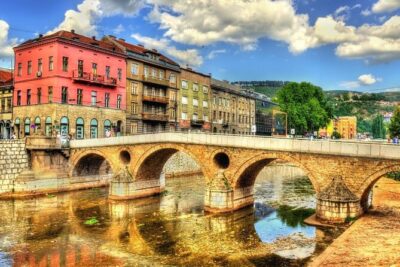
Private Walking Tour, Food Tasting and Bosnian Coffee in Sarajevo
Read our review →
Delicious Sarajevo: Eat, Walk & Discover City Tour
Read our review →
PROFESSIONAL SARAJEVO WALKING TOUR – With guide who guided STING!
Read our review →
Sarajevo genuine walking tour: Steps through history
Read our review →
Browse the lists this tour appears in