
Reviewed · WALKING TOURS IN SARAJEVO
Crossroads of Cultures – Sarajevo Walking Tour
Sarajevo makes its story visible in a few city blocks. You can move from a Catholic cathedral to an Ottoman mosque, pass a Jewish site, cross an Austro-Hungarian square, and reach the bridge tied to the 1914 assassination that helped trigger the First World War. This crossroads of cultures tour gives you that quick, useful orientation in about two hours.
I like the compact route and the strong mix of sights. I also like the practical food advice at Bravadžiluk Street, where the guide can point you toward ćevapčići and burek. The main drawback is pace: fifteen stops in two hours means some places receive only five or ten minutes, and museum and City Hall entry fees are not included.
Key points to know before you book
- Four traditions in one short walk: Catholic, Jewish, Muslim, and Orthodox landmarks all appear on the route.
- Adnan is the guide name to know: He has led the tour in Spanish as well as English, with a warm and clear style described in the available feedback.
- The route is best for first-day orientation: You cover Sarajevo’s central historic area without transport between stops.
- Food advice is built in: Bravadžiluk Street is where you get suggestions for ćevapčići and burek.
- The group is capped at 15 people: That is small enough for a more personal walk, though the exact group size may vary.
- Budget $24.08 plus optional admissions: Museums, lunch, and some listed entry fees are extra.
Why Sarajevo rewards a walking tour
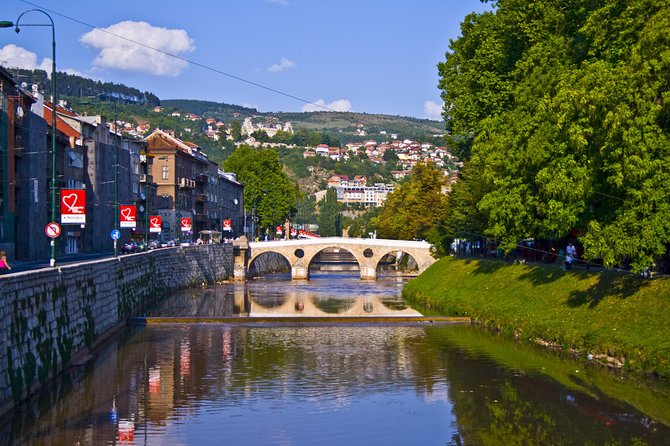
Sarajevo is not a city you understand from a single viewpoint. Its character comes from the close meeting of different faiths, empires, trades, and painful chapters. This walk places those layers side by side rather than treating them as separate museum subjects.
You start at Muvekita 7, in front of the Toureedoo office, at 10:30 a.m. The route ends back at the same meeting point. That makes the tour easy to fit into a first full day, and you can use the return to the center for lunch or another visit.
The tour is also a useful choice if you have only a short stay. It does not attempt to cover every part of Sarajevo. Instead, it keeps to the central area and links the sights with explanations from a local guide. That matters here, because a building’s appearance often tells only half the story.
More Walking Tours in Sarajevo
- Sarajevo: 2 Hours Old Town Walking Tour With Local Guide
★ 5.0 · 505 reviews - Private Walking Tour, Food Tasting and Bosnian Coffee in Sarajevo
★ 5.0 · 255 reviews - Sarajevo Grand Walking Tour
★ 5.0 · 232 reviews
From the Sacred Heart Cathedral to the Jewish Museum
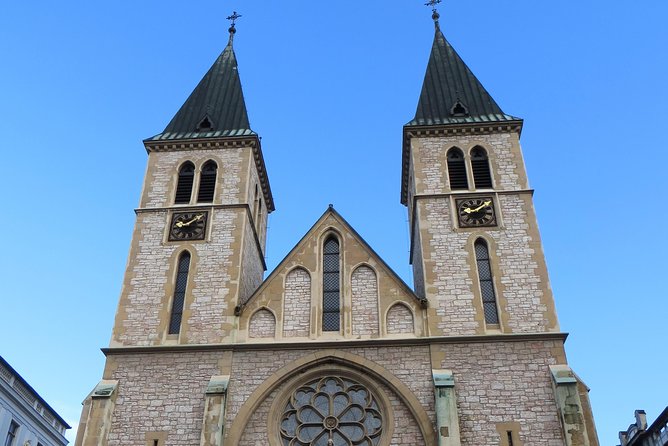
The first major stop is Katedrala Srca Isusova, the Sacred Heart Cathedral. You have about ten minutes here, enough for the guide to explain why this Catholic landmark belongs in a walk titled Crossroads of Cultures. The cathedral marks one part of Sarajevo’s religious mix and provides a clear contrast with the Ottoman sites later in the route.
Next comes the Jewish Museum of Bosnia and Herzegovina, with another ten-minute stop. The focus is the place where Sarajevo’s first Jewish temple was built. Admission is not included, so you should treat this as an exterior and history stop unless you choose to pay separately.
I appreciate the order. You begin with two places that make Sarajevo’s religious variety clear before reaching the central point called the Sarajevo Meeting of Culture. The schedule is short, so do not expect a long museum visit or time to study displays at length. This is a guided introduction, not a museum afternoon.
The line where East meets West
At the Sarajevo Meeting of Culture, you learn why the city is often described as a place where East meets West. The stop lasts about five minutes, but it gives the whole walk its organizing idea. Sarajevo’s center is compact enough for these cultural contrasts to appear within a short walk, not across separate districts.
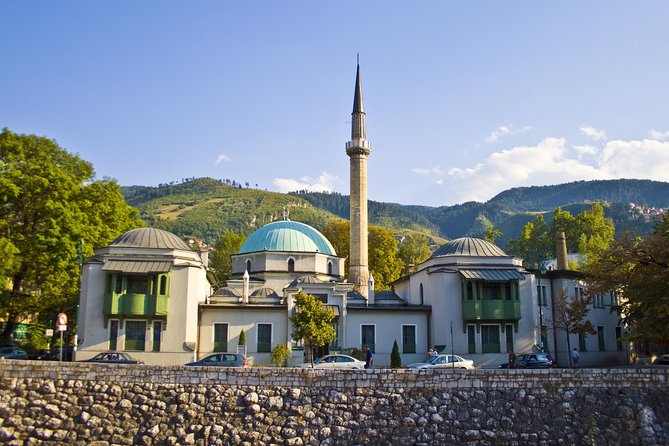
From there, the route moves into the Ottoman heart of the city. Gazi Husrev-beg Mosque receives ten minutes, and the guide explains its role as the central mosque in Bosnia and Herzegovina. Admission is listed as free, but you should still follow any visitor rules in place at the mosque, including respectful clothing and quiet behavior.
This is one of the places where a guide adds real value. A quick look at a mosque can leave you with only architectural impressions. A good explanation helps you understand its place in the city and why the surrounding streets developed as they did.
The Old Sarajevo Clock Tower follows for about five minutes. The tower may be a brief stop, but its importance is part of the city’s Ottoman-era identity. Five minutes is enough for an explanation and a look, but not for a long architectural inspection. Keep your expectations in line with the timetable.
Morica Han and the old trading streets
Morica Han is described as the only preserved han, or roadside inn, in Sarajevo. You have ten minutes here. That is a useful pause because a han helps explain the practical side of old Sarajevo: merchants needed places to stay, store goods, and conduct business as they moved through the city.
Admission is included at this stop. The visit also shifts the tour from major religious buildings to the commercial life that supported them. I find that balance helpful. Sarajevo’s past was not only about rulers and worship. It was also about coffee, crafts, trade, and food.
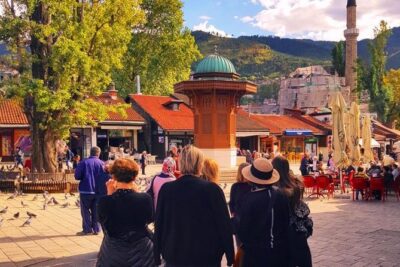
The Sebilj Fountain comes next, with five minutes at the landmark also known as Pigeon’s Square. This is one of the city’s most recognizable public places, and the fountain gives you a strong visual marker for the Ottoman quarter. The short stop works well for photos and orientation, though the square can feel like a quick pass rather than a place to linger.
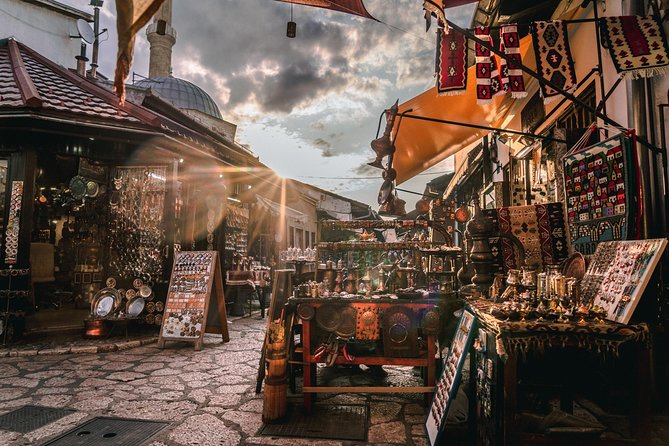
From Sebilj, you continue to Kazandžiluk, the old coppersmiths’ street. The guide explains Sarajevo’s traditional crafts and the way Bosnian coffee is made. This ten-minute stop is among the more distinctive parts of the route because it connects the city’s past to things you can still see in the street today.
If you enjoy food and craft traditions, pay close attention here. The coffee explanation is not just a generic tasting note. It gives you a reason to notice the small details of the old market area when you return on your own.
Same base, a completely different day out:
- Sarajevo: Mostar, Konjic, Blagaj Tekke, Pocitelj & Waterfall
★ 4.9 · 1,335 reviews - Fall of Yugoslavia, Sarajevo War Tour with Tunnel of Hope Museum and Frontlines
★ 5.0 · 1,314 reviews - Sarajevo: Mostar, Konjic, Sufi House, Pocitelj & Kravice Falls
★ 5.0 · 1,179 reviews - ROSES OF SARAJEVO (Official WAR + CITY tour)- Story of a Survivor
★ 5.0 · 770 reviews
A practical food stop on Bravadžiluk Street
Bravadžiluk Street receives about five minutes, with recommendations for the best places to try ćevapčići and burek. Lunch is not included, so this advice is especially useful. You can take the suggestions and return after the walk, or plan a meal in the area once the tour finishes.
The short stop does not include a meal according to the tour details. Think of it as a food briefing, not a tasting session. That distinction matters when you compare this experience with a dedicated food tour.
Still, I like having food guidance built into a city walk. Ćevapčići and burek are central to the experience of eating in Sarajevo, and a local recommendation can save you from choosing at random in a busy market quarter. You get the advice early enough to make a lunch plan.
Sarajevo City Hall and the weight of 1914
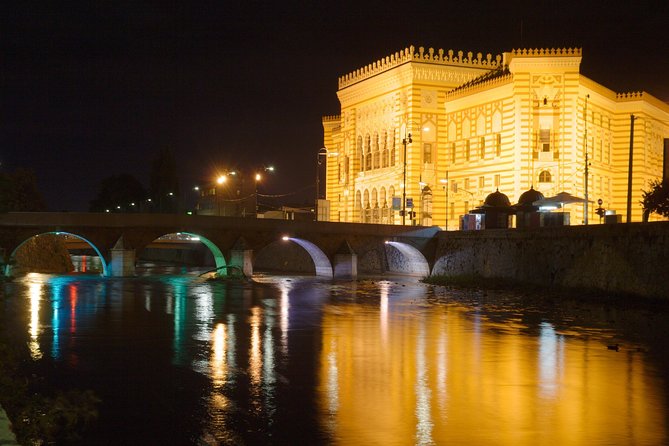
The tour then turns toward Sarajevo City Hall, one of the most striking buildings from the Austro-Hungarian period. You have ten minutes outside or around the building, while entry is not included. If you want to go inside, budget separately for admission and allow more time than the walking schedule provides.
This stop adds another layer to the city. After the Ottoman streets, City Hall shows the architectural and political mark of Austro-Hungarian rule. The value is not simply the building’s appearance. It helps you see how quickly Sarajevo’s public face changed as different powers shaped the city.
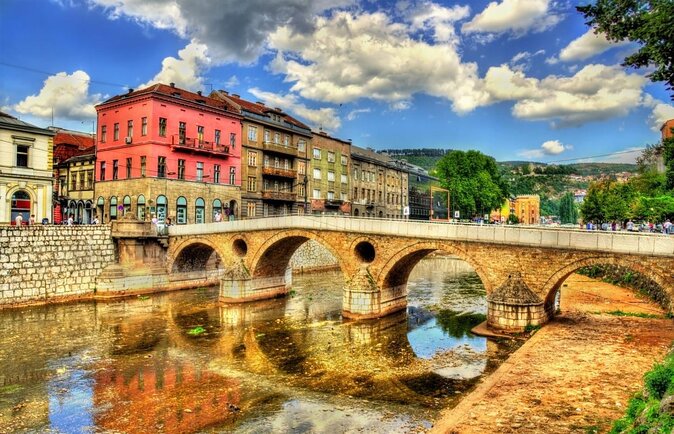
Latin Bridge follows, with twenty minutes, the longest stop on the route. Here the guide explains the Sarajevo Assassination of 1914, the event that shook Europe and helped set the First World War in motion. The extra time is sensible. This subject needs more than a quick sentence beside a bridge.
I would pay close attention to the explanation here, because the stop is not just a photo opportunity. The bridge is a physical place tied to a world event, but the surrounding context is what makes it meaningful. The tour gives you enough time to connect the location with the wider political crisis.
Orthodox Sarajevo, Markale Market, and the Eternal Flame
The Serbian Orthodox Cathedral is next, with about five minutes. The guide explains the main Orthodox church in Sarajevo. Entry is not included, so the stop is primarily a guided look at the building and its role in the city.
Again, the brief timing fits the overall goal. You are not visiting each religious site for an extended interior tour. You are comparing them as parts of one urban story. The cathedral follows the mosque, cathedral, and Jewish site, reinforcing the point that several faith communities shaped Sarajevo’s center.
Pijaca Markale, the city market, receives ten minutes. It is a practical place where you can see the everyday side of Sarajevo, with fruit, vegetables, and meat products sold in a central market setting. This is a useful change of rhythm after the formal landmarks.
The market also carries wartime associations, though the provided route description focuses on its role as a place to buy food. If your guide expands on its past, listen carefully. The tour’s strength is the way it moves from broad history into ordinary city life.
The final sight is the Eternal Flame, a five-minute stop at the monument dedicated to the fighters of the Second World War. It closes the walk with a twentieth-century memorial rather than an older building. That gives the route a broad time span, from Ottoman Sarajevo to the Austro-Hungarian era, the First World War, and the Second World War.
After the Eternal Flame, the activity ends back at the Muvekita 7 meeting point. You are left in the center, close to the areas covered earlier in the walk.
What the guide adds to the experience
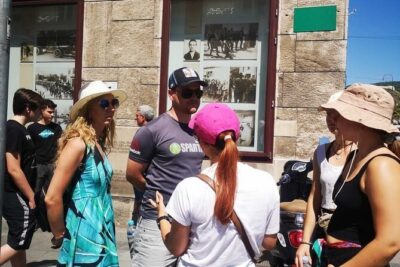
The tour includes a guide, and the available information identifies Adnan as the guide praised most often for this experience. His strengths are described as friendly, clear, and well informed, with particular praise for explaining Sarajevo’s culture, history, and present-day life in an approachable way.
Adnan has also led Spanish-language tours, and several past visitors specifically valued his Spanish. The current tour is offered in English, so you should book this version if English is the language you need. The Spanish feedback is still useful because it shows that the guide has worked with international groups and can explain the city across language and cultural barriers.
A Bosnian coffee welcome has also been part of some past visits, including coffee offered by Adnan’s mother before the walk. It is a memorable local touch, but it is not listed as an included feature, so you should not book expecting it as a guaranteed part of the experience.
The group maximum is 15 people. That is a reasonable size for a central walking tour. It should allow you to hear the guide more easily than on a large coach-style outing, while still giving the tour enough energy for a social group.
Is $24.08 a fair price?
At $24.08 per person, the price is fair if you want a guided introduction to central Sarajevo rather than a series of long indoor visits. The fee covers the guide, the route, and the explanations that connect fifteen stops into one story.
The value is strongest on a first visit. You get a useful map of the center, learn where the main Ottoman streets begin, see the key religious buildings, and receive food suggestions for later. You can then return to the places that deserve more time.
The price does not cover museum entrance, City Hall admission, or lunch. The Jewish Museum and City Hall are specifically listed with admission not included, while the mosque, clock tower, Sebilj Fountain, and several other stops are listed as free or included. Set aside extra money if you want to enter paid sites.
The two-hour length also keeps the cost sensible. You are not paying for a full-day excursion with transport, but you are getting more structure than a simple stroll. If you prefer slow photography, long museum visits, or extended café time, this will feel brisk.
Timing, comfort, and who should book
The start time is 10:30 a.m. That gives you a manageable morning start and places the walk before lunch, which fits the food recommendations at Bravadžiluk Street. The tour requires good weather, so have a flexible plan if rain or other poor conditions could affect the date.
Most people can participate, and service animals are allowed. The tour is near public transportation, though no specific transit route is provided. You should wear comfortable walking shoes and bring weather protection, since this is an outdoor city walk with several short stops.
I would recommend it for:
- A first visit to Sarajevo
- Anyone with only a short stay
- People who want religious and political history in one route
- Visitors interested in Ottoman crafts, coffee, and local food
- Small groups or solo visitors who want a guide without booking a private tour
I would think twice if you need long interior visits, a meal included in the price, or a slower pace. The itinerary has fifteen stops, and several last only five minutes.
You receive confirmation when booking. Free cancellation is available up to 24 hours before the 10:30 a.m. start time for a full refund. Changes or cancellations inside that window are not accepted, and a poor-weather or minimum-group cancellation offers either another date or a full refund.
Should you book Crossroads of Cultures?
Book this walking tour if you want Sarajevo’s main story explained in a compact, human-scale route. The mix is unusually strong: a Catholic cathedral, Jewish site, Ottoman mosque and han, old craft streets, Austro-Hungarian City Hall, Latin Bridge, Orthodox cathedral, market, and wartime memorial.
The best reason to choose it is the connection between the stops. You are not simply collecting photographs. You are learning how Sarajevo’s faiths, empires, trades, food, and twentieth-century conflicts meet in the same small center.
At $24.08, it is a sensible orientation tour, especially when led by Adnan. Just remember that two hours moves quickly, some admissions cost extra, and lunch is not part of the deal. Use the walk to get your bearings, then return to the places that catch your interest.
FAQ
Where does the Sarajevo walking tour start?
The tour starts in front of the Toureedoo office at Muvekita 7, Sarajevo 71000, Bosnia and Herzegovina.
What time does the tour begin?
The tour starts at 10:30 a.m.
How long does the walking tour last?
The experience lasts approximately two hours.
What language is the tour offered in?
The tour is offered in English.
Does the tour include entrance fees?
The tour includes a guide, but museum entrance fees and some other admissions are not included. Lunch is also not included.
Where does the tour finish?
The activity ends back at the meeting point on Muvekita 7.
What happens if the weather is poor?
The experience requires good weather. If it is canceled because of poor weather, you will be offered a different date or a full refund.
Just added around Sarajevo
- Strbacki Buk and Una Waterfalls: Day Trip from Sarajevo★ 5.0 · 3 reviews
- Bosnian Kingdom Capitals: Travnik & Jajce Tour from Sarajevo★ 5.0 · 3 reviews
- Walking Tour in Sarajevo★ 5.0 · 3 reviews
- MTB Bjelasnica – Lukomir★ 5.0 · 3 reviews
- Sarajevo Under Siege: A City’s Struggle & Survival Tour★ 5.0 · 3 reviews
- Herzegovina Tour from Sarajevo: Mostar, Počitelj, Blagaj, Kravice★ 5.0 · 3 reviews
- Travnik, Jajce, Pliva Lakes & Mills –Medieval & Ottoman Bosnia Full Day Tour★ 5.0 · 3 reviews
- Tour of Herzegovina – From Sarajevo★ 5.0 · 3 reviews
Walking Tours in Sarajevo, compared.
Sarajevo: 2 Hours Old Town Walking Tour With Local Guide
Read our review →
Private Walking Tour, Food Tasting and Bosnian Coffee in Sarajevo
Read our review →
Delicious Sarajevo: Eat, Walk & Discover City Tour
Read our review →
PROFESSIONAL SARAJEVO WALKING TOUR – With guide who guided STING!
Read our review →
Sarajevo genuine walking tour: Steps through history
Read our review →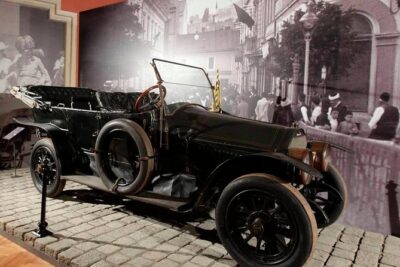
Browse the lists this tour appears in