
Reviewed · SARAJEVO TOURS
SARAJEVO CONCEPTUAL ART TOUR (galleries, art and arhitecture)
Sarajevo’s art scene does not sit apart from the city’s past. It grows out of it. On this small-group tour, you move from contemporary galleries to shell-scarred pavement, a memorial to Srebrenica, and a bridge that has become a piece of public art. It is a thoughtful way to see Sarajevo beyond its old-town postcard views.
I like the mix of artists and difficult history, and I like that you get help finding places you could easily miss on your own. Guide Mak is singled out for sharing personal wartime experiences and answering questions. The main consideration is pace: two to three hours is enough for an introduction, not a full study of Sarajevo’s art world.
Key points at a glance
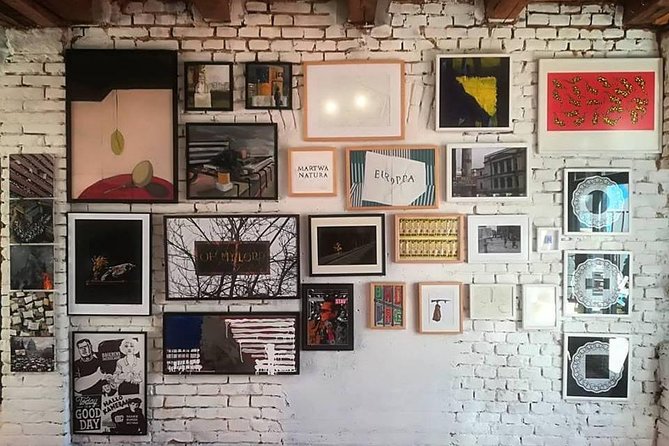
- Brodac Gallery occupies a former Austro-Hungarian prison, now used for changing contemporary Bosnian exhibitions and local craft beer.
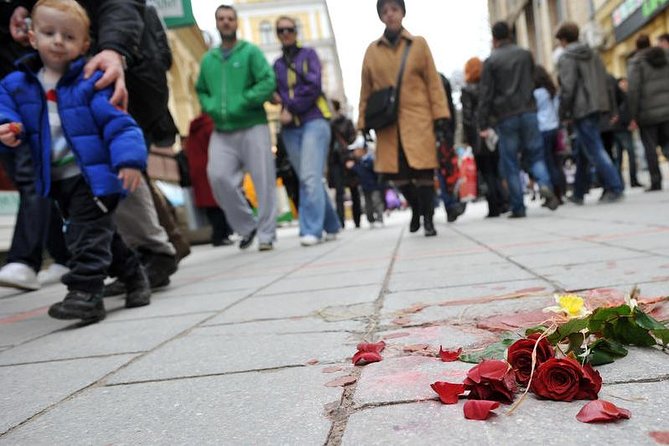
- Sarajevo Roses make the Siege of Sarajevo visible underfoot, turning mortar scars into red-filled memorials.
- Java Gallery supports Bosnian and international artists in a central exhibit space on Titova Street.
- The Srebrenica memorial in Veliki Park is emotionally demanding, using concrete, metal bars, plastic, and silicone to recall a painful image.
- A cafe break at Gallery BORIS SMOJO gives the route a pause before you see the Festina Lente bridge.
- The group is capped at 15, and the $33.64 price includes gallery admission and a guide in English.
Why this Sarajevo art walk feels different
Many city tours in Sarajevo focus on Ottoman streets, Austro-Hungarian buildings, and the bullet marks left by the 1990s war. This one uses art to connect those subjects. You see works in galleries, but you also read the city itself as an artwork of sorts, with memorials and public structures carrying their own meaning.
That approach suits you if you want context instead of a quick list of buildings. The guide can explain not only what a work represents, but also how it fits into Sarajevo today. If Mak leads your tour, you may also hear personal memories of the war, something a map or museum label cannot provide.
The tour is offered in English and begins at 1 pm from Đulagina 2. The route ends in the Skenderija area, so you finish in a different part of central Sarajevo rather than returning to the starting point. That is useful if you plan to continue sightseeing nearby.
More museums in Sarajevo:
- Fall of Yugoslavia, Sarajevo War Tour with Tunnel of Hope Museum and Frontlines
★ 5.0 · 1,314 reviews - Tunnel Museum: Bosnian & Yugoslav Wars Tour with War Veteran
★ 5.0 · 551 reviews - Tunnel of Hope Museum Tour
★ 5.0 · 38 reviews
Brodac Gallery: art inside an old prison
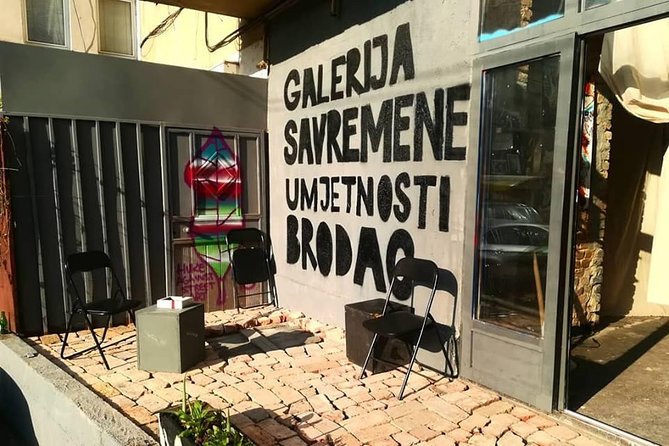
The first stop is Brodac Gallery, set in an old building with a strong story of its own. During the Austro-Hungarian occupation, the building served as a prison. Now it is a cozy venue for contemporary Bosnian exhibitions.
That contrast is part of the appeal. You are not entering a grand national museum with polished displays and long explanatory panels. You are seeing current art in a modest space whose walls carry an older and less comfortable memory. Exhibitions change, so the exact works on view will depend on your date.
Admission is included, and the planned visit lasts about 45 minutes. That gives you time to look at the exhibition and discuss it with the guide instead of making a hurried stop. The gallery also serves Gelender, a local craft beer. It is a small but welcome detail, especially if you appreciate places that combine art with ordinary city life.
The drawback is that a changing gallery cannot promise a particular artist or style. If you need a fixed collection, Brodac may feel unpredictable. If you like seeing what is current, that uncertainty is part of the point.
Ferhadija Street and the Sarajevo Roses
From the gallery, the tour reaches Ferhadija, one of Sarajevo’s central pedestrian streets. It runs between the Vječna Vatra area and Gazi Husrev-Begova Street, then continues east as Sarači Street.
The important detail here is under your feet. Along the route, you see Sarajevo Roses, concrete scars made by mortar explosions during the Siege of Sarajevo and later filled with red resin. The impact patterns spread outward in shapes that can look almost floral. The red color turns a mark of destruction into a memorial.
This is a powerful example of public art because it does not require a museum entrance. The city’s pavement carries the evidence. You can pass over it without noticing, which is exactly why a guide matters. The tour gives these marks a name and a setting, linking them to Sarajevo’s years of urban warfare and the thousands of shell explosions that hit the city.
Expect this portion to take about 30 minutes. It is not a long formal lecture, but the subject is heavy. The Roses are simple to see and difficult to absorb. Give yourself time to look closely rather than treating them as another photo stop.
Ferhadija also helps connect Sarajevo’s different architectural periods. The street leads through the central city, where the route moves between older structures, commercial spaces, and public squares. The tour is not presented as a full architecture survey, but the setting adds useful visual context to the art.
Java Gallery and Sarajevo’s current art scene
Java Gallery, at Titova 21, is the longest gallery visit on the route, with about an hour planned. Its central location makes it an easy place to include in a city walk, but its purpose matters more than its address.
Java works to support and promote artists from Bosnia and Herzegovina as well as artists from other countries. It presents work in several artistic mediums, giving you a wider view of current contemporary practice than a single-theme gallery might offer.
I like this stop because it shifts the tour away from memorials and toward the living art scene. Sarajevo is not only a city where history happened. It is also a city where artists continue to make work, question public life, and respond to the world around them.
The hour-long visit should give you time to compare works and ask questions. Use that time. Ask the guide what makes the gallery important locally, how the artists relate to Sarajevo, or what to look for in a piece that may not explain itself at first glance.
Because the exhibitions change, the experience will vary. Some displays may speak to you right away. Others may seem spare or hard to read. That is normal with conceptual art, and a guide can help you approach it without pretending every piece has one obvious answer.
A few more Sarajevo day trips to weigh up
- Sarajevo: Mostar, Konjic, Blagaj Tekke, Pocitelj & Waterfall
★ 4.9 · 1,335 reviews - Sarajevo: Mostar, Konjic, Sufi House, Pocitelj & Kravice Falls
★ 5.0 · 1,179 reviews - ROSES OF SARAJEVO (Official WAR + CITY tour)- Story of a Survivor
★ 5.0 · 770 reviews - Sarajevo: Mostar, Konjic, Počitelj, Sufi House, & Waterfalls
★ 4.9 · 572 reviews
Veliki Park and the Srebrenica memorial
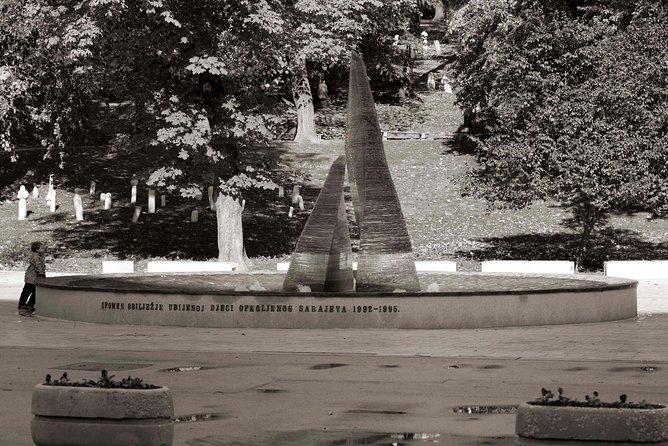
The route then reaches Veliki Park, one of Sarajevo’s best-known parks. Here you see Nermine, dođi, a sculpture by Bosnian artist and sculptor Mensud Kečo.
The work is dedicated to the genocide in Srebrenica. It uses concrete, reinforcement bars, plastic, and silicone to represent the most distressing documented photograph from Srebrenica, according to the artist’s description of the piece.
This is not a light sightseeing stop. The materials are rough and exposed, and the subject demands care. The sculpture shows how contemporary art can carry testimony when ordinary words feel too small. You do not need a specialist background in art to understand the human weight of the work.
The visit lasts about 30 minutes and admission is free. The park setting also changes how you encounter the sculpture. It is not sealed away in a gallery, separated from daily life. It shares space with a public park, which makes the memorial part of the city rather than a distant historical display.
You should be prepared for the emotional shift. The tour moves from beer and gallery rooms to wartime scars and genocide memorialization. That range is one of its strengths, but it also means this is not a casual art outing in the usual sense.
Gallery BORIS SMOJO and the Festina Lente bridge
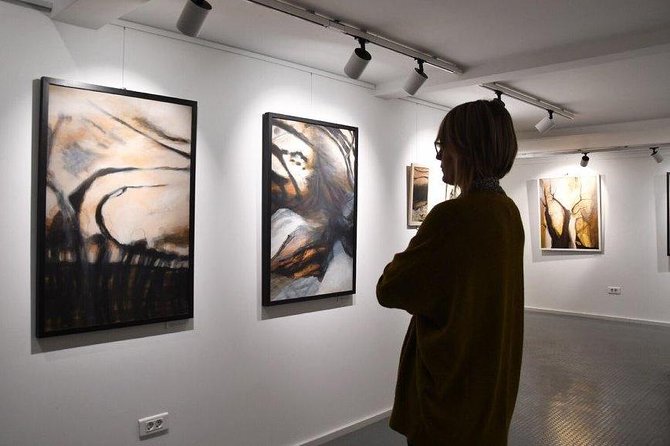
The final section takes you toward Skenderija. You stop for a cafe break at Gallery BORIS SMOJO, then go on to see the Festina Lente bridge.
The break matters because the tour asks you to process a lot in a short period. A pause at a gallery gives you time to reset before the final sight. The available information does not specify the drink or whether it is included, so plan to treat it as a break rather than a promised food or beverage service.
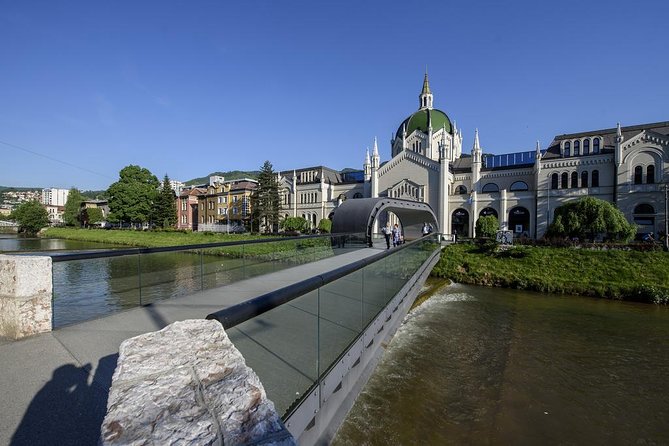
Festina Lente means make haste slowly, an apt name for a curved pedestrian bridge that has become one of Sarajevo’s recognizable modern structures. The bridge adds architecture to a route that has mainly focused on galleries and memorials. It also gives the tour a more open, public ending after the enclosed gallery visits.
The stop is scheduled for about 30 minutes, and the tour ends in Skenderija. If you want photographs of the bridge, this is a good point to have your phone ready. The tour’s purpose is not to provide a long engineering talk, so expect a focused look rather than a technical architecture lesson.
What you get for $33.64
At $33.64 per person, the price is fair if you want a guide to connect several central sites in one afternoon. You are paying for an English-language guide, a small group, included admission at Brodac and Java, and a route that saves you the trouble of locating each gallery.
The value is less about the ticket price of any one gallery. It comes from the connections. A gallery visit alone shows you an exhibition. A Sarajevo Rose alone may look like an unusual mark in the pavement. Together, with explanation, they form a clearer picture of how art, memory, and city life overlap here.
A maximum of 15 people keeps the group from becoming unwieldy, though it is not a private tour. If you want long one-on-one conversations with the guide, a smaller group would be better. For most people, this size offers a reasonable balance between personal attention and cost.
Free cancellation is available if you cancel at least 24 hours before the 1 pm start time. Changes or cancellations made inside that window are not refunded. The tour also requires a minimum number of participants, so a cancellation by the provider can lead to another date, another experience, or a full refund.
Who should book this tour
I would choose this tour if you have already seen some of Sarajevo’s main historic sights and want a different angle. It also works well early in a visit if you want a guide to point out places you could return to later.
This is a good match for you if:
- You enjoy contemporary or conceptual art, even when it takes some thought.
- You want to understand Sarajevo’s war memorials in their city setting.
- You prefer a guided route over planning several galleries yourself.
- You are comfortable discussing painful subjects such as the Siege of Sarajevo and Srebrenica.
- You like meeting local artists or visiting creative spaces that are not standard museum stops.
I would be more cautious if you want a relaxed cafe walk with only cheerful sights. The Sarajevo Roses and Srebrenica sculpture are central parts of the experience, not brief background details. You should also expect the art on display to change, so do not book this expecting one specific exhibition.
Most travelers can participate, and the meeting point is near public transportation. The supplied details do not give a full accessibility description, so ask the provider directly if you have specific mobility needs. The route includes a pedestrian street, galleries, a park, and a bridge, with the final point at Skenderija.
A useful afternoon plan
The 1 pm start gives you a practical middle-of-the-day option. You can spend the morning exploring Sarajevo’s older quarters, then use the art tour to see a different side of the center.
Wear comfortable shoes and leave room in your schedule after the tour. The route lasts about two to three hours, but the exact timing may depend on gallery visits and discussion. Since you end at Skenderija, you can continue from there rather than doubling back to Đulagina 2.
Bring questions. Ask about the artists, the buildings, the war memories connected to the city, and the meaning of the memorials. The experience gains much of its value through conversation, especially if Mak is your guide. One personal account describes him as generous with his time and able to share both history and his own wartime experiences. He also wrote a book and gave a copy to that participant, but that should be treated as a personal possibility, not a scheduled part of the tour.
Should you book it?
Book this tour if you want Sarajevo presented through contemporary art, architecture, and memory, not only through famous old buildings. The route is compact, the group limit is reasonable, and the included gallery visits make the price easier to justify.
Skip it if your main goal is a broad introduction to every major Sarajevo sight, or if you prefer art that comes with simple explanations and a fixed collection. For the right visitor, this is a focused and serious afternoon that reveals how Sarajevo’s creative life responds to its past while continuing in the present.
FAQ
How long does the Sarajevo Conceptual Art Tour last?
The tour lasts approximately two to three hours. The listed visits range from 30 minutes to one hour, depending on the stop.
Where does the tour start?
It starts at Đulagina 2, Sarajevo 71000, Bosnia and Herzegovina. The start time is 1 pm.
Where does the tour end?
The tour ends in the Skenderija area of Sarajevo, at Skenderija 71000.
Is the tour offered in English?
Yes. The tour is offered in English.
What is the maximum group size?
The tour has a maximum of 15 participants.
What is included in the tour?
Admission is included for Brodac Gallery, Java Gallery, and the stop at Gallery BORIS SMOJO. The route also includes free-to-enter public sites such as Ferhadija Street and Veliki Park. The details do not state that drinks at the cafe break are included.
Just added around Sarajevo
- Strbacki Buk and Una Waterfalls: Day Trip from Sarajevo★ 5.0 · 3 reviews
- Bosnian Kingdom Capitals: Travnik & Jajce Tour from Sarajevo★ 5.0 · 3 reviews
- Walking Tour in Sarajevo★ 5.0 · 3 reviews
- MTB Bjelasnica – Lukomir★ 5.0 · 3 reviews
- Sarajevo Under Siege: A City’s Struggle & Survival Tour★ 5.0 · 3 reviews
- Herzegovina Tour from Sarajevo: Mostar, Počitelj, Blagaj, Kravice★ 5.0 · 3 reviews
- Travnik, Jajce, Pliva Lakes & Mills –Medieval & Ottoman Bosnia Full Day Tour★ 5.0 · 3 reviews
- Tour of Herzegovina – From Sarajevo★ 5.0 · 3 reviews
Sarajevo Tours, compared.
Sarajevo: Mostar, Konjic, Blagaj Tekke, Pocitelj & Waterfall
Read our review →
Fall of Yugoslavia, Sarajevo War Tour with Tunnel of Hope Museum and Frontlines
Read our review →
Sarajevo: Mostar, Konjic, Sufi House, Pocitelj & Kravice Falls
Read our review →
Sarajevo: 2 Hours Old Town Walking Tour With Local Guide
Read our review →
Sarajevo: Mostar, Konjic, Dervish House, Pocitelj & Kravica Falls
Read our review →
From Sarajevo: Srebrenica Genocide Memorial Study Tour
Read our review →
Mostar,Kravica Waterfall,Blagaj,Počitelj – Day Tour from Sarajevo
Read our review →
Sarajevo War Tour: A Veteran’s Story of the Siege (fees included)
Read our review →Browse the lists this tour appears in