
Reviewed · HISTORICAL TOURS IN SARAJEVO
SARAJEVO STREET ART TOUR (art, history & mystery) – sARTajevo!
Sarajevo’s street art is not just decoration. On this evening walk, murals become clues to the city’s wars, grief, humor, artists, and changing daily life. You’ll visit works that are easy to miss, including the Srebrenica 1992/1995 mural and the blue flowers that may have you scanning walls long after the tour ends.
I like the small maximum of five people, which gives the guide room to explain details and answer questions. I also like the direct connection to local artists, since guides such as Alan, Ado, and Mak have been linked with the city’s street-art scene, and Alan includes his own work along the route.
The main consideration is scope. This is a focused introduction rather than a full survey of every piece in Sarajevo. The route and discussion could use a more clearly developed structure, and some visitors may want more artworks. Still, at about two to three hours and $30.04, it offers a personal way to see the city beyond its usual sights.
Key points for your Sarajevo street art walk
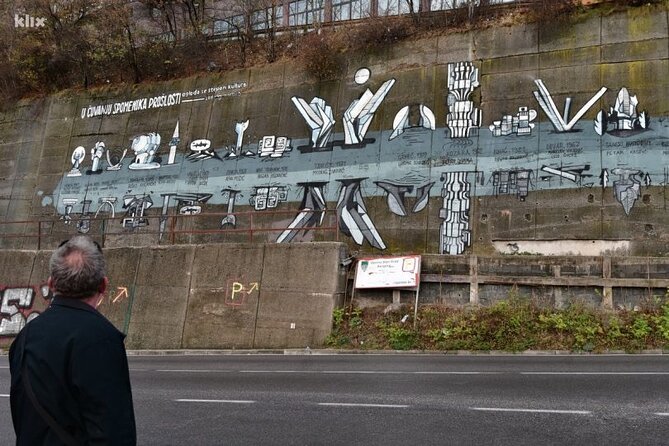
- Bentbaša opens the story: Begin with the mural In the preservation of monuments of the past and learn how public art can carry memory.
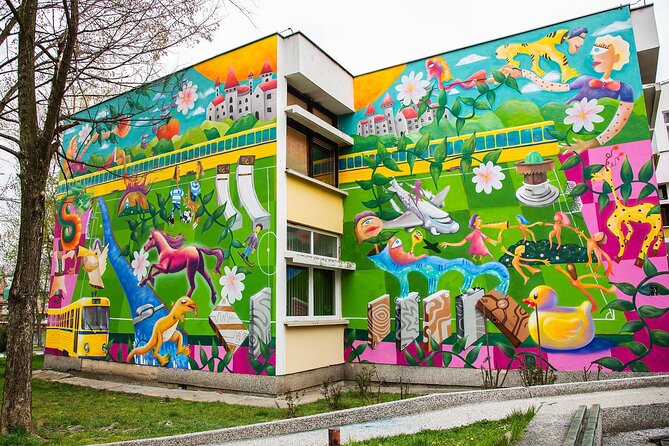
- Papagajka connects art and place: Visit the building known as Copy Papagajka, linked with Sarajevo’s first street-art festival.
- The Academy of Fine Arts adds architecture: Use one of Sarajevo’s best-designed buildings as a setting for history, stickers, and formal art.
- Ferhadija brings difficult history into view: See the Srebrenica 1992/1995 mural behind the pedestrian street.
- The tiny group matters: With no more than five people, you get a more conversational walk than a large city tour.
- The evening start suits Sarajevo: The tour begins at 6:00 p.m. and returns to its meeting point at Đulagina 2.
Why Sarajevo’s walls tell more than a city map
Many city walks take you to Sarajevo’s major religious buildings, markets, bridges, and war sites. This one asks you to look slightly higher, lower, and to the side. A sticker on a sign, a painted figure on a wall, or a mural tucked behind a busy street can reveal how people express ideas outside museums and official monuments.
That makes the tour useful even if you do not usually seek out street art. You do not need an art background to follow it. The guide explains the works in plain terms and places them in the story of Sarajevo, so you can see how public images relate to the city’s past and its present-day culture.
I especially like this approach because it does not treat art as a separate attraction. The works are part of ordinary streets where people live, shop, meet, and pass through. You get a look at Sarajevo as a working city rather than only as a historic setting.
The tour has also earned a 4.9 rating from 18 published ratings, with 94 percent of participants recommending it. That is a strong signal for a small experience, though the limited number of ratings means you should still match the tour to your interests. If you want a formal gallery visit or a long list of famous artists, this may feel modest. If you want context and conversation, it is a better fit.
More Historical Tours in Sarajevo
- East Bosnia & West Serbia UNESCO heritage day tour from Sarajevo
★ 5.0 · 55 reviews - Sarajevo Full Day Tour: History, Culture, Nature, War & Olympics
★ 5.0 · 27 reviews - Sarajevo genuine walking tour: Steps through history
★ 5.0 · 22 reviews
Bentbaša and the first mural, about 20 minutes
The route begins at Đulagina 2 and heads to Bentbaša. The first featured work is the mural In the preservation of monuments of the past. This gives the walk a clear starting idea: art can preserve memory, not only decorate a surface.
At this stop, your guide explains the mural in detail. That matters because street art often disappears into its surroundings. A quick look may show you colors and shapes, but the guide helps you consider why the work is there and what it says about Sarajevo.
Bentbaša is also a useful opening point because it moves you away from the most predictable center-city checklist. You start by paying attention to a specific work, then carry that habit through the rest of the walk.
The stop lasts about 20 minutes and has no admission fee. Since the tour is on foot and the exact condition of outdoor art can change, you should expect the experience to depend partly on what is visible on the day. The listed works give the route its structure, but street art is never as fixed as a museum collection.
Papagajka and Sarajevo’s first street-art festival
The second stop is the art building called Copy Papagajka, also identified as Perrot. This is not simply another wall with paint on it. The building is connected with Sarajevo’s first street-art festival, giving you a chance to hear how the local scene developed.
You will see examples of wall art here while the guide explains the place and its role. I find that combination more useful than a stop that only points out a finished mural. You get both the artwork and a little sense of the people, events, and spaces that helped public art take root.
The 20-minute visit keeps the pace moving. You are not asked to spend an hour studying one facade, but you have enough time to ask questions and compare different approaches to wall art.
The drawback is that the experience may depend on how much of the original work remains visible. Outdoor art changes. Pieces can fade, be covered, or be altered. You should book this for the guide’s interpretation as well as for the exact appearance of every wall.
The Academy of Fine Arts, architecture and sticker art
The Academy of Fine Arts is the longest listed stop, at about 30 minutes. It is described as one of Sarajevo’s most beautifully designed objects, so this part of the route broadens the subject beyond graffiti and murals.
Here, you can connect Sarajevo’s architectural identity with its newer street-art language. The guide also demonstrates and explains sticker art, a form that is easy to overlook because it is smaller and often placed on everyday surfaces.
That detail makes this a good stop for anyone who assumes street art means only large painted walls. Stickers can be quick, portable, playful, political, or personal. They also show how artists use the city in different ways.
I would give this section your full attention. Large murals announce themselves, but sticker art rewards close observation. If you are taking photographs, look at the smaller areas around the main building as well as the building itself.
This stop also helps balance the tour. You are not simply moving from one painted wall to another. You are considering how formal design, public space, and informal art meet in the same city.
Same base, a completely different day out:
- Sarajevo: Mostar, Konjic, Blagaj Tekke, Pocitelj & Waterfall
★ 4.9 · 1,335 reviews - Fall of Yugoslavia, Sarajevo War Tour with Tunnel of Hope Museum and Frontlines
★ 5.0 · 1,314 reviews - Sarajevo: Mostar, Konjic, Sufi House, Pocitelj & Kravice Falls
★ 5.0 · 1,179 reviews - ROSES OF SARAJEVO (Official WAR + CITY tour)- Story of a Survivor
★ 5.0 · 770 reviews
Aria, Mr. Chat, the Singer, and Gallery Boris Smoje
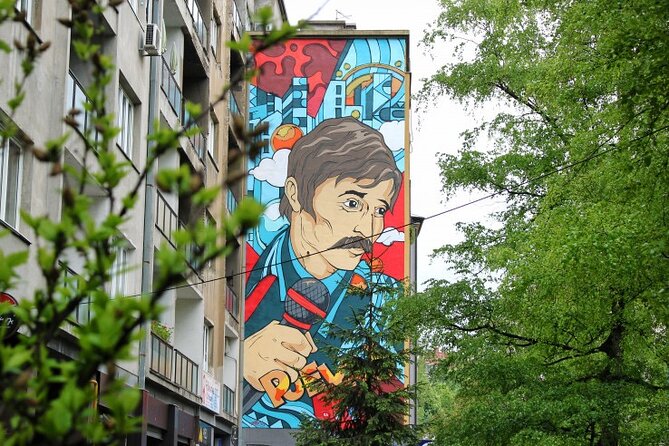
The Aria stop lasts about 20 minutes and brings together several different references: Mr. Chat, the mural Singer, also known as Pjevač, and Gallery Boris Smoje.
The value here is variety. You will encounter more than one idea of what street art can be, and the guide explains the works rather than leaving you to guess at their meaning. This is where a small group is especially helpful. With a maximum of five people, you can pause without the awkwardness of holding up a crowd.
The presence of a gallery in this section also suggests a link between street-based work and more conventional art spaces. Sarajevo’s art life is not split neatly into public walls on one side and galleries on the other. The route lets you consider how those worlds overlap.
You should not expect every stop to have the same visual impact. Some works will appeal to you more than others, and part of the point is learning how to read pieces that may not fit your personal taste. The guide’s explanation is central here.
Ferhadija and the Srebrenica mural
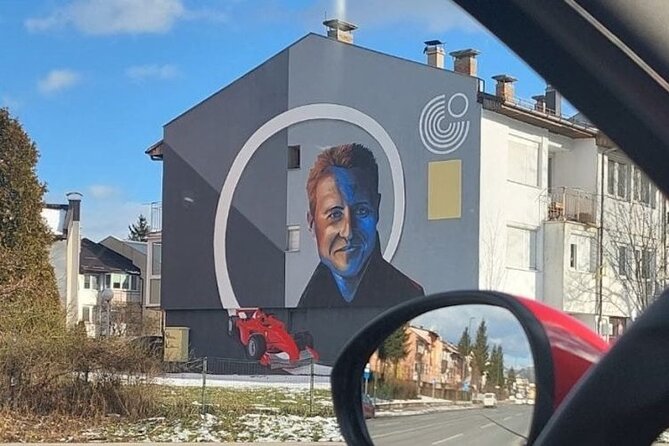
The final listed stop is behind Ferhadija Pedestrian Street, where you see the mural Srebrenica 1992/1995. The route also introduces you to the wider graffiti scene around the street.
This is the most emotionally serious point on the walk. The mural links public art with remembrance of one of the darkest periods in Bosnia and Herzegovina’s recent past. You should expect the discussion to carry more weight here than at the stops focused on style, festivals, or stickers.
That does not mean the tour becomes a formal war-history lecture. Instead, the artwork provides a way to discuss how memory appears in public space. For many people, this is the point where the connection between Sarajevo’s history and its modern art becomes clearest.
The location behind a busy pedestrian street is significant in practical terms. You can see how a work dealing with painful history exists close to ordinary shopping and social life. Sarajevo does not place all its difficult memories behind museum doors.
After this stop, the activity returns to the meeting point. The total walk lasts roughly two to three hours, depending on the pace and discussion.
What the guides add to the walk
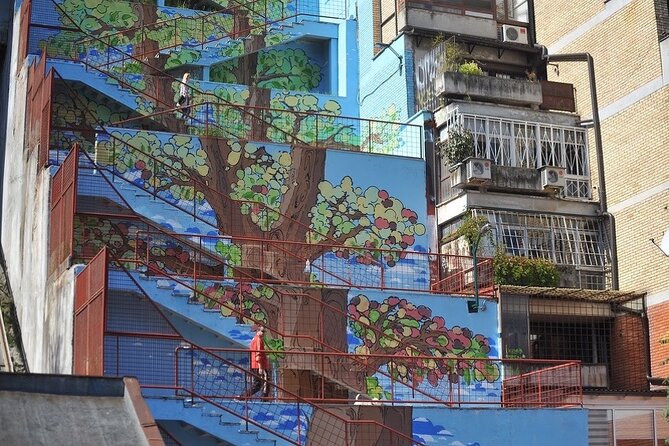
The guide is the main reason to choose this experience instead of making your own street-art route. Public art is easy to find in fragments, but much harder to understand without local context.
The guide names connected with past departures include Alan, Ado, and Mak. Alan is described as an artist who shows some of his own work during the walk. Ado is noted for clear English and strong knowledge of Sarajevo. Mak is connected with the local works and the people who made them.
Because the provider is Art and Tours Sarajevo, you should expect the experience to be led by someone familiar with the local scene. The exact guide is not specified in the booking details, so you should not assume that one particular person will lead every departure.
The most praised quality is the guide’s ability to explain art in relation to Sarajevo’s past and everyday life. That is especially helpful if you are not an art specialist. You can ask what you are seeing, why it matters, and how it fits the city without needing technical vocabulary.
English is the offered language. The activity is also limited to five people, which should make it easier to hear the explanations and speak directly with the guide.
Is $30.04 a fair price?
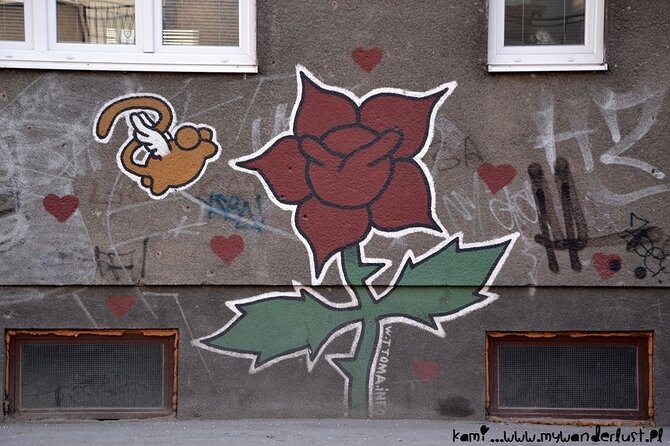
At $30.04 per person, this is not the cheapest way to spend an evening in Sarajevo. You can walk through the center on your own for nothing. The value comes from access to interpretation, local knowledge, and works you might otherwise pass without noticing.
The tour includes around two to three hours of guiding and five main areas, with no separate admission fees. You are paying for the conversation and route design rather than tickets.
I think the price is fair if you care about how a city expresses itself outside its major monuments. It is also good value for a solo visitor or couple who would struggle to find the same range of pieces and background independently.
The calculation changes if you want only a quick photo stop. In that case, you may find the price harder to justify. The tour asks you to listen, look closely, and think about the history behind the images.
Who should book this evening walk?
I would recommend it to you if:
- You want to see Sarajevo beyond its standard sightseeing route.
- You enjoy learning the story behind public art.
- You are new to street art and want a clear introduction.
- You are interested in how the city remembers war and loss.
- You prefer a small, conversational group.
- You want an English-language activity beginning at 6:00 p.m.
It is less suitable if you want a large collection of major murals, a purely artistic analysis, or a fast photo-focused walk. One published assessment found the tour informative and varied but felt the structure and range of content could be developed further. That is a fair caution.
You should also remember that the route features outdoor work. Art can change between visits, and the exact visual condition of a piece is not entirely within the guide’s control.
Practical details before you go
The meeting point is Đulagina 2, Sarajevo 71000. The tour starts at 6:00 p.m. and finishes back at the same meeting point.
You receive confirmation when you book. A mobile ticket is accepted, and the tour is offered in English. It is near public transportation, service animals are allowed, and most people can participate.
The group maximum is five people. That is one of the strongest practical features because it keeps the walk personal and makes questions easier.
Free cancellation is available if you cancel at least 24 hours before the local start time. Cancellations or changes made less than 24 hours before the start are not refunded or accepted. The activity also requires a minimum number of people, so if the provider cancels for that reason, you are offered another date or experience, or a full refund.
Should you book sARTajevo?
Book this tour if you want Sarajevo’s murals, stickers, and graffiti explained as part of the city’s life and memory. The strongest parts are the small group, the personal guide-led context, the Academy of Fine Arts, and the Srebrenica mural near Ferhadija.
Skip it if you want a broad, exhaustive catalogue of street art or prefer to explore walls silently on your own. For most visitors who have already seen Sarajevo’s main sights, this offers a useful second look at the city. You may leave with more than photographs. You may also start noticing the smaller marks on the walls that you once walked past.
FAQ
Where does the Sarajevo Street Art Tour start?
The tour starts at Đulagina 2, Sarajevo 71000, Bosnia and Herzegovina.
What time does the tour begin?
The start time is 6:00 p.m.
How long does the tour last?
The activity lasts approximately two to three hours.
Where does the tour finish?
The tour ends back at the meeting point.
What language is offered?
The tour is offered in English.
How many people can join?
The activity has a maximum of five participants.
What places are included on the route?
The listed stops are Bentbaša, Copy Papagajka, the Academy of Fine Arts, Aria, and Ferhadija Pedestrian Street.
Can I cancel for a full refund?
Yes. You must cancel at least 24 hours before the experience start time for a full refund. Cancellations made less than 24 hours before the start are not refunded.
More History Walks near Sarajevo
- BOSNIAN PYRAMIDS TOUR (nature, history & archeology)
★ 5.0 · 17 reviews - Sarajevo: Jewish Heritage Tour
★ 5.0 · 13 reviews - Sarajevo Under Siege: A War History Tour
★ 5.0 · 10 reviews - Mostar War Heritage Walking Tour
★ 5.0 · 6 reviews
Just added around Sarajevo
- Strbacki Buk and Una Waterfalls: Day Trip from Sarajevo★ 5.0 · 3 reviews
- Bosnian Kingdom Capitals: Travnik & Jajce Tour from Sarajevo★ 5.0 · 3 reviews
- Walking Tour in Sarajevo★ 5.0 · 3 reviews
- MTB Bjelasnica – Lukomir★ 5.0 · 3 reviews
- Sarajevo Under Siege: A City’s Struggle & Survival Tour★ 5.0 · 3 reviews
- Herzegovina Tour from Sarajevo: Mostar, Počitelj, Blagaj, Kravice★ 5.0 · 3 reviews
- Travnik, Jajce, Pliva Lakes & Mills –Medieval & Ottoman Bosnia Full Day Tour★ 5.0 · 3 reviews
- Tour of Herzegovina – From Sarajevo★ 5.0 · 3 reviews
Historical Tours in Sarajevo, compared.
East Bosnia & West Serbia UNESCO heritage day tour from Sarajevo
Read our review →
Sarajevo genuine walking tour: Steps through history
Read our review →
BOSNIAN PYRAMIDS TOUR (nature, history & archeology)
Read our review →
Browse the lists this tour appears in