
Reviewed · JAJCE & TRAVNIK DAY TRIPS
Travnik, Jajce & Pliva Lakes Day Tour From Sarajevo (fees Incl.)
Jajce gives this day its real spark: a medieval royal town built around a waterfall in the middle of Bosnia. You’ll see the falls, climb into a fortress, step into an underground church, then trade stone walls for the calm waters and old mills of Pliva Lakes. I like the small group size, capped at eight, and the way the guides connect medieval kings, Ottoman viziers, Yugoslavia, religion, and daily life. The mountain roads also supply some fine scenery along the way.
I especially like that the key entrance fees are included, and that pickup and drop-off in Sarajevo can be arranged. The catch is simple: this is a long day with many stops. Some sights in Travnik may be closed, and you’ll want to manage your own lunch, drinks, and toilet breaks carefully.
Key points at a glance
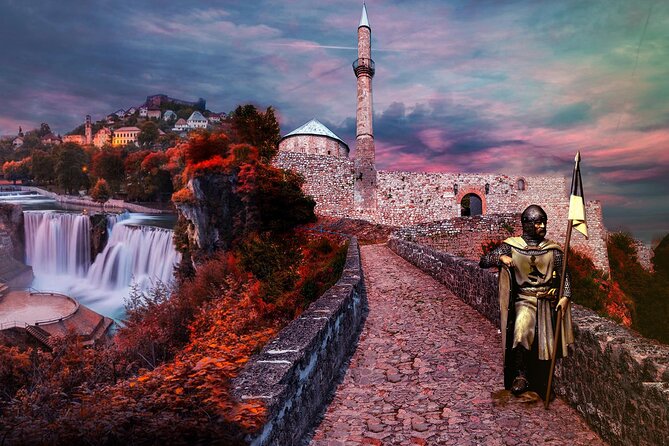
- Jajce’s waterfall sits in the town center: Pliva River drops into the Vrbas River at one of Bosnia’s most unusual urban sights.
- The medieval and modern stories meet: The fortress, catacombs, and royal connections share the day with the AVNOJ Museum, where socialist Yugoslavia was founded.
- Pliva Lakes bring a change of pace: You get time for photos, a lunch break, and a short walk among the traditional Mlinčići watermills.
- Travnik adds Ottoman-era character: See the old fort and the colorful Šarena Džamija, or Painted Mosque.
- The group stays small: A maximum of eight people makes conversation with the guide easier than on a large coach tour.
- The price covers essential admissions: At $96.12 per person, the tour includes four paid attractions, but food and drinks are extra.
Why Jajce makes this a worthwhile day from Sarajevo
Sarajevo is a superb base for Bosnia and Herzegovina, but the country’s interior deserves your time. Jajce is about more than a pretty waterfall. It was a royal center in the Middle Ages, a fortified town on important routes, and later the birthplace of socialist Yugoslavia.
That mix gives the day unusual range. In the morning, you may be standing by the water with spray from the falls in the air. A short time later, you can be inside a rock-cut crypt or looking over the town from a medieval fortress. Then the tour shifts again to lakeside mills and the Ottoman town of Travnik.
I like this sort of route because it avoids reducing Bosnia to one period of its past. You get kings, dukes, religious buildings, Ottoman officials, the Second World War, Yugoslavia, food, and present-day local life. Guides such as Emir, Adnan, Christian, Ajla, Saudnic, and Dadu have led departures on this route, and the strongest part of the experience is the personal storytelling during the drive and walks.
More Jajce, Pliva and Travnik days:
- Jajce, Travnik and Pliva watermills – Day Tour from Sarajevo
★ 5.0 · 295 reviews - From Sarajevo: Travnik, Jajce, Pliva Lakes & Watermills Tour
★ 5.0 · 213 reviews - Jajce, Travnik, Pliva lake and Watermills Tour
★ 5.0 · 104 reviews
The drive from Sarajevo through central Bosnia
Pickup begins at 8:00 a.m. at the Funky Tours office in Baščaršija, Sarajevo, or at a chosen address in Sarajevo if pickup has been arranged. The vehicle carries no more than eight people, so the ride should feel more like a small excursion than a full coach outing.
The route passes through Visoko and the valley associated with the Bosnian Pyramids, then follows sections of the Bosna and Lašva rivers before reaching the Vrbas area. The Bosnian Pyramids can be arranged as a stop, but the timing of this one-day route generally favors continuing to Jajce. If that site is a major priority, a two-day option is suggested instead.
The drive is part of the experience, not just a transfer. You’ll see central Bosnia change from city streets to river valleys, hills, and canyon scenery. Still, keep the day in perspective. The tour covers a lot of ground, so you will spend several hours in the vehicle. If you prefer a slow visit to one town, this is not the right format.
Jajce Waterfall: a dramatic first stop
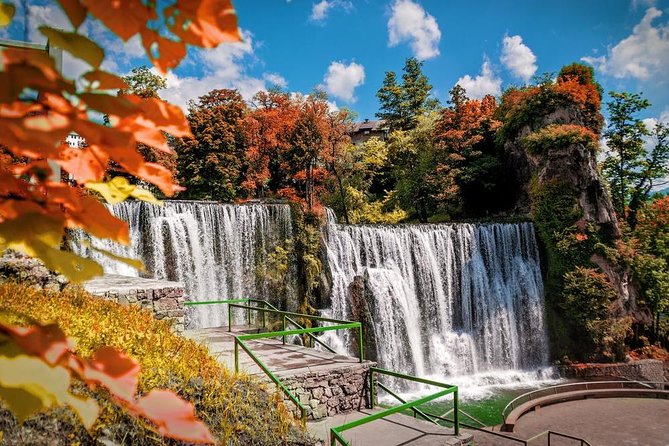
The first major sight is Pliva Waterfall, where the Pliva River meets the Vrbas in the center of Jajce. Its setting is what makes it memorable. This is not a waterfall reached after a long forest walk. It is part of the town itself, with the old settlement and surrounding hills close at hand.
You’ll have time to take photographs and get your bearings before the walking portion begins. The sound of falling water gives Jajce an immediate sense of place, and it makes a strong opening to the visit.
The route description calls this one of the world’s most beautiful waterfalls, but you need not accept the sales pitch to enjoy it. The useful point is that it is unusually accessible and closely tied to the town’s identity. If you want the best light for photographs, your guide can help you understand where to look, though the exact conditions depend on the day.
Jajce’s fortress and the medieval town
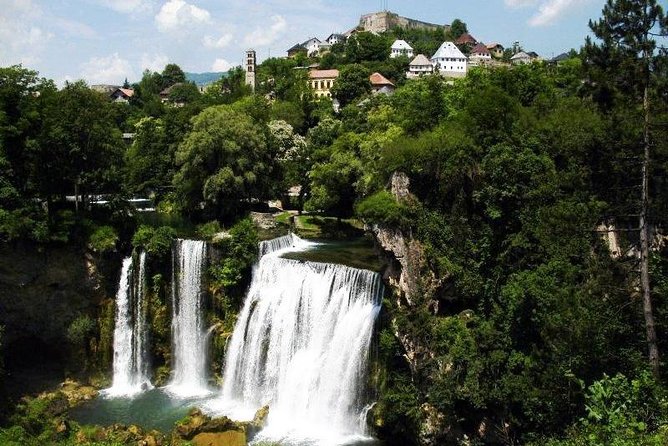
The walking tour continues through the old center and up to Jajce Citadel. The fortress began as the main defensive stronghold of the medieval town, with construction dating from the 13th century through the first half of the 14th century.
Jajce became especially important under Duke Hrvoje Vukčić Hrvatinić around the turn of the 15th century. In the middle of the 15th century, the royal court moved here, and a palace was built inside the fortress. The remaining royal portal and a surviving biphora, or two-opening window, hint at the town’s former importance.
The fortress is included in the admission price. You should expect some walking and an uphill section, but the visit is fairly short, listed at about 20 minutes. The reward is the sense of how the town was defended and how closely royal power was tied to the walls.
Nearby, Medvjed Kula, or Bear Tower, is an early medieval military structure built in Romanesque style. Its walls are between 4.5 and 6 meters thick, which explains the practical origin of its name. A darker local tale says bears were fed captives and prisoners there. Your guide can help separate the building’s military purpose from the legend.
The Tower of St. Luke rises about 23 meters and is the only surviving medieval tower of its kind in the continental Balkans. It was the bell tower of the former Church of St. Mary, a building with Romanesque, Gothic, and Renaissance features. The church once held relics said to belong to St. Luke the Evangelist, brought to Jajce by the last Bosnian queen, Mara Jelena.
These are short stops, so don’t expect a detailed architectural study of every structure. Their value comes from seeing several layers of Jajce together during one walk.
A few more Sarajevo day trips to weigh up
- Sarajevo: Mostar, Konjic, Blagaj Tekke, Pocitelj & Waterfall
★ 4.9 · 1,335 reviews - Fall of Yugoslavia, Sarajevo War Tour with Tunnel of Hope Museum and Frontlines
★ 5.0 · 1,314 reviews - Sarajevo: Mostar, Konjic, Sufi House, Pocitelj & Kravice Falls
★ 5.0 · 1,179 reviews - ROSES OF SARAJEVO (Official WAR + CITY tour)- Story of a Survivor
★ 5.0 · 770 reviews
Catacombs and the AVNOJ Museum
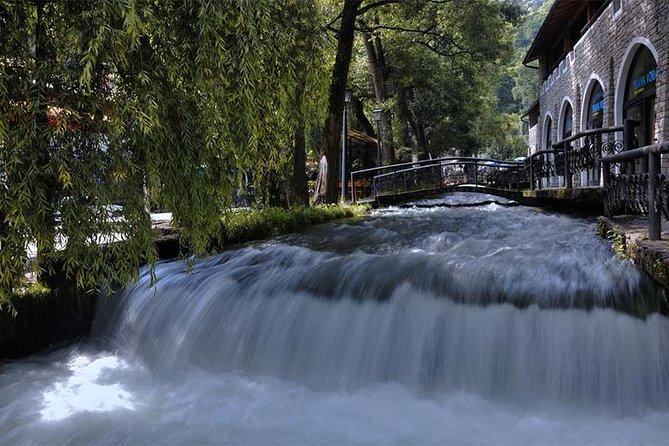
Two included attractions add very different kinds of historical context.
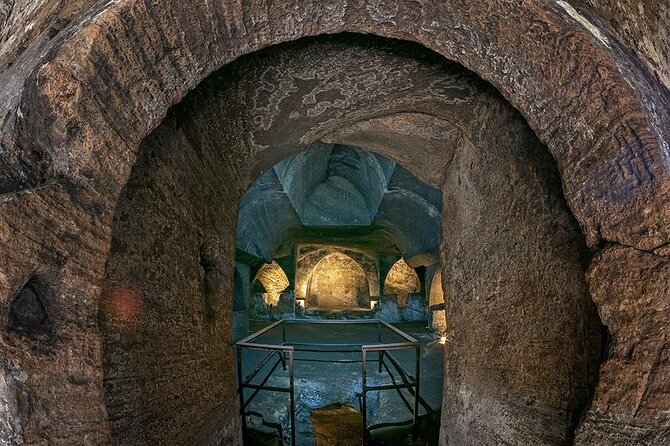
The Catacombs of Jajce are an underground church and crypt carved into solid rock about six meters below ground. Duke Hrvoje Vukčić Hrvatinić ordered them built between the late 14th and early 15th centuries as a final resting place for his family. The space is compact, atmospheric, and unlike the open-air fortress above it.
The visit lasts about 15 minutes. Because the catacombs are underground and carved from rock, take care on steps and low or uneven sections. The site has been protected as a national monument of Bosnia and Herzegovina since 2003.
The Museum of the Second Session of AVNOJ offers a sharp change of subject. On November 29, 1943, delegates met in Jajce for the second session of the Anti-Fascist Council of National Liberation of Yugoslavia. The meeting helped establish the foundations of the postwar Socialist Federal Republic of Yugoslavia.
The museum opened in 1953, with its first permanent collection installed in 1959. It suffered serious damage and looting during the 1992 to 1995 war, so the building also reflects the difficult work of preserving Bosnia’s 20th-century past.
You get about 20 minutes inside, with admission included. That is enough for an introduction, but not enough for an extended study of Yugoslav politics. If this period matters greatly to you, listen closely to the guide and ask questions during the drive.
Lunch beside the Large Pliva Lake
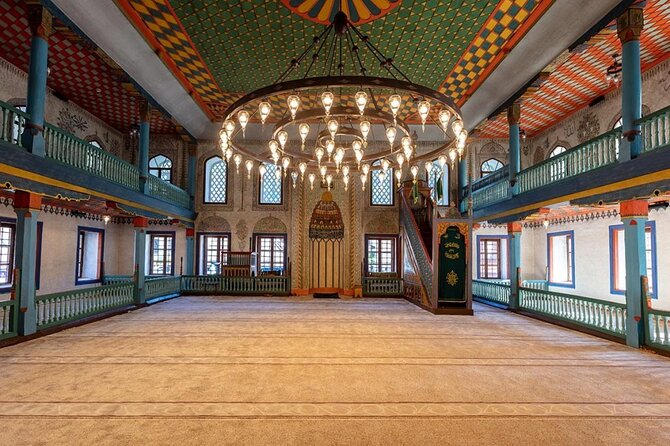
After Jajce, the tour heads to the Large and Small Pliva Lakes. This is the day’s natural pause. You can walk by the water, take photographs, and enjoy a lunch break. Swimming, fishing, kayaking, and canoeing are associated with the lakes, but the supplied schedule does not promise equipment rental or time for each activity.
The lakes also have a sporting connection. Pliva hosted the 1963 World and European Championships in flat-water kayaking and canoeing. That detail helps explain why the water is more than a scenic backdrop for local people.
Food is not included, so plan to pay separately for lunch and drinks. One guide, Emir, has taken a group to a favorite ćevapi place in his hometown, which suggests that the meal stop may include a local recommendation rather than a fixed restaurant experience. Ask your guide about the day’s lunch plan early, especially if you have dietary needs.
The lakeside break is welcome, but it is not a full resort day. With only about an hour scheduled here, you should think of it as time to eat, stretch your legs, and enjoy the setting rather than a long swim or paddle.
Mlinčići, the small mills of Pliva
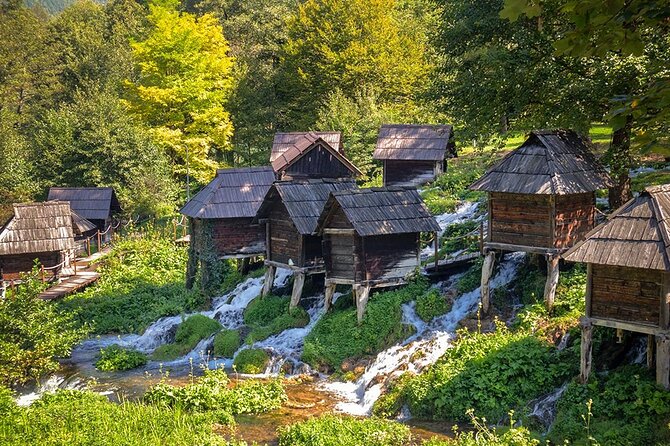
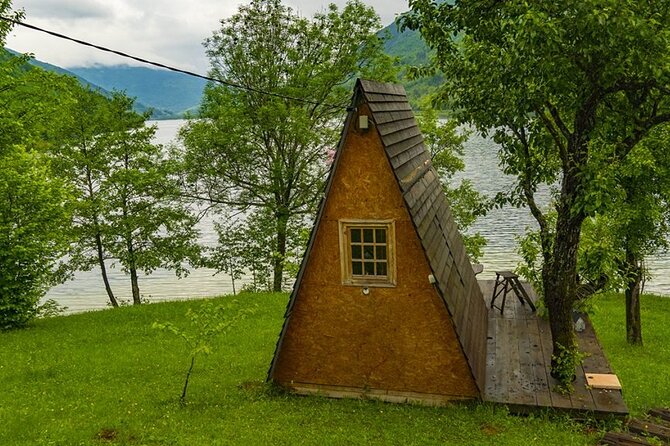
At the Small Pliva Lake, the Mlinčići watermills provide one of the most photogenic stops of the day. These little mills sit over the water and once served a practical purpose for local communities. Their neat wooden forms and the surrounding lake make them easy to appreciate even on a short visit.
The stop lasts about 15 minutes and includes a gentle walk. Bring your camera, but also take a moment to look at how the mills use the movement of the water. The site once attracted visitors during the Austro-Hungarian period, and it remains one of those places where an ordinary tool became part of the region’s visual identity.
This is a short stop, so don’t count on a long lakeside wander. If you enjoy small industrial or rural details, you may find it more rewarding than another grand monument.
Travnik, the town of viziers
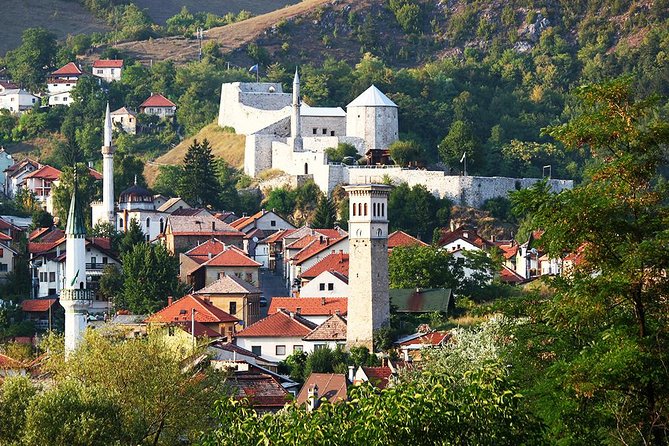
Travnik gives the return journey a second historic town, but with a different character from Jajce. It is known as the town of viziers, a reference to its role during the Ottoman period. It is also the birthplace of Nobel Prize-winning author Ivo Andrić.
You’ll have about an hour in Travnik, including the old town, the fortress, and the Šarena Džamija, or Painted Mosque. Travnik is also known for ćevapi and white cheese, so this can be another useful place to ask your guide about local food.
Travnik’s Old Fort is among the best-preserved medieval fortified buildings in Bosnia. Later periods left their own marks on the structure, giving it a layered appearance rather than a perfectly uniform medieval style. Admission is included, and the fort visit is scheduled for about 30 minutes.
The Šarena Džamija is known for its colorful decoration and is described as one of the country’s most beautiful mosques. The planned visit is about 20 minutes, but opening times can affect what you see inside. Some departures have found that particular Travnik sights were closed, so keep your expectations flexible.
A useful extra stop has sometimes been a divided school in a remote town. It is not listed as a guaranteed stop, so treat it as a possible guide-led addition rather than part of the fixed route.
How much value do you get for $96.12?
At $96.12 per person, this is not the cheapest way to reach Jajce, but the price covers several costly parts of a day out: transport from Sarajevo, an English-speaking guide, pickup and drop-off within Sarajevo, and admission to the Jajce catacombs, Jajce fortress, AVNOJ Museum, and Travnik fortress.
Those entrance fees total 8 euros per person based on the supplied amounts. The bigger value is time and organization. You do not need to work out the winding route, find parking in several towns, or connect Jajce and Travnik by public transport in one day.
Food and drinks are not included. The full day also means you may want to budget for lunch, coffee, and anything extra at the lakes. The tour is most useful if you want a guided overview and have only one free day from Sarajevo. If you have a rental car and prefer to linger, an independent visit could give you more control.
The experience is recommended by 98 percent of people who rated it, with an overall score of 4.8 from 50 ratings. More important than the numbers is the pattern of praise: guides are described as friendly, personal, and strong at explaining Bosnia’s politics, faith, food, and past. One family found the guide especially patient with children and flexible about toilet breaks and walking speed.
There is one practical warning. One person specifically wanted more frequent toilet stops. Use facilities when they are available, and tell the guide early if you need a break. The small group makes this easier than on a large bus, but the roads and schedule still limit how often the vehicle stops.
Who will enjoy this day most?
I would choose this tour if you are staying in Sarajevo and want to see more of Bosnia without renting a car. It suits people who enjoy stories as much as scenery, especially if you want medieval Bosnia, Ottoman culture, Yugoslav history, and local life in the same outing.
Families can also do well here, provided everyone is prepared for a long day. The guide can help with a slower pace, and the waterfall, fortress, lakes, and mills give children several different settings. Still, the drive and repeated historic stops may test young children’s patience.
The tour is less suited to you if you want a relaxed day at the water, a long fortress visit, or a highly predictable schedule. Sight access can change, lunch is separate, and the tour covers a great deal in roughly 11 hours. The stated return is around 8:00 p.m., so keep your evening free.
Free cancellation is available up to 24 hours before the start time. Confirmation arrives within 48 hours, subject to availability. Service animals are allowed, public transport is near the Sarajevo meeting point, and most people can take part, though the walking and fortress sections deserve attention if mobility is a concern.
Should you book the Jajce and Travnik day tour?
Book it if your priority is seeing a broad slice of central Bosnia in one day. Jajce supplies the biggest visual rewards, especially the waterfall, fortress, and Pliva Lakes. Travnik adds Ottoman-era atmosphere and a painted mosque, while the AVNOJ Museum gives the route serious 20th-century context.
I would skip it only if you dislike long road days or want to explore each town slowly. For everyone else, the small vehicle, included admissions, Sarajevo pickup, and strong guide-led storytelling make the $96.12 cost reasonable. Go prepared for a full day, bring water, keep lunch flexible, and use every toilet stop. That is the practical formula for getting the most from this memorable outing.
FAQ
Where does the tour start?
You can meet at the Funky Tours office at Besarina čikma 5 in Sarajevo’s old town, in Baščaršija. Complimentary pickup can also be arranged from your chosen starting location in Sarajevo.
What time does the tour start and end?
The start time is 8:00 a.m. The return to Sarajevo is expected at around 8:00 p.m., while the stated duration is approximately 11 hours.
Is transportation from Sarajevo included?
Yes. Transportation from Sarajevo is included, along with pickup and drop-off services at a chosen Sarajevo address when arranged.
How large is the group?
The tour has a maximum of eight participants.
Is the tour offered in English?
Yes. The experience is offered in English.
Which entrance fees are included?
Admission to the Jajce Catacombs, Jajce Fortress, AVNOJ Museum, and Travnik Fortress is included. The listed fees are 2.5 euros for the catacombs, 2.5 euros for Jajce Fortress, 1 euro for the AVNOJ Museum, and 2 euros for Travnik Fortress.
Is lunch included?
No. Food and drinks are not included in the tour price.
Can I cancel for a full refund?
Yes, if you cancel at least 24 hours before the experience begins. Cancellations or changes made less than 24 hours before the start time are not accepted for a refund.
Just added around Sarajevo
- Strbacki Buk and Una Waterfalls: Day Trip from Sarajevo★ 5.0 · 3 reviews
- Bosnian Kingdom Capitals: Travnik & Jajce Tour from Sarajevo★ 5.0 · 3 reviews
- Walking Tour in Sarajevo★ 5.0 · 3 reviews
- MTB Bjelasnica – Lukomir★ 5.0 · 3 reviews
- Sarajevo Under Siege: A City’s Struggle & Survival Tour★ 5.0 · 3 reviews
- Herzegovina Tour from Sarajevo: Mostar, Počitelj, Blagaj, Kravice★ 5.0 · 3 reviews
- Travnik, Jajce, Pliva Lakes & Mills –Medieval & Ottoman Bosnia Full Day Tour★ 5.0 · 3 reviews
- Tour of Herzegovina – From Sarajevo★ 5.0 · 3 reviews
Jajce & Travnik Day Trips, compared.
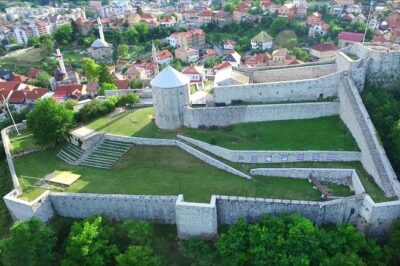
Jajce, Travnik and Pliva watermills – Day Tour from Sarajevo
Read our review →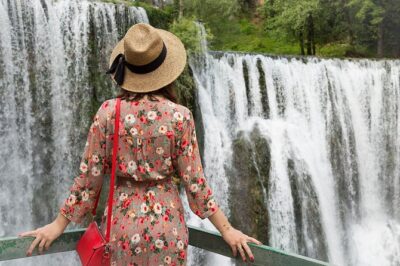
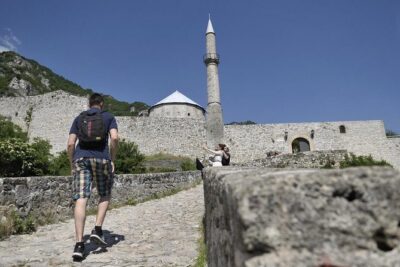
CENTRAL BOSNIA | A medieval tour (Jajce + Travnik + Pliva lakes)
Read our review →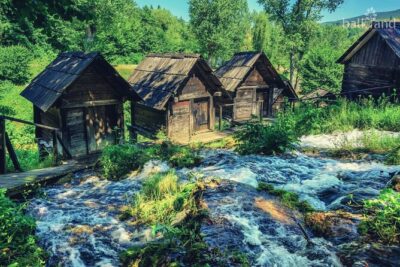
Bosnian Kingdom Capitals: Travnik & Jajce Tour from Sarajevo
Read our review →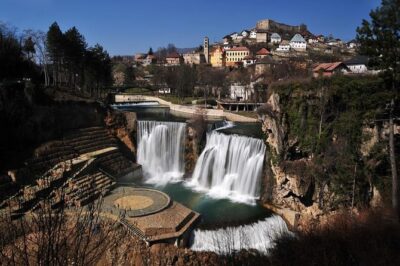
Sarajevo to Zagreb: One-Way Tour via Jajce, Travnik, Pliva Lake and Watermills
Read our review →
Travnik, Jajce, Pliva Lakes & Mills –Medieval & Ottoman Bosnia Full Day Tour
Read our review →Browse the lists this tour appears in